They dug up tailbones.
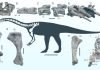
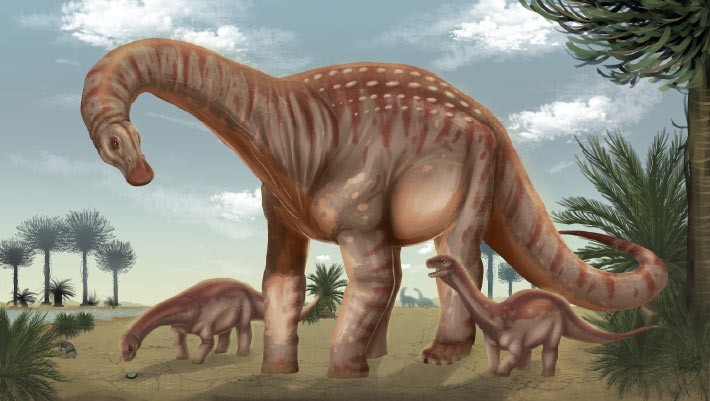
Just two of them. But those particular bits of calcified history are rewriting the story of Late Cretaceous Uruguay. Paleontologists have named the beast Mesetasaurus protector, a titanosaursae from the aeolosaurine line, and it’s sitting somewhere in the family tree next to cousins like Aeolosaurus and Arrudatitan.
Found near the Uruguay River way back in the 80s. Left to gather dust. Until now.
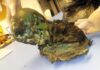
The site is the Guichón Formation up in northern Uruguay. Red sandstone. Small exposure. The two vertebrae lay right next to each other, cataloged as FC-DPV 37 and FC-DPV 38 (okay, 3740A/B for accuracy’s sake). Close proximity suggests a single animal. Not a scavenged pile, just a guy who died standing or falling hard.
Dr. Matías Soto Núnez and his team at Universidad de la República didn’t take this lying down. Or sitting down, whatever. They ran the phylogenetic numbers. Big data sets. Comparing Mesetasaurus against dozens of other titans.
Where did it fit? Deep inside the Aeolosaurini clade.
This matters because Titanosaurians were the heavy hitters of the Late Cretaceous.
“Titanosaurians constituted the most abundant diverse sauropod clade particularly in South America,” Soto Nunez says. “Several dozen genera recognized.”
They started early, Valanginian period stuff (137-132 mya), hit massive sizes by the Albian-Cenoman, and somehow outlasted every other sauropod line right up to the big K-Pg extinction at 67 mya.
Uruguay thought it had seen them all. There was Udelartitan celeste, a saltasauroid, described a while ago. But here? Another lineage entirely. Endemic to the continent. Mesetasaurus protector lived between 86 and 71 million years ago.
It proves multiple groups of giant herbivores were hanging out here at once. Not one lonely herd, but a complex ecosystem of massive beasts eating leaves while the sky darkened.
The morphology of these caudal vertebrae is distinct. Sharp diagnostic traits. Could actually serve as a biostratigraphical proxy later.
Who knew? A pair of backbones tells you so much more than a skull sometimes.
The paper hit Ameghiniana on July 8 2026. DOI: 10.5701/amgh… wait.
Anyway. Mesetasaurus protector is the second sauropad from the Uruguayan soil. Different branch of the tree than the previous find. Aeolosaurini was already there, faint traces in the Asencio formation referred to Aeolosaurus. But now we have a species name. A full ID.
What do the ribs say? Probably nothing. We only got the tail.
And that is enough for today.