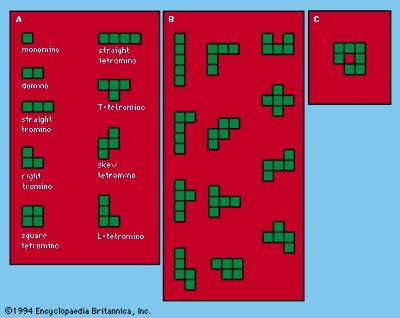
If you’ve ever stared at a set of Tetris-like blocks and wondered what else they could do, you’re looking at polyominoes. These are shapes made of equal-sized squares joined edge-to-edge. The name arrived in 1953, borrowed directly from dominoes to describe these multisquare tiles. Flipping them over doesn’t count as a new shape if the piece is asymmetrical. It’s all about how you count distinct forms.
The math here is tricky. While the count of distinct polyominoes depends on the number of squares, mathematicians still haven’t found a general formula to predict it. We do know the specific numbers, though. There are 35 distinct hexominoes (six squares) and 108 heptominoes (seven squares), assuming you include that bizarre heptomino with a hole in the middle.
Why Can’t You Build a 14×15 Rectangle?
Recreation with these pieces usually involves combinatorial geometry. The goal is often to cover a surface, like a chessboard, under strict rules. Take the 35 hexominoes. Their total area is 210 squares. Logically, that should fit into rectangles like 3×70 or 14×15. It doesn’t. No such rectangle can be formed. The geometry just won’t allow it.
The pentominoes are the more famous crowd. There are 12 of them, plus one single square tetromino. People have known since around 1935 that these 13 pieces can fill an 8×8 checkerboard. But here’s the catch. We don’t know how many other solutions exist. Estimates suggest at least 1,000 ways to solve it.
The Computer-Solved Center
In 1958, computers stepped in to crunch the numbers. They proved that there are exactly 65 solutions where the single square tetromino sits perfectly in the center of the board. That’s a specific constraint that reduces the chaos.
Why do we care about empty spaces and missing rectangles? Because the puzzle isn’t about the shape itself. It’s about the limit of human calculation. A computer can find the 65 center-square solutions in seconds. A human has to guess, fail, and restart. The polyomino remains a test of patience. You can arrange the squares. You can cover the board. But you can’t always find every way to do it. Not even close.