Most stars die quietly enough. They collapse, explode, leave behind a neutron star or maybe a black hole, and the blast wave scatters ionized gas into the cold. Standard stuff.
But then there are the outliers. The superluminous ones.
They are blindingly bright, ten to a hundred times brighter than normal core-collapse supernovae. For decades, astronomers watched these monsters light up the sky without a clear explanation for where that extra energy came from. Too much fuel burned out? Interacting debris? Maybe.
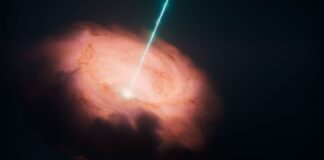
Now, NASA’s Fermi Gamma-ray Space Telescope has a theory. It involves magnetars. Ultra-magnetic, rapidly spinning neutron stars with fields strong enough to tear atoms apart.
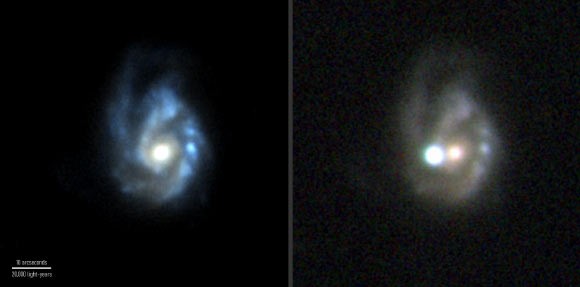
Fermi’s Large Area Telescope likely caught gamma rays from one such event. It was SN 2017egm, happening in NGC 3190, a barred spiral galaxy tucked about 440 million light years away in Ursa Major.
Guillem Martí-Devesa from the Institute of Space Sciences in Spain led the hunt. They looked at the six closest superluminous supernovas Fermi had ever seen over sixteen years of operation. Only SN 2017egam showed gamma rays. Just one.
“Only SN 2017егм shows evidence for gamma rays… This opens up a new window for studying These fascinating events.”
It confirms old whispers that some explosions shine as fiercely in high-energy gamma radiation as they do in visible light. A double-header.
Why does it matter?
Because light requires energy. Extra light requires an extra engine. Theorists have long suspected magnetars are that engine. These objects spin hundreds of times a second. Their rotation spins out clouds of electrons and posit antimatter counterparts. A magnetar wind nebula forms. Inside that cloud, chaos reigns. Particles collide, annihilate, and turn into gamma rays.
But here is the twist.
The gamma rays can’t escape right away. The supernova debris is too dense. Instead, they bounce around, losing energy, shifting down into lower-energy visible light. This process fuels the extreme brightness.
Fabio Acero from Paris-Saclay University noted that the magnetar model fits the first few months perfectly. The luminosity tracks the gamma-ray arrival time. But then the data gets weird. The light fades irregularly. The simple model breaks down.
Other forces likely step in. Debris falling back onto the magnetar. Shock waves hitting material the star ejected centuries earlier. A messy late life.
The paper dropped in Astronomy & Astrophysics. It’s not a complete solve. Far from it. But it’s a start.
So, was the magnetar alone? Probably not. But it was definitely there, pumping power into the explosion when no one expected such a signal from across the universe.
The question remains how much of that late-stage irregular fading is physics and how much is just chaos. Space usually answers neither clearly. 🌌
F. Acero et al., 2026. Astronomy & Astrophysics