The Spotted Rocks of Bright Angel
Complex carbon compounds are hiding in the mud of Jezero crater. That is what NASA’s Perseverance rover found. It found them right where things already looked promising. These compounds are linked to dead organisms back on Earth. Scientists want to be careful though. Lifeless things like meteorites have these compounds too. No definitive answers yet.
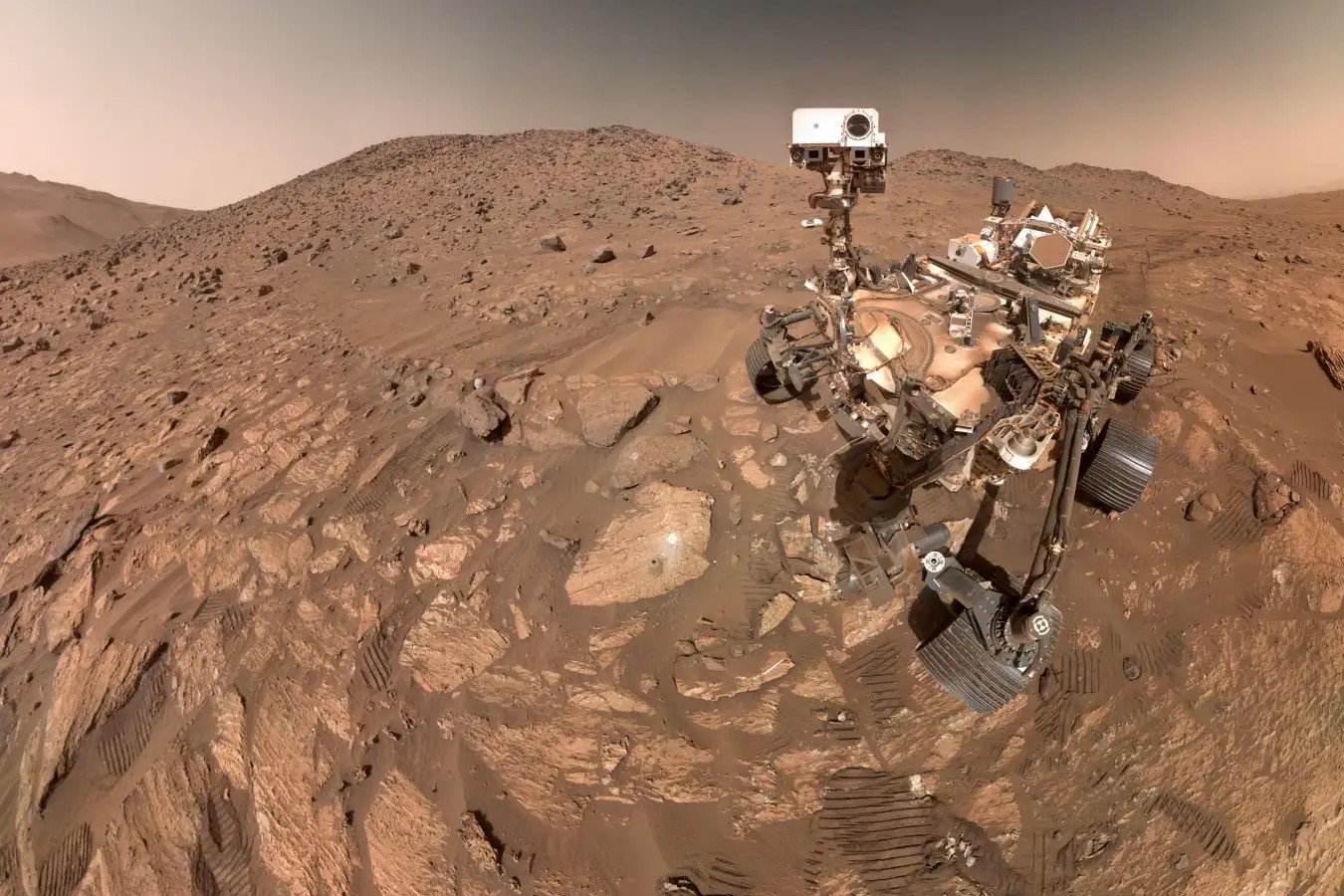
Perseverance rolled into an outcrop named Bright Angel in 2024. It was near an old riverbed feeding a long-dead lake. The rocks here looked odd. Spotted patterns appeared on several surfaces. NASA folks called them “leopard spots”. Some called them “poppy seeds”. Dark circular blots, barely a millimeter wide, covered the stone. On Earth? You’d look for ancient microbes. Maybe here too? Maybe not. Non-biological causes haven’t been ruled out.
These patterns are still top contenders for signs of ancient life. We just needed more chemistry. The SHERLOC instrument provided that. It zaps rocks with ultraviolet light to read the reflected glow. Ashley Murphy at the Planety Science Institute used it. She and her team found macromolecular carbon on the marked rocks. They even found it a hundred meters away in another rock of the same formation.
Context Is Everything
Macromolecular carbon matters. It hangs around in extremely old Earth rocks. Sometimes it’s the only proof past microbes ever existed.
“Finding these organic macromolecules… helps us determine whether the necessary… environmental conditions to support life have ever [existed there],” says Murphy.
But presence alone isn’t proof. Lewis Dartnell of the University of Westminster points out the meteorite problem again. However, Murphy’s team noticed something else. The carbon hung out with carbonate and sulphate minerals. Those form in water. Water is the other big requirement.
It tells us about the geology. Jezero crater was probably wet anyway. So finding water-linked minerals isn’t shocking. The macromolecular carbon itself is new. Never seen on a rock surface like this before. Kyle Uckert from JPL says it’s unusual. It seems tougher than other Martian carbon we’ve found.
It was everywhere in the mudstones at Bright Angel. That surprised Uckert. Why? Nobody knows. Yet.
Back to the Lab?
Dartnell likes the persistence. It confirms complex organics can last billions of years. A good sign? Sure. But SHERLOC has limits. Sean McMahon of Edinburgh says it only tells us the rocks are carbon-rich. Not exactly what the molecules look like structurally.
Is it biology? Maybe. Can SHERLOC say for sure? No.
“We would need to get the samples back Earth,” says McMahon.
So the hunt continues. We have the carbon. We have the context. We don’t have the body yet. Or do we?