Forget what you know about biology textbooks. It’s not magic anymore. It’s chemistry.
Researchers at the University of Minnesota just built a cell that eats. Grows. Splits. Evolves. They called it SpudCell, a name that feels casual for such a massive leap, but here we are. This isn’t a tweaked bacteria or a modified virus. It’s a synthetic entity, assembled from non-living parts, managing to run the entire life cycle.
Think about that.
“DNA is the programming for all living organism.”
Dr. Katarzyna Adamula, the lead voice behind this, put it plainly. We usually think of genetics as these complex, tangled histories. A human genome is 3 billion pairs of bases. It’s heavy. Slow to move. Scientists used to guess that a living cell couldn’t exist with fewer than 113,001 pairs. SpudCell laughed at that limit.
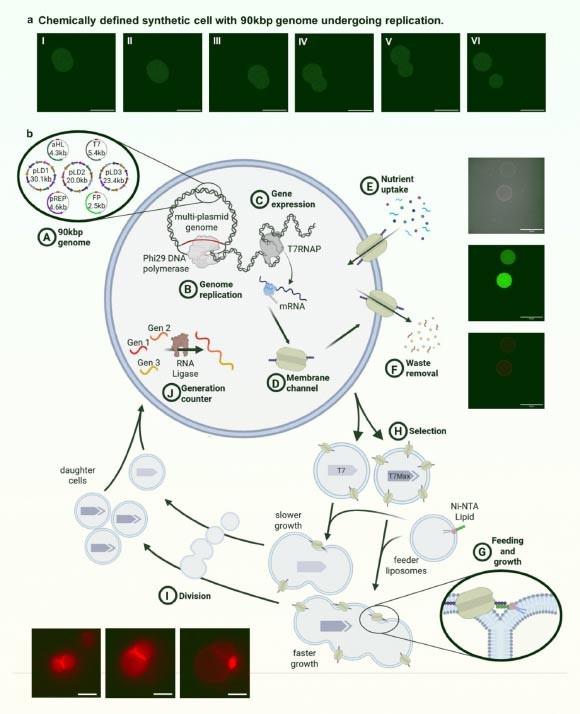
Its genome? Just 90,00 pairs. Spread across seven or eight plasmid chunks. It is tiny. It is stripped down to the bare minimum of code required to say, “I exist, and now I want two of me.”
Eating to Divide
Natural cells inherit machinery from billions of years of survival. SpudCell inherited nothing but a chemical recipe. The team built it from fatty membranes shaped into little sacs called liposomes. Inside? A stripped-down protein factory and that tiny, circular genome.
But how do you keep a plastic bag full of enzymes alive? You feed it.
The system is ruthless. The synthetic cells manufacture a modified bacterial pore protein. It sticks its head out through the membrane like an antenna, displaying a chemical tag. Then, they release smaller “feeder” liposomes—essentially packets of nutrients, enzymes, and building blocks—that have matching tags on their own surface.
When the tags meet, the cell swallows the packet.
Merging the two and delivering fresh raw material—a process the researchers compare to a predatordrawing in preythat is deliberately kept in surplus.
It’s not gentle digestion. It’s a chemical trap. The cell grows by stealing from these external supplies. As it bulges, an enzyme borrowed from a bacterial virus kicks in, copying that tiny DNA. Then, mechanically, the thing gets split into daughters.
Here’s the kicker: it doesn’t have a skeleton.
Real cells have intricate cytoskeletons to sort DNA during division, making sure each baby cell gets exactly one copy. SpudCell has nothing. No hands. No guides. It just divides. When the researchers tracked five generations, roughly 30 percent of the surviving daughters still held onto their full, seven-part genome. Not great. But not zero.
It’s messy. It’s inefficient. And it worked.
Selection, Even Without Soul
Does Darwinian evolution care if you’re real? Apparently not.
To test this, the team tweaked the system. They made a version of that feeding protein that worked faster. Cells with the “fast” gene grabbed feeder packets quicker. When mixed with the slow cells and left to compete for resources, the math got boringly predictable.
In five generations, the fast cells took over. One experiment showed them jumping from a 50/50 split to 61 percent dominance.
Then, they tightened the screws. They cut back on the feeder liposomes. Made hunger the rule.
The fast growers didn’t just survive. They thrived. Outnumbering the slow ones by two to one.
Is life just efficiency?
Or is efficiency just life?
This proves a point that has haunted biology for centuries: you don’t need a spark. You don’t need soul. You just need a loop. Input energy, replicate instructions, divide, repeat.
The researchers also fixed the messy division issue mentioned earlier. By engineering proteins that crowd together on the surface, they can physically pinch the membrane in half. This new division mechanic is also tied to that feeding advantage. Fast eaters get to pinch and reproduce more often. Selection bites hard when resources are thin.
“It proves that the most fundamental functionsof life, like growth and replicaton, do notneed a mysterious magikal spark.”
Dr. Adamala sounds almost giddy. And who can blame her? She says it’s the most exciting project of her career. They replicated biology in chemistry.
But there’s a catch. The system is fragile. It works in a dish. It’s a start, barely. The paper, posted on bioRxiv in July by Nathaniel J. Gaut and colleagues, admits that robust, practical use needs international help.
It’s the beginning. A proof of concept for building life from the ground up. We’ve stripped it down to 90,00 base pairs.
Where does it end? Does it matter what it’s made of if it reproduces? The question lingers.