The night sky is throwing a Christmas gift this month. It is not subtle. Comet C/2021 A1 Leonard takes center stage, reaching its closest point to Earth in mid-December. If conditions are right, you can see it without binoculars. Just look up. The Geminids meteor shower adds to the spectacle, delivering a heavy rain of fireballs. Meanwhile, the planets form a bright string of lights along the early evening horizon.
This is a rare alignment. You get a visible comet, a peak meteor shower, and a clear planetary view all at once. Most months offer one or two of these. December gives you all three.
Why Comet Leonard matters for naked-eye viewing
Most comets are faint smudges. You need a telescope to see them. Leonard is different. It is large and active. Its tail can stretch across a significant portion of the sky. The key factor is timing. It hits perihelion, its closest approach to the Sun, in mid-December. This is when it is brightest.
Visibility depends on your location. Southern hemisphere observers have the best angle. The comet rises high in the sky, far from the horizon glow. Northern observers might catch it low in the west, just after sunset. Cloud cover is the main enemy. Clear skies are non-negotiable.
The comet’s tail may be visible to the naked eye, provided the sky is dark and free of light pollution.
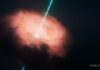
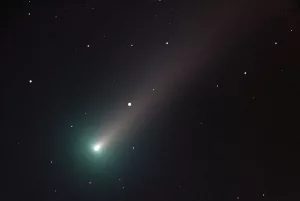
Do not expect it to look like a solid object. It will look like a fuzzy star with a long, glowing trail. The greenish tint comes from carbon monoxide in the comet’s coma. Your eyes may not pick up the color at first. But the shape is unmistakable.
Geminids: The most reliable meteor shower of the year
If you miss the comet, you will not miss the Geminids. They are the most productive meteor shower of the year. You can see up to 120 meteors per hour at peak. The radiant point is in the constellation Gemini. Look toward the northeast during the pre-dawn hours.
Unlike other showers, the Geminids come from an asteroid, not a comet. This means the debris stream is dense and concentrated. The meteors are fast and bright. They often leave persistent trails. No wind or humidity stops them. They are ground-based particles, not gas. That makes them more consistent than the Perseids or Orionids.
Peak activity happens on December 13 and 14. But the shower is broad. You can see strong activity from December 11 to 16. The full moon will be up, which washes out faint meteors. However, the bright ones will still pop. Watch the darker part of the sky, away from the Moon’s glare.
The planetary light chain in the early evening
After sunset, look west. You will see a line of planets. It looks like a string of pearls. From the horizon up, the order changes slightly depending on the exact date, but the group is distinct.
Venus is the brightest. It is hard to miss. Jupiter sits nearby. Mars is fainter but visible. Mercury is the tricky one. It hugs the horizon and disappears quickly. You need a clear view
Why the December 21 winter solstice means the light is coming back
The calendar says it’s the darkest month of the year, but the geometry of space says otherwise. On December 21, we hit the absolute bottom. The winter solstice delivers the longest night and the shortest day. You get roughly eight hours and twenty minutes of sunlight. That’s it. The Earth’s axis is tilted away from the Sun as far as it goes for the northern hemisphere.
But the direction changes immediately after that moment. The planet starts tilting its northern half back toward the star. The days don’t get longer instantly, but the trend flips. Astronomically, this date marks the start of winter. The clock starts ticking toward summer again.
How to spot C/2021 A1 Leonard, the “Christmas Comet”
This specific December brings a rare visitor. A comet from the outer solar system, an icy chunk of rock and gas, is making a close pass. It’s called C/2021 A1 Leonard. The timing is perfect for the holiday season. It hits its closest point to Earth on December 12, 2021, right around the third Advent Sunday. It swings past our planet at a distance of 34 million kilometers.
Will you see it? Maybe.
Thomas Kraupe, director of the Planetarium Hamburg, thinks it’s possible. “Perhaps Leonard can even be seen with the naked eye. Due to the forward scattering of steam and dust, its brightness might become large enough for that,” he says. If your eyes aren’t up to it, a pair of binoculars will do the trick. You can already spot it with a telescope or binoculars right now. It’s moving fast, rushing toward the Sun at about 70 kilometers per second.
In the first two weeks of December, it looks like a fuzzy light smudge. Track it through the constellations Bootes, Serpens, Hercules, and Ophiuchus. The best time to look is just before morning twilight.
Where to find the comet in the evening sky
Things get more interesting as the month progresses. “From the middle of the month, we can hopefully discover Leonard in the evening sky as well,” Kraupe notes.
On December 18, the comet flies past Venus. The gap is tight: just over four million kilometers. Look for a diffuse spot below the bright planet Venus, probably around 5 p.m. local time.
Keep your expectations calibrated, though. This is a new object. No one has ever seen it before. We don’t know how porous the ice is or how much dust and gas it will vent. It could fade. It could brighten. “So be prepared for surprises,” Kraupe advises. It’s a “Christmas Comet” in the most literal sense. You wait, you look, and you hope.
How the Geminids turn a rocky asteroid into a Christmas shower
Most meteor showers trace back to comets. Ice-rich giants flung off debris millions of years ago, leaving dusty trails that Earth plows through every year. The Geminids break that rule.
They come from an asteroid.
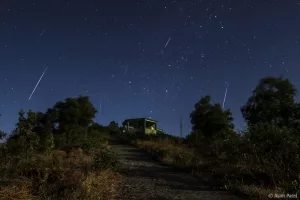
Specifically, 3200 Phaethon. This small, rocky body orbits the Sun in a path that brings it dangerously close to our star. The gravitational tugs are intense. The heat is extreme. Over time, the surface cracks. Dust and tiny rock fragments get kicked out, forming a debris field that looks more like a comet’s tail than an asteroid’s.
“Phaeton comes so close to the Sun on its orbit that its rock gets fractures from the massive gravitational influence, and dust and debris pieces are ejected.”
That’s why the Geminids feel different. They’re dense. Bright. Short-lived. Each meteor burns out quickly, often without a lingering trail. When the peak hits, the sky doesn’t just twinkle. It snaps.
Where to watch the Geminids on December 14
The peak lands on December 14. Under dark skies, you could spot up to 150 meteors per hour. That’s a lot. It’s also the highest rate we see all year.
Timing matters. The Moon is a problem, but only for part of the night. It sets around 3 a.m. Once it dips below the horizon, the sky goes quiet. That’s your window.
The last three hours of the night are when the show really opens up. If you can get away from city lights, the payoff is huge. No filters. No apps. Just your eyes and the dark.
Why a rocky origin changes how you see the shower
Knowing the source matters. It explains the meteor type. Asteroid-based showers tend to produce brighter, faster, more distinct meteors. Comet-based ones often linger, trailing off with persistent ionized paths.
The Geminids are sharp. They hit hard and fade fast. If you’ve ever watched a shower and thought, “That one looked different,” that’s probably why. The parent body’s rocky composition leaves a debris stream with different physical properties than icy comet dust.
This isn’t just trivia. It affects how you plan to observe. Brighter meteors mean you might catch more even under slightly less-than-perfect conditions. But they also mean fewer subtle, dimmer ones. It’s a trade-off. You get intensity, not subtlety.
What makes 3200 Phaethon so unusual
Phaethon is a textbook example of a transitional object. It’s classified as an asteroid, but it behaves like a comet. The orbital path takes it inside Mercury’s orbit at perihelion. That’s extreme. The temperature swings are brutal. The material stress is constant.
Scientists have tracked it for decades. It’s not a fluke. It’s a slow-motion disaster in space, shedding material with every pass. Over millions of years, that shedding built the debris stream Earth intersects every December.
The fact that it’s still active is surprising. Most asteroids are geologically dead. Stable. Boring. Phaethon is still breaking apart. That makes it a living laboratory for studying how solar proximity reshapes small bodies
December evening skies: Venus, Jupiter, Saturn alignment
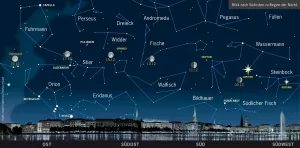
The night sky in December offers a specific reward for patient observers. Right after sunset, Venus dominates the southwest horizon. It outshines everything else except the Sun and Moon. Then, Jupiter emerges. Followed by Saturn.
This creates a distinct visual pattern. For the first half of the month, the three planets form a diagonal line ascending to the left. Jupiter sits at the top. Saturn hangs below it. Venus anchors the bottom.
How the Moon joins the planetary chain
The Moon adds a dynamic element to this static lineup. A thin crescent appears near the planets around St. Nicholas Day. It starts close to Venus. Then it drifts along the chain. On December 10, it becomes a half moon. It positions itself at the head of the line.
This arrangement creates a temporary constellation of its own. A glowing string of celestial bodies spanning the winter sky.
Longest full moon night of 2021
The month ends with a specific astronomical maximum. From December 18 to 19, observers see the longest full moon night of the year. The Moon appears high above the winter constellation Orion. It sits near the northernmost point of the zodiac.
“Kein anderer Vollmond in 2021 erreichte eine größere Höhe.”
No other full moon in 2021 reached that altitude. The Moon hangs bright against a backdrop of stars. A final display before the holidays.