Paleontologists in South Korea have uncovered a rare “snapshot” in time: a fossilized moment capturing a high-stakes pursuit between a flying reptile and its potential prey. The discovery, preserved in a rock slab for over 106 million years, offers a rare glimpse into the terrestrial behavior of creatures usually associated only with the sky.
The Scene of the Chase
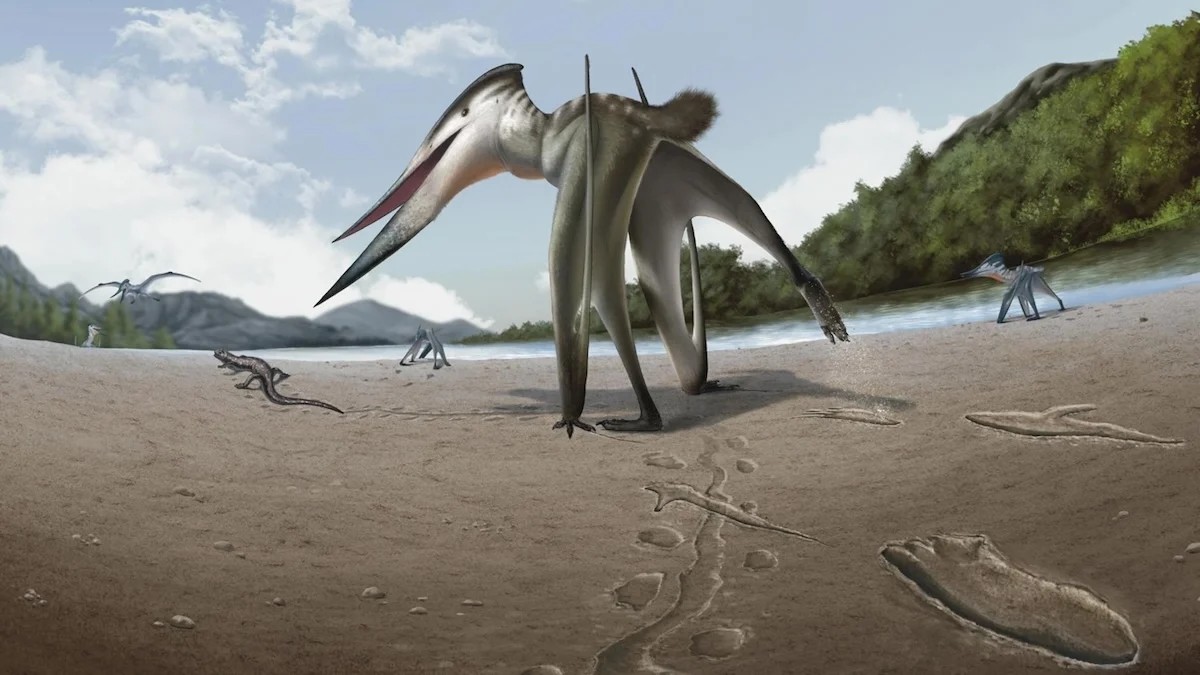
The fossilized trackway tells a dramatic story through movement. The sequence begins with the footprints of a small animal—likely a lizard, salamander, or small crocodilian —moving at a leisurely pace. This calm rhythm is abruptly broken when the small creature suddenly changes direction and breaks into a run.
Close behind, approaching from an angle, are the heavy, rapid tracks of a large pterosaur. Unlike the graceful gliders often depicted in popular media, this predator was moving on all fours, closing the gap with intent. While the tracks eventually exit the preserved area, leaving the final outcome unknown, the patterns strongly suggest a predatory encounter.
A New Species: Jinjuichnus procerus
The predator has been identified as a previously unknown species, which researchers have named Jinjuichnus procerus . The name carries specific scientific meaning:
– Jinju : The region in South Korea where the find was located.
– Ichnus : Greek for “track,” denoting how the animal was discovered.
– Procerus : Latin for “elongated,” referring to the uniquely long fingers visible in the handprints.
Why This Matters: The “Stork” Strategy
For a long time, pterosaurs were viewed primarily as aerial specialists. However, this find reinforces a growing scientific understanding of neoazhdarchians —a group of pterosaurs that were highly adapted for life on the ground.
Rather than spending all their time in flight, these animals likely utilized a “terrestrial stalking” strategy. Much like modern-day storks, they would land to forage, using their limbs to hunt small vertebrates, mammals, or even juvenile dinosaurs.
“While trackway association alone does not constitute direct evidence of predation, the convergence of these lines of evidence… could suggest an interaction scenario.” — Research Team
Key takeaways from the movement analysis:
– Speed: The pterosaur was moving at approximately 2.9 km/h (1.8 mph). While not a full sprint, it represents a purposeful, rapid gait for a large flying reptile.
– Locomotion: The tracks confirm the animal moved with a “gorilla-like” gait, using all four limbs to navigate the terrain effectively.
– Ecological Niche: This discovery helps bridge the gap in our understanding of how pterosaurs functioned as both masters of the air and formidable hunters on the ground.
Conclusion
This discovery highlights the immense value of ichnology (the study of trace fossils). While bones tell us what an animal looked like, footprints tell us how it lived, transforming static fossils into dynamic stories of survival and predation.