The ocean didn’t start with sharks and dolphins.
It started with stuff that barely looked alive.
Or at least not alive like we are today.
Before the Bones Showed Up
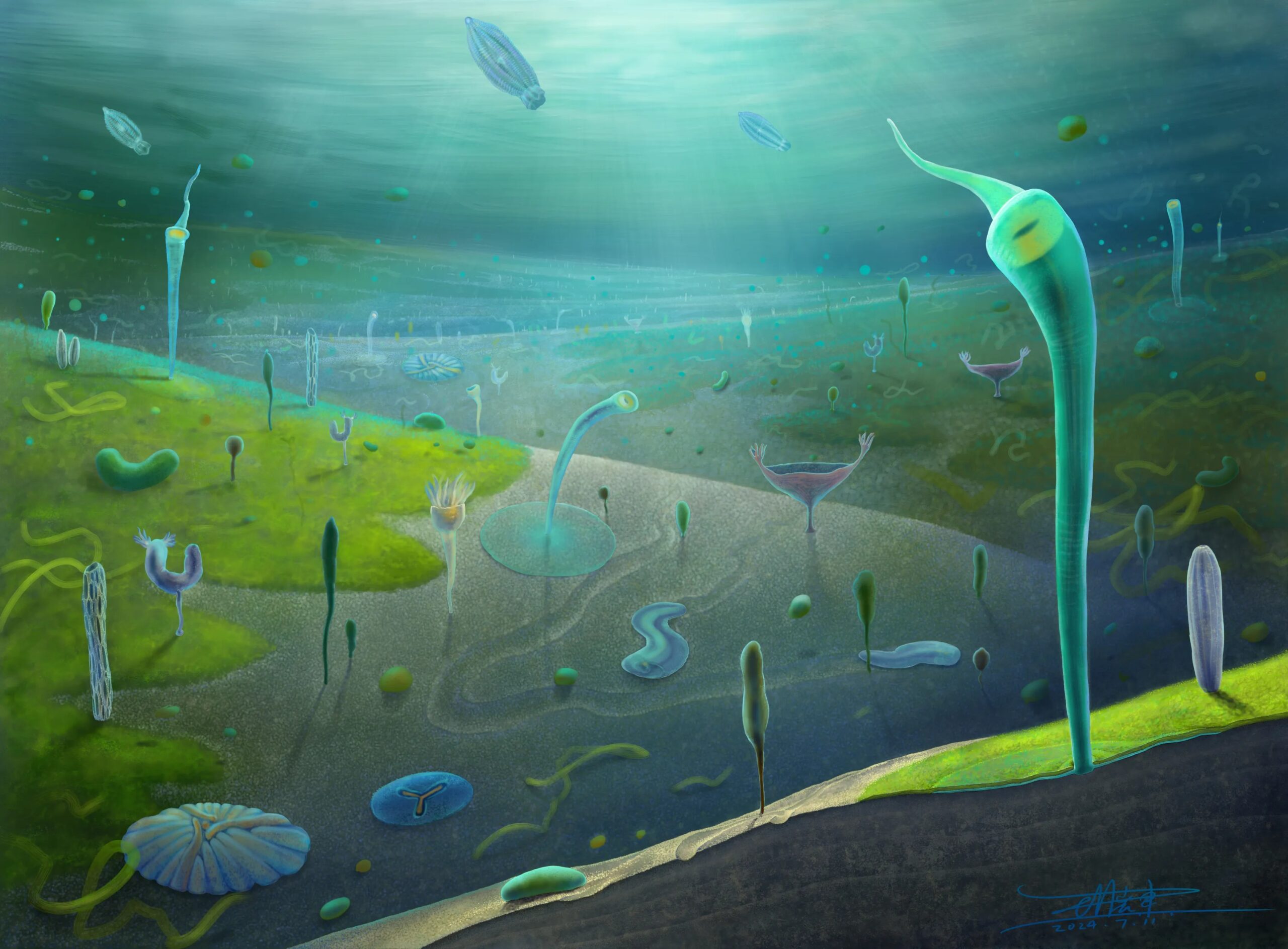
Meet the Ediacaran.
That’s a geology term.
Sounds like a distant cousin of Edvard Munch, but it’s just a slice of time. 635 million years ago to 538 million.
Life was soft back then.
No shells.
No exoskeletons.
Just squishy blobs drifting through salty water.
Seawater, technically. Different from the fresh stuff in lakes and streams because, you know, it has salt.
“Most life from that time had soft bodies.”
This is bad for fame.
Soft things don’t make great fossils.
They rot.
They vanish.
We call the bits that stick around body fossils or trace fossils. Even ancient dinosaur poop counts. It’s true. The process is called fossilization, and it’s picky about what it preserves. So the Ediacaran record is sparse. Hints, mostly. Insights gained by thinking hard about scraps.
Then It Happened
Time ticks forward.
We hit the Cambrian.
Roughly 541 million years ago. Down to 510.
Maybe shorter if you look closely—some say 530 is the hard cutoff.
Regardless.
Something exploded.
The seas woke up.
An array of organisms appeared. Broad. Organized. Astounding.
Dozens of new phyla.
That’s a biological level above class and order. Big.
These groups would eventually spin off into every animal you see walking the earth or flying above it.
Strange Shapes
Not all of them made it.
Many emerged.
Many died.
Gone within tens of millions of years.
Extinct before anyone wrote a song about them.
But for a moment?
They were everywhere.
We think in terms of symmetry now. Left and right. Bilateral brains.
But earlier things were different. Some spread out from a center. Radial.
Like a wheel. Or a flower underwater.
And don’t get started on the algae.
People used to call them plants.
They aren’t.
Never were.
Single-celled. Multicellular. Doesn’t matter. They grow in water and they love the sun. Photosynthesis isn’t a club exclusive to leafy trees. Algae do it too.
Just… differently.
Why It Matters
What is diversity, really?
A range. A spectrum.
In biology, it means different life forms. Different traits within a species.
A species being a group of similar organisms.
Can they reproduce? Can their kids survive? Good.
You got a species.
If not?
Maybe just a memory.
The paleontologists are the ones digging this up. Scientists specializing in old remains. They piece it together from bone fragments and stone imprints. They give us insight.
“An insight is understanding deep without experiment.”
Sometimes.
Most of the time it’s just rock. And guesswork.
And then you find something weird.
Something bilateral in a world that should only be radial.
Something hard in a soft period.
Who knew?