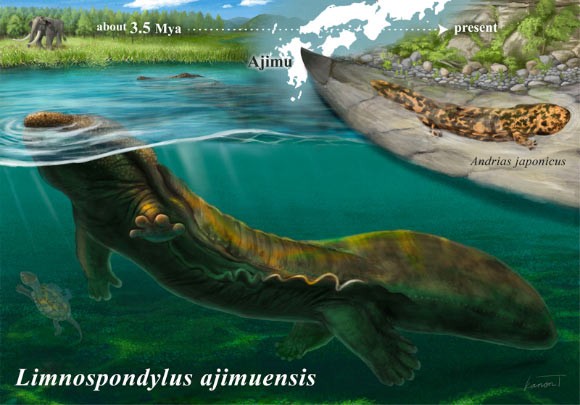
It turns out the giant salamanders we see today are just the survivors of a much older, weirder experiment in evolution. A new study confirms a previously unknown branch of these aquatic giants roamed Japan 3.5 million years ago. They weren’t the river-bound creatures of today. They were lake dwellers.
Meet Limnospondylus ajimuensis.
This new genus fills a massive gap in the fossil record. For over 60 million years, cryptobranchids have been drifting through time. But East Asia? It has been surprisingly quiet in the fossil archive. Until now.
A New Species Uncovered
The bones weren’t new. They were pulled from the Tsubusagawa Formation in Kyushu back between 1995 and 2017. For years, scientists slapped the label Andrias on them. The living genus. The logical guess.
It was wrong.
Dr. Masahiro Noda and the team at Kyoto University didn’t just look at the bones. They CT-scanned them. They used geometric morphometrics. They compared the vertebrae against every living and fossil relative they could find. The shape was off. Distinctly off.
The combination of traits simply didn’t match any known species.
“It is the only site in the world where both giant salamander fossils and living genera have been found.”
This discovery changes the map. Limnospondylus ajimuensis is a distinct entity. A unique lineage. One that likely grew to about 1.1 meters long. Smaller than today’s giants, which can hit 1.8 meters, but still massive compared to most amphibians.
The Ajimu Fauna
Why does this site matter? Because the Ajimu fauna is a time capsule.
During the Pliocene, this part of Japan wasn’t a forest. It wasn’t a river valley. It was a sprawling network of freshwater lakes. Surrounded by wetlands. Forests closed in around the edges.
The ecosystem was a hot mess of biodiversity. You had crocodilians. Elephants. Rhinos. Turtles and birds of every kind. And in those quiet, deep waters, Limnospondylus hung out.
Living giant salamanders (Andrias japonicus in Japan, Cryptobranchus alleganiensis in the US) need fast-flowing oxygen-rich water. They are river specialists.
Limnospondylus was a lacustrine generalist. It thrived in the still waters. This proves the family Cryptobranchidae once held a broader ecological niche. They weren’t locked into one habitat type. They adapted. Or at least, Limnospondylus did.
Why Did They Disappear?
The Pliocene ended. The world cooled.
Starting around 2.6 million years ago, temperatures dropped. The lakes shrank. Wetlands turned to land or mud. The environment became hostile for a creature built for still, warm water.
The river-dwelling cousins of Limnospondylus? They were already adapted to flow. To oxygen. To change. They held their ground.
The lake specialists? They were left high and dry. Extinct.
This isn’t just history. It’s a warning.
Japan’s current native species face hybridization threats. Habitat destruction. Fragmentation. Dr. Noda notes that this research offers a “renewed appreciation” for why we must protect extant species. The modern lineages are the last stand. If they go, the entire family line ends in the region.
The past shows us that habitats shift. Species adapt. Or they die. There is no middle ground.
The paper was published in PeerJ. The bones have spoken. They say we had a giant. A unique, lake-dwelling giant. And we almost lost its story.
We won’t lose the living ones. Not if we pay attention.