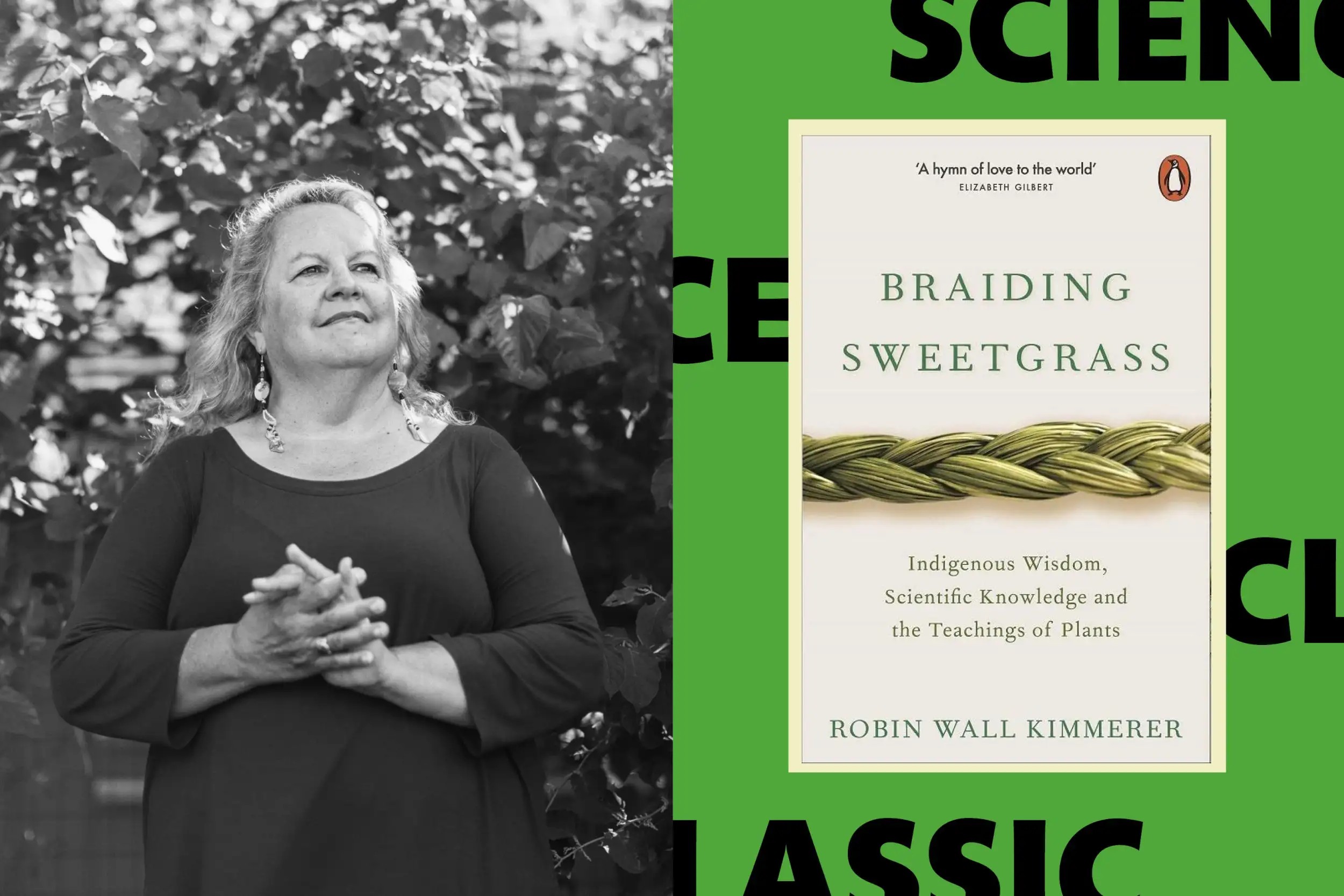
Fifteen years after its publication, Robin Wall Kimmerer’s Braiding Sweetgrass has not aged into a relic; rather, it has matured into an essential text for understanding the intersection of ecology, ethics, and epistemology. The book addresses a persistent gap in environmental discourse: while the language of reconciliation and respect for Indigenous knowledge is now commonplace, the practical integration of these worldviews with Western science often remains elusive.
Kimmerer, a botanist and member of the Potawatomi Nation, does not offer a political manifesto. Instead, she provides a lived demonstration of what Indigenous science looks like in practice. Her work challenges the historical entanglement of Western science with colonialism and extraction, proposing instead that scientific inquiry can be reshaped by asking different questions, designing experiments with relational ethics, and interpreting results through a lens of reciprocity.
Challenging the Myth of the “Absent” Human
One of the most compelling examples in the book involves an experiment on sweetgrass, a plant with deep ceremonial significance across many Indigenous nations. Kimmerer and her colleagues sought to determine how different harvesting methods affected the plant’s health. They compared plots where sweetgrass was pulled by the roots, plots where it was carefully pinched at the base, and control plots left untouched.
The results defied conventional conservation wisdom:
- Untouched plots fared the worst, showing signs of stagnation and decline.
- Harvested plots thrived, regardless of the specific method used.
This finding unsettled a panel of predominantly white, male scientists who reviewed the work. Their skepticism stemmed from a foundational assumption in Western environmentalism: that humans are inherently outsiders to nature, and that our presence inevitably degrades the ecosystem. Under this paradigm, the ideal conservation strategy is withdrawal —the belief that the best human is an absent one.
Kimmerer’s work, however, aligns with Indigenous land management traditions that view sustained, respectful interaction as essential to ecological health. This is not merely a philosophical stance; it is increasingly being vindicated by modern science. Today, fire ecologists recognize that controlled Indigenous burning practices reduce the risk of catastrophic wildfires, and conservationists are actively studying Indigenous harvesting techniques to better manage natural resources.
Beyond Critique: An Act of Healing
The urgency of Braiding Sweetgrass lies in its ability to move beyond critique toward healing. In an era defined by ecological collapse, Kimmerer invites readers to relinquish the self-conception that views ordinary acts—eating, harvesting, breathing—as inherently extractive. She proposes a shift from guilt and alienation to responsibility and gratitude.
This is not a sentimental view of nature as a purely maternal figure, nor is it a simplistic narrative of humanity as either villain or savior. Kimmerer embraces our ambivalence: we are estranged children, careless interlopers, devoted stewards, and curious witnesses. Her central argument is that to address environmental crises, we must abandon the fiction that we are separate from nature.
A New Lens for Knowledge
The book’s ultimate achievement is its refusal to force a choice between Western science and Indigenous knowledge. Near the end, Kimmerer asks the reader to look at a flower through two simultaneous lenses:
- The Scientific Lens: A triumph of evolution, with pigments tuned to attract pollinors and forms shaped by millions of years of selection.
- The Indigenous Lens: A gift, a relative, and an invitation into relationship.
Indigenous knowledge does not replace the scientific view; it settles over it, adding depth and meaning. Braiding Sweetgrass argues that science does not need to surrender its methods or standards. Instead, it needs to remember what it often forgets: that knowledge is not only about control, but about care. It is not just a tool for seeing nature, but a guide for belonging within it.
In a world facing ecological crisis, the integration of scientific rigor with relational ethics offers a path forward—not by withdrawing from nature, but by engaging with it more deeply and responsibly.