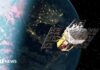
25 light-years. In galactic terms, that’s right there. Astronomers found a rocky super-Earth orbiting the red dwarf Gliese 3378 – also called GJ 3378 or LHS 1805 – in Camelopardalis.
Gliese 3378 b is big. Twice Earth’s diameter. Mass sits at roughly 2.3 Earths. It circles its star every 21.45 days.
The planet hangs out in the habitable zone. The “goldilocks” band where stellar flux might keep surface water liquid.
Dr. Michael Endl of the University of Texas at Austin knows red dwarfs well.
“About 70% of stars are red dwarfs.”
“They’re the standard.”
He thinks understanding planets around them matters. A lot.
Dr. Paul Robertson from UC Irvine is excited too. He calls Gliese 337 b our cosmic next-door neighbor. Sure, 25 light-years feels huge. The Milky Way spans 100,00 light-years though. Scale it up and the distance shrinks to a backyard visit.
The team didn’t guess. They measured. Using the Habitable-zone Planet Finder at Texas’ Hobby-Eberly Telescope. Then cross-checking with the NEID Spectrometer at Arizona’s WIYN Telescope on Kitt Peak.
Here’s the kicker. The super-Earth basks in about 90% of the radiation Earth gets from our Sun. Robertson called it the sweet spot.
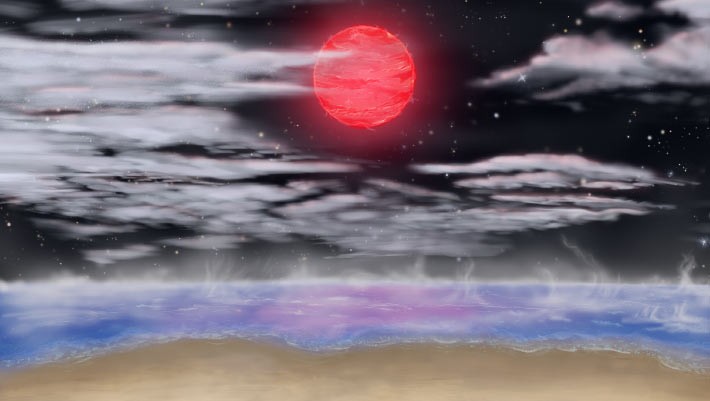
But there is a snag. A big one. Atmospheres are tricky near red dwarfs. Gliese 337 8 b sits right on what researchers call the cosmic shoreline.
Stray too far out, or sit in that line too long, and solar winds strip everything away. Think Mars. It probably had Earth-like air once. Solar radiation ate it. Now it’s just rocks.
Robertson puts it in perspective.
“Earth’s atmosphere is the skin on an apple.”
That thin layer. That’s it. Just enough to keep surface pressures up for liquid water. Enough to block a little cosmic harshness. Enough maybe to breathe?
Or maybe nothing at all. The atmosphere is the mystery.
Does Gliese 337 b keep its coat of gases? We don’t know yet.
If it does – if the atmosphere survives the radiation – the search changes. Gogod James at UC Irvine points out that finding the right atmosphere justifies digging deeper. Looking for biosignatures. Searching for signs that something alive needs both the right heat and an air envelope.
If it doesn’t, it’s just another rocky rock in the dark.
The results are out. Published in The Astrophysical Journal. Robertson and team call the paper A Revised Mass and Period for the habitable-zone Super-Earth GJ 3452b: A Planet Straddling The Cosmic Shoreline (2026).
They are looking closer. Watching. Waiting.