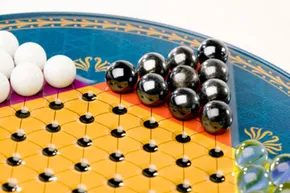
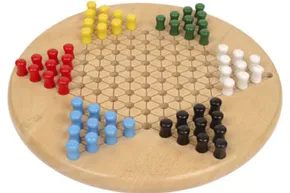
Chinese checkers looks easy. It is a standard fixture in game boxes around the world, but it has little in common with traditional checkers. Despite the name? It has nothing to do with China. The board itself is a unique six-pointed star. Whether the material is wood, plastic, metal or cardboard, it has 121 holes. Place marbles or pegs in these slots. The goal is a pure traversal. Be the first to march your pieces from the starting triangle to the opposite triangle. It’s a race against time and logic.
The name is misleading. A purposeful marketing strategy. This game is not from Asia. It comes from a game called Halma. It was invented in 1885 by Massachusetts surgeon George Howard Monks. Halma means “jump” or “leap” in Greek. The rules are almost the same as today. The only difference is the board. Halma uses a square grid. Monks’ creation quickly became popular. Two giants, E.I.
E.I. Horseman of New York and Milton Bradley of Springfield, Massachusetts competed for the sale. After a legal dispute, Bradley dropped Halma. They renamed it Eckha.
Then came the stars. In 1892, the German publisher Ravensburger introduced a star-shaped board. They called it Stern Halma. Star Halma. Looks sharper. It feels faster. The real turning point came in the 1920s. J. Pressman & Co.
marketed it as Chinese checkers. Why? America went wild with Asia and the Middle East. King Tutankhamun’s tomb was discovered in 1922. The world went wild with exotic things. The name stuck. By the 1930s, it had become nationwide craze. Milton Bradley finally patented it in 1941.
Now anyone can buy it. Both young and old. The rules are simple, but the strategy is deep. Variations exist. Tricks can give you an edge. Let’s break down how to play.
The chessboard is set up. you have a marble. What now? Chinese checkers may seem simple, but winning requires more than just randomly moving pieces. This requires familiarity with certain mechanics and a willingness to think about the next three steps.
Game geometry is non-negotiable. I use a star network. The central hexagon has 61 holes and six 10-hole equilateral triangles on each side. These triangles are the base. Each player requires one. Settings vary depending on the number of people. 2 players? Each uses 15 pieces and is placed on opposite platforms. Will there be 3 or 6 players? Everyone gets 10 pieces and either takes turns filling them or fills all available bases. Will there be 4 or 5 players? This is where the rulebook becomes vulnerable. Some people choose a blank space. Others believe that four players should leave their opponent’s two bases empty to maintain balance. 5 players? Some purists say geometry is messed up. Don’t let red tape stop you. Just play.
Master the jump
The goal is simple, but brutal. Move all the pieces from the starting platform to the piece directly opposite the star. You can do this by using Step and Jump.
You get bored after just one step. Move the piece to the adjacent hole. Jumping is the lifeblood of the game. Jump over the adjacent piece (friend or foe) and land in the cavity next to it. What’s in it? You can chain these jumps together. 1 round. Infinite jump. As long as the chain lasts.
It is important that the debris does not get caught. Jumping does not remove obstacles. Just use it as a springboard. You also cannot mix steps and jumps in the same turn. Choose one. Move one piece each round. The first to clear the base wins.
If you play casually, Hop is the way to go. If you want to win, hops are everything.
How to make a ladder
Advanced Chinese checkers strategy revolves entirely around jumping. This is the only way to move the board efficiently. If you have enough pieces, you can theoretically launch a marble from your base to the enemy’s base in one turn.
You need to build a ladder.
This means placing pieces to create a continuous jump path. But here’s the twist, the same ladder also works for your opponent. If you build a bridge, they will cross it. Strategy is therefore a balancing act between building and destroying.
Assemble the pieces along the center line. Thanks to the dense cluster, you can jump from more platforms. Scattered trash? It is very heavy. Moving slowly together and returning to the original position wastes time.
Stop your opponent. If jumping helps someone more than you, don’t jump. Prevent them from using the ladder. It is very small. This works well.
Fast driving
Curious how fast this goes? The shortest two-player game takes 30 steps. 15 for you. There are 15 opponents. that’s it. Can you do it?
The standard star-shaped board may feel repetitive after a few rounds of the game. If you’re looking for more chaos and strategy, the game has plenty of hidden modes. No need to buy a new set. Just change the rules.
Team Play
Group up This mode turns a solo march into a coordinated attack. Divide 4 people into 2 teams and play together with 2 people per team. Or divide six people into two teams of three.
The settings are specific. Each player must start from a base directly across from a member of the opposing team. This forces you to watch your partner’s back. The goal is still simple. Move the marbles on the board. Make it to the enemy’s home base. The first team to fill the opposite hole wins. It’s faster. It’s more social. And that requires real communication.
Super Chinese Checkers
Call it fast-paced Chinese checkers. Or some super Chinese checkers. The name has changed, but the speed remains the same.
Setup is identical as in the traditional version. Pieces start in the corners. Your target is the opposite base. The movement is where things get wild. In traditional games, you can only jump between adjacent pieces. One step. One hop.
Range is important in super mode. You can jump pieces far away. The catch?
You must land at a symmetrical distance on the other side.
If there is an empty space between your piece and the goal, hop over the target.
You land two spaces past it. You can chain these hops. Long lines of jumps.
However, you cannot jump more than one piece at a time. The board opens up. The game accelerates.
“You can jump more pieces as long as you land at a symmetrical distance on the opposite side.”
Capture Mode
This version is completely different from the game you know. Abandon the corner setups. Forget your opposite base race.
Fill the middle hexagon with all 60 pieces. Every spot filled except the very center hole. Two to six players take turns. The goal is not to move the pieces. It is to steal them.
Jump any piece over any other piece. Color doesn’t matter. This is a checkers on a star board. When you jump a piece, you capture it. You remove it from the board. just like in American checkers, you can make multiple jumps during a round. The game ends when you can’t jump anymore. The player with the most pieces wins. This is cruel. It is efficient. And clears the board fast.
Why Bother With Variations?
The original game is elegant. But it is static. Team play adds social dynamics. Super mode tests your speed and pattern recognition. Capture mode turns it into a tactical massacre.
You already own this board. The pieces are there. The rules are flexible. Stop playing the same way. Try one of these. The star is waiting.