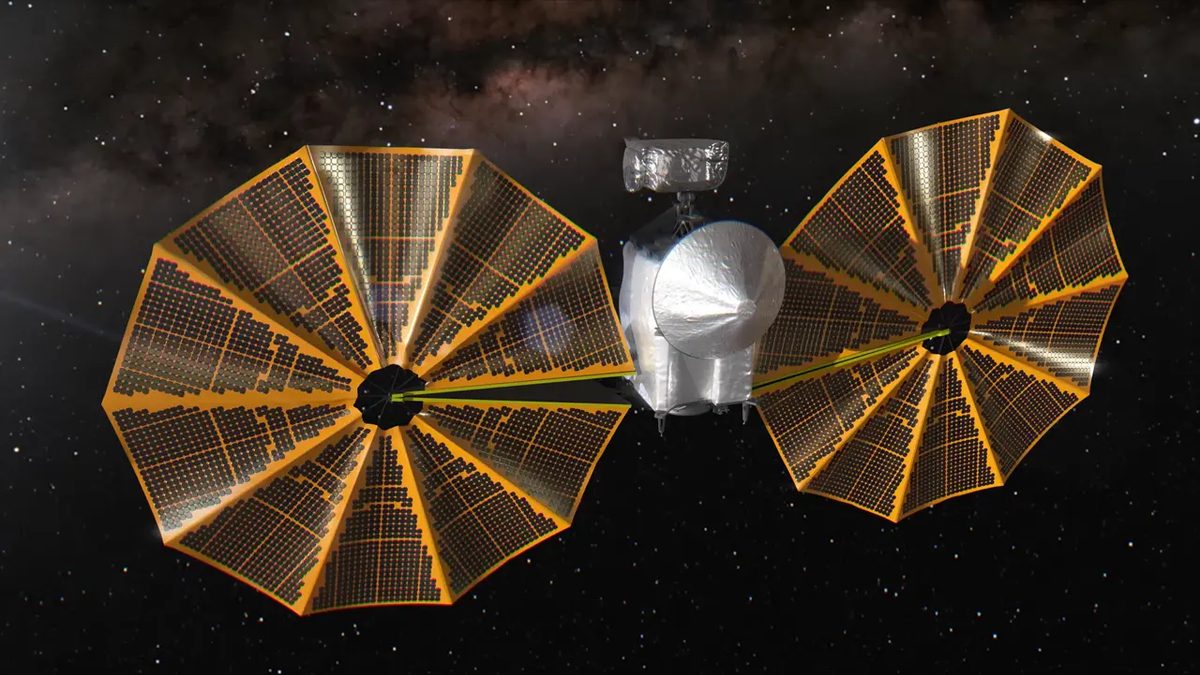
The sun is setting on a busy week for space enthusiasts. If you are wondering how to track this event or want to know why this specific flyby matters, the answer lies in the data Lucy will collect tonight. The NASA probe is closing in on asteroid (52246) Donaldjohanson. It will pass within just 960 kilometers of the rock this Sunday evening at 19:51 Paris time.
This is not the first time Lucy has dipped close to an asteroid. But this encounter is different. The mission’s primary goal is to study Jupiter’s Trojan asteroids. These are space rocks trapped in the planet’s gravitational grip, sharing its orbit around the sun. They are essentially time capsules from the dawn of our solar system. Before they can reach those deep-space targets, Lucy has to work its way through the main asteroid belt.
Why study Donaldjohanson now?
You might ask why scientists care about a rock between Mars and Jupiter. The answer is calibration. Lucy needs to test its instruments. It has to make sure its cameras and spectrometers work correctly before facing the darker, colder Trojans years later.
The flyby of Donaldjohanson serves as a critical dress rehearsal. It allows the team to verify that the spacecraft can handle close approaches without damaging its sensitive equipment.
The Sunday Evening Maneuver
At 19:51 Paris time, Lucy will be at its closest point. For the last 30 minutes of the approach, the probe will orient itself to face the asteroid. Three scientific instruments will power up. There is a high-resolution camera. There are also two spectrometers designed to analyze the mineral composition of the surface rocks.
But here is where the drama comes in. The sun will be directly behind the asteroid from Lucy’s perspective. If the instruments stay on too long, they could be blinded by the glare.
So, 40 seconds before the closest approach, Lucy will shut down its sensors. It will go dark for just 40 seconds. This protects the delicate optics from solar damage. Once the sun moves out of the direct line of sight, the instruments can wake up again.
A Long Road Ahead
This flyby follows the mission’s first asteroid encounter. In November 2023, Lucy flew past Dinkinesh. That was a big deal. Scientists discovered the asteroid has a small moon orbiting it. Finding moons around small asteroids gives us clues about how these bodies form and collide.
Since launching in 2021, Lucy has performed gravity-assist maneuvers. It has looped around Earth twice to gain speed. This slingshot technique is essential for reaching the distant Trojans.
The schedule for future encounters is packed. After Donaldjohanson, the probe will target Eurybates and Polymèle in 2027. Then it will visit Leucus and Orus in 2028. The final listed stop is Patrocle in 2033.
It is a marathon, not a sprint. Each flyby brings us closer to understanding the building blocks of our solar system. The data from tonight will be just the beginning of a much larger story.

We’re past the era of plugging in everything. Or at least, we should be. The shift toward wireless power isn’t just about cleaner desks. It’s about efficiency, convenience, and a fundamental change in how we think about energy distribution.
How wireless power actually works
Most people know the basics. You place a phone on a pad. Energy moves. End of story. But the physics behind it is far more intricate than a simple magnetic link.
Inductive coupling relies on two coils. One in the charger. One in the device. When alternating current flows through the first coil, it creates a magnetic field. This field induces a current in the second coil. It’s electromagnetic induction. The same principle used in transformers, but scaled down and miniaturized for portability.
The efficiency matters. Early pads lost significant energy as heat. Newer standards like Qi v2.0 have tightened this up. They can transmit power over slightly greater distances. And with better alignment algorithms, devices don’t need to sit perfectly still. You can nudge your phone. The connection holds.
“Wireless charging is not just about convenience; it’s about reducing the physical wear and tear on ports, which are common points of failure in modern electronics.”
Resonant coupling: Going beyond the pad
Inductive coupling is restrictive. You need contact. Or near-contact. Resonant coupling changes the rules.
Instead of direct induction, both the transmitter and receiver are tuned to the same resonant frequency. Think of it like tuning forks. If you strike one, the other vibrates in sympathy. Energy transfers across space. Not just inches. Feet.
This technology is still maturing. But it promises true mid-range charging. Imagine walking into a room. Your devices charge as you sit. No pads. No cables. Just ambient power.
The challenge lies in efficiency. Energy drops off sharply with distance. And interference from other objects can disrupt the resonance. Engineers are working on dynamic tuning. Real-time adjustments to maintain the frequency match. It’s complex. But necessary for true freedom.
Why this matters for the grid
We often talk about wireless charging in terms of personal gadgets. Laptops. Headphones. Watches. But the implications stretch further.
Electric vehicles. This is the biggest frontier. Inductive charging for EVs is being tested in several cities. Parking spots double as chargers. You pull in. The car charges. No plug. No fuss.
This changes urban infrastructure. Streetlights. Bus stops. Even roads embedded with charging coils. Vehicles could charge while moving. Extending range. Reducing battery size. Which reduces mining. And cost.
The grid itself could benefit. Smart grids use wireless communication for management. But wireless power transmission? That’s the next step. Microwave or laser-based transmission over long distances. Still experimental. Still risky. But potentially transformative for remote areas.
The safety question
Radiation. It’s a buzzword. And a fear.
Non-ionizing radiation. That’s what we’re dealing with here. Radio waves. Microwaves. Infrared. Not like X-rays. It doesn’t strip electrons from atoms. It doesn’t damage DNA directly.
But heat? That’s a concern. High-intensity fields can warm tissue. Regulations are strict. Specific absorption rates