We think of the great white as the ocean’s apex predator. It is terrifying. It is efficient. It is dead.
The megalodon was not just a bigger great white. It was a monster of a different era. Reaching lengths of up to 65 feet, this prehistoric shark dominated ancient seas for millions of years. Its bite force was crushing. Its presence was undeniable.
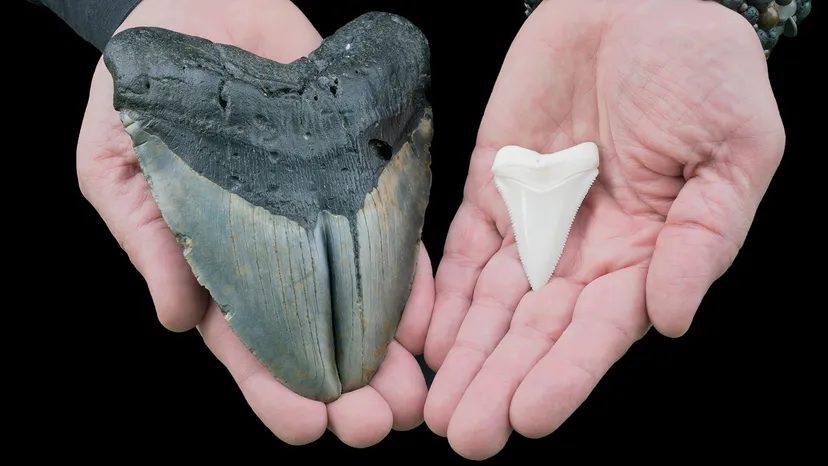
Most of what we know about this creature comes from teeth. Not bones. Teeth. Because sharks are made of cartilage, their skeletons dissolve quickly after death. They leave almost no trace. But teeth? Teeth are diamond-hard. They survive. And they tell a story of absolute power.
The Megalodon vs. Other Giants
Is there a bigger shark? No.
The megalodon holds the record for the largest shark to ever live. No modern species comes close. Even the whale shark, the biggest fish in today’s oceans, is a gentle filter-feeder. It is not a predator in the same league.
But the megalodon was not the largest fish ever. That title belongs to Leedsichthys problematicus. This ancient giant reached about 54 feet. It lived around the same time. The difference? The megalodon ate other animals. Leedsichthys likely filtered plankton. One was a hunter. The other was a vacuum cleaner.
How We Measure a Ghost
You cannot weigh a ghost. But paleontologists have figured out a workaround.
Shark skeletons do not fossilize. They rot. So how do we know how big the megalodon was? We use its teeth.
Specifically, we compare the size of fossilized megalodon teeth to the teeth of modern great white sharks. The math is simple. If the tooth is proportional to the jaw, and the jaw is proportional to the body, you can estimate the total length.
The largest teeth found are nearly 8 inches long. Most are 4 to 5 inches. By scaling these up against living relatives, scientists estimate the largest megalodons hit 65 feet. That is two school buses linked together.
The Bite That Crushed Bone
The jaw of a megalodon was a biological marvel. It could open to a width of 11 feet. Imagine two adults standing side-by-side fitting inside that mouth.
The power behind that gape was staggering. Estimates suggest the bite force was six to ten times stronger than a great white’s. It was also three times stronger than a Tyrannosaurus rex.
Why does this matter? Because the megalodon did not just bite. It crushed. It shattered bone. It could take down baleen whales. It could end a hunt in seconds. The teeth were serrated, like steak knives, designed to slice through flesh and bone with minimal resistance.
What Did It Actually Look Like?
For decades, pop culture depicted the megalodon as a giant great white. It wore the same clothes. It had the same shape.
This is wrong.
Recent reconstructions suggest a different profile. The megalodon likely had a shorter, blunter nose. Its jaw was flatter and more compact. The pectoral fins were longer. It looked less like a sleek torpedo and more like a heavy, armored tank.
It was built for ambush. Not speed. It sat in the water column, waiting. Then it struck.
Teeth as History Books
The most iconic fossils of the megalodon are its teeth. They are triangular. Robust. Serrated.
The largest single tooth ever discovered was found in Peru. It measured 7.48 inches. These are rare finds. Most adult teeth were smaller. But each one tells us about the shark’s diet.
The wear patterns on the teeth show it ate hard-shelled prey early in life. Later, it switched to large mammals. Whales. Seals. Other sharks.
An adult megalodon had about 276 teeth. They were in continuous replacement. If one broke, another took its place. It was a machine designed to never stop eating.
Where Did They Roam?
The megalodon was global.
Fossils have been found on every continent except Antarctica. They lived in warm waters. Cold water slows them down. It also slows down their prey. The megalodon preferred the tropics and subtropics.
This widespread distribution explains why their teeth are so common. They were everywhere. They were always there.
But they are gone now. Why?
Climate change. The oceans cooled. Their prey migrated to colder waters. The megalodon could not follow. It starved. It vanished.
We have only fragments left. Teeth. Jaws. Shadows.
But in those fragments lies a truth. The ocean has been ruled by giants before. And they did not die out quietly. They ruled until they didn’t.
The Apex Predator’s Menu
You don’t get to be the biggest shark in the sea without eating big. The megalodon didn’t just snack on fish. It hunted large marine mammals. Baleen whales. Seals. Sea cows. Occasionally, a sea turtle might have made a mistake. The size of the megalodon dictated a diet of substantial calories.
The evidence is written in bone. Paleontologists find whale fossils with distinct gashes. These injuries match the size and shape of megalodon teeth. It wasn’t a gentle encounter. It was violent. The shark had the sheer power to tackle almost any creature swimming in the prehistoric ocean. This made it the uncontested apex predator.
Eating these massive animals wasn’t just about hunger. It was about ecosystem regulation. By keeping whale and seal populations in check, the megalodon maintained a delicate balance. Its adaptability as a hunter allowed it to exploit various large prey sources, meeting the huge energy demands required by its colossal body.
Nursery Grounds and Baby Sharks
Reproduction remains a bit of a mystery. Experts think megalodons gave live birth. They aren’t sure if the process was ovoviviparous or viviparous. One way eggs stay inside the mother until hatching. The other involves continuous nourishment from the mother to the embryo.
We do know the size of the newborns. Juvenile teeth suggest pups were about 2 meters long. That is 6.6 feet. Big enough to swim. Small enough to hide.
They likely gave birth near the shore. Shallow coastal waters acted as a natural nursery. This strategy offered protection. The open ocean is full of predators. The coast was safer.
These nursery areas were rich in food. Fish. Smaller mammals. Ideal for young sharks to practice hunting. They could hone their skills without the immediate threat of larger sharks. It was a safe zone for development.
The Disappearance Act
Do they still exist? No. They have been gone for more than a million years. Specifically, about 2.6 million years. The fossil record is clear. There are no recent giant shark teeth. No fossil remains from the last few thousand years.
Sharks shed teeth constantly. If megalodons were swimming today, we would find their massive teeth scattered on the seafloor. We don’t.
We would also see bite marks on modern marine mammals. Distinct signs of a colossal predator. These marks are absent. The lack of physical evidence, combined with comprehensive study of old fossils, confirms their extinction. The mystery is solved. They are gone.
Why They Vanished
Climate change was the killer. Not directly, but indirectly. Ocean temperatures began to drop. Sea levels changed. The environment shifted dramatically.
The megalodon’s primary food source migrated. Large marine mammals moved to colder waters. They sought habitats that suited them. The megalodons stayed behind. Or rather, they couldn’t follow. Their massive size and energy requirements required specific conditions.
Without enough prey, the population declined. New predators emerged. Competition increased. The ecosystem changed. The megalodon couldn’t adapt fast enough. Even the most formidable creatures are vulnerable to shifting climates. The ocean got colder. The food moved away. The shark disappeared.
This article was created in conjunction with AI technology, then made sure it was fact-checked and edited by a HowStuffWorks editor.
Frequently Asked Questions
What were the primary prey of megalodon sharks?
Megalodon sharks primarily preyed on large marine mammals such as whales, dolphins and seals, using their powerful jaws and teeth to hunt effectively.
How did megalodon sharks contribute to their ecosystem?
Megalodon sharks helped maintain the balance of the marine ecosystem by keeping the population of large marine mammals in check.