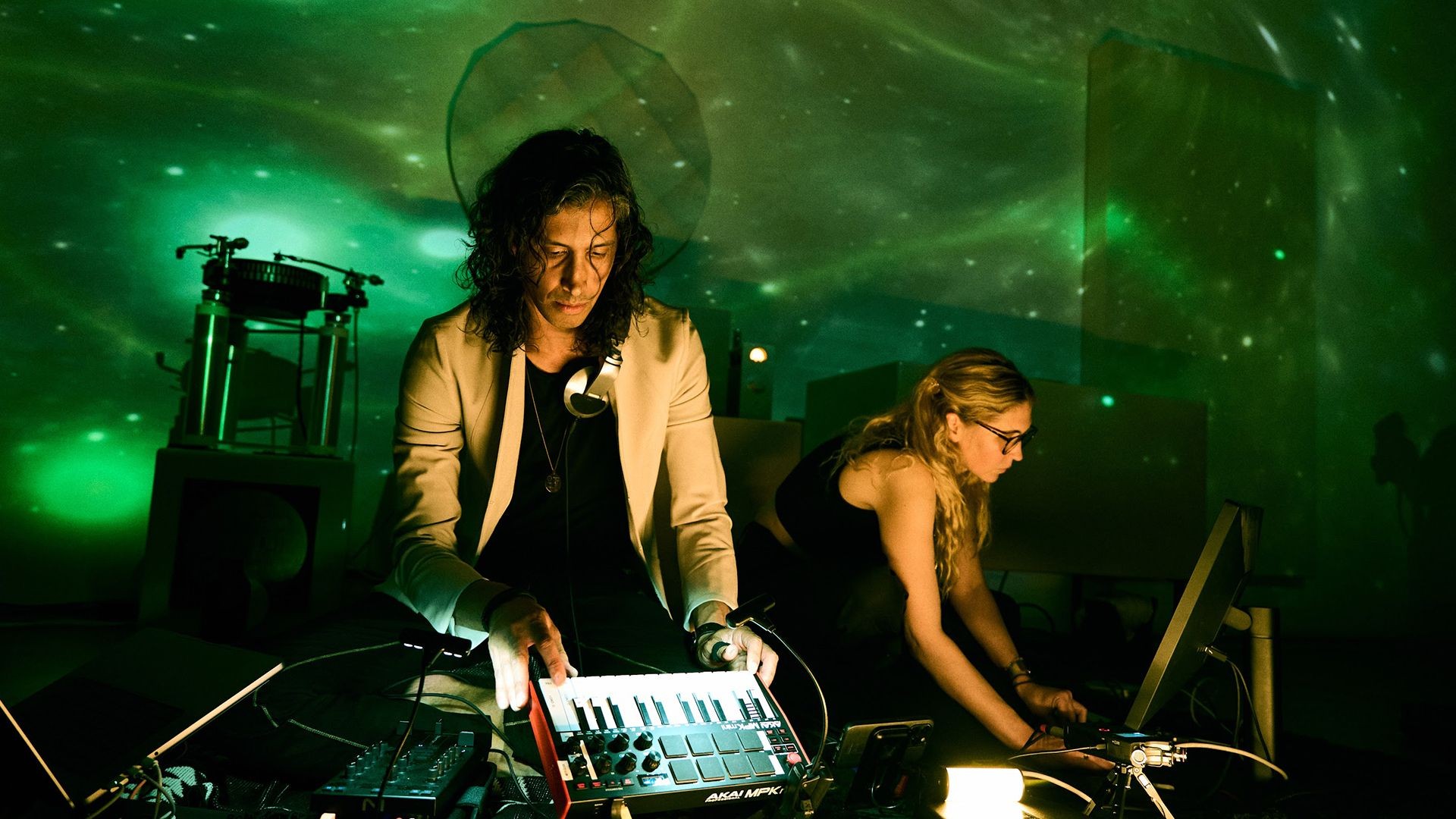
Redshift isn’t just a concert.
It’s an existential trap for your senses.
On May 22, Heft Gallery in NYC stopped being a room full of walls.
For a sold-out crowd, it became a vessel. Ashley Zelinskie and illich Mujica turned space into something you could feel. They mixed live electronics with NASA data and spoken word into a ride through wavelengths.
It started quiet.
With history.
The opening played NASA’s Golden Record through Joe Doucet’s “Volumes” listening system. That disc has been sailing in the void since 1977, a time capsule from Earth sent to whoever might be out there.
It set a tone.
Science, art, and wonder all breathing at once.
Waves, Light, and the Stretch of Time
Zelinskie projected images from the James Webb Space Telescope on one wall.
She didn’t just show pretty pictures of galaxies.
She simulated redshift. The actual stretching of light as it travels across the cosmos. Older light gets redder. The waves stretch.
Mujica’s audio tracked it.
He moved from ambient electronica to psychedelic rock, weaving in spoken-word snippets that felt like transmissions from deep space.
Our concept was “light in service of sound and sound in use of light,” Zelinskie explained. They started in ultraviolet frequencies. The light shifted toward red as the music shifted from long-wave experimental noise to higher BPM scores. It’s a cross-pollination of physics and art. Short light waves paired with long sound waves, then reversed. The friction was the point.
Which Webb images stuck?
Zelinskie always goes back to the first ones. She was at Goddard when they dropped. It changed her practice forever. She built visuals around the Carina Nebula’s cosmic cliffs, the collision of Stephan’s Quintet, and the pulsing rings of the Southern Ring.
She even used AI and custom VJ software to train visuals on Webb’s deep field stars.
It’s tech serving awe.
A Bowie Rejection
Here’s where it got unexpected.
Mujica decided mid-performance to drop a track.
He was hunting for David Bowie’s “Space Oddity.” He found it too literal. Instead, he spun Pink Floyd’s “Is There Anybody Out There?”
It’s not a hit single. It’s a bridge track from The Wall, sandwiched between “Hey You” and “Nobody Home.” It’s about isolation. Alienation. A teenage inner monologue about detachment.
But over time, the song mutated for Mujica.
It stopped being just mental health.
It became the old cosmic question: Is anybody there?
The ethereal, abstract quality of the guitar fit the redshift theme better than Bowie’s ballad.
He needed it to land into a specific sample.
The View From Andromeda
He sampled an answer to a child’s question on a NYT podcast about Artemis II.
The kid asked if there was life out there.
One astronaut gave an answer that blew Mujica’s mind.
“If you look at the closest neighboring galaxy… Andromeda… what do they see? They see us a couple of hundred years ago.”
Wait.
A thousand?
The transcript says a couple of thousand years.
We are already gone to them. Or at least, our past is. The distance is so vast that the light takes centuries to bridge the gap.
It’s a terrifying thought.
And a beautiful one.
The redshift performance wasn’t just about seeing distant stars. It was about time lag.
Mujica closed with another original piece, “Surya Rising.” It featured a voice memo from collaborator Tory Stolper doubting the creative process before dropping into the track about desert sunrises at Burning Man.
A raw human moment floating in a synthesized universe.
The set ended.
The lights stayed dim for a moment too long.
You’re left thinking about Andromeda.
And whether we are really alone, or just too far apart to say hello.