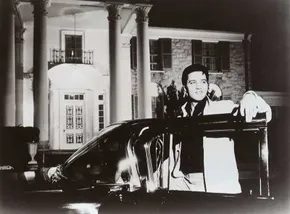
We think we know the King. The jumpsuits, the hip thrusts, the blue suede shoes. It’s easy to forget that underneath the image was a man who was oddly polite but brutally honest when the cameras weren’t spinning. Elvis didn’t care much for press conferences designed to sell you a version of him he didn’t recognize. He preferred to speak plainly about fame, music, and the sheer exhaustion of being a global icon.
His connection to fans wasn’t built on polished PR statements. It came from his genuine appreciation for their adoration and his frank acknowledgment of where he came from. These aren’t soundbites crafted by a team. They are snapshots of the man behind the myth.
The Cow and the Fence
In 1956, the press was obsessed with his personal life. They wanted to know if he was settling down. Elvis had a different perspective on romance and practicality.
“Why buy a cow when you can get milk through the fence?”
He dropped this line into Time magazine in May of that year. It wasn’t just a joke. It was a deflection wrapped in humor. He wasn’t ready to be tied down by the expectations of marriage at twenty-one. He knew the press wanted a scandal or a solemn announcement. Instead, he gave them a riddle that hinted at convenience over commitment.
The Source of the Sound
Elvis never claimed to invent rock and roll. He knew better than to insult the people who built the foundation. But he was also aware of how he changed the delivery.
“The colored folks been singing it and playing it just like I’m doin’ now, man, for more years than I know. They played it like that in the shanties and juke joints and nobody paid it no mind ’til I goose it up. I got it from them. Down in Tupelo, Mississippi, I used to hear old Arthur Crudup bang his box the way I do now, and I said if I ever got to the place I could feel all old Arthur felt, I’d be a music man like nobody ever saw.”
This wasn’t just humble bragging. It was a tribute. Speaking to the Charlotte Observer in June 1956, Elvis acknowledged that he didn’t create the sound. He amplified it. He took the raw energy of the blues and bluesmen like Arthur Crudup and pushed it into the mainstream. He admitted he “goosed it up,” but he never forgot who provided the original spark.
The Physical Toll
By 1957, the schedule was relentless. Tours, movies, press. The physical cost was steep.
“I lose myself in my singing. Maybe it’s my early training singing gospel hymns. I’m limp as a rag, worn out when a show’s over.”
In the Tacoma New Tribune, Elvis described the performance as a total physical drain. It wasn’t the showman popping up for a bow. It was a man who had emptied himself onto the stage. The reference to gospel hymns explained the intensity. He didn’t just sing notes. He lived them until there was nothing left.
The Shirt Incident
Fans wanted everything. Not just the music, but the merchandise. The clothing. The artifacts. Elvis found the demand for his

The Man Behind the Jumpsuit
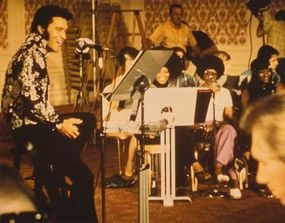
You think you know the King. You know the pompadour, the jumpsuit, the Vegas glare. But strip away the rhinestones and you find a guy who was deeply, painfully aware of being trapped by his own success.
“I don’t regard money or position as important. But I can never forget the longing to be someone,” he told Time in 1965. “I guess if you are poor, you always think bigger and want more than those who have everything when they are born.”
That’s the raw engine of Elvis Presley biography details often miss. It wasn’t just about fame. It was about proving he wasn’t just a poor boy from Tupelo who got lucky.
The Weight of the Image
Live for a while and the cracks start showing. By 1968, he was telling Tropic that “the sad things are always stronger in his memory than the happy things” when he was alone.
Then there was the acting. He hated the typecasting. “I get tired of playing a guy who gets into a fight, then starts singing to the guy he’s just beat up,” he complained to Newsweek in 1969.
It was a specific frustration for fans tracking Elvis Presley movies during that era. He wasn’t trying to be an A-list dramatic actor. He just wanted to sing without the choreography.
Accepting the Jaycees’ Outstanding Young Man of America Award in 1971, he leaned into the spiritual side. “Without a song, the day would never end… without a song, a man ain’t got a friend.” He kept singing as a tether.
Practicality Over Passion
He wasn’t romantic about the music business either. In the 1972 documentary Elvis on Tour, he dropped the myth. His dad told him guitar players didn’t work. “Make your mind up to either be a guitar player or an electrician,” he said. “I never saw a guitar player that was worth a damn.”
It was a pragmatic view. A job vs. a dream. Most chose the dream. Elvis tried to keep one foot in the practical world while living in a fantasy.
When asked at a Madison Square Garden press conference in June 1972 if he was satisfied with his image, his answer was blunt. “Well, sir, it’s very hard to live up to an image.”
Roots and Rules
To understand Elvis Presley early life influences, look at the gospel. “Since I was two years old, all I knew was gospel music… it was as natural as dancing. A way to escape from the problems,” he said in 1977.
Clothes were another layer. “[Clothes] say things about you that you can’t, sometimes,” he noted in The World According to Elvis.
And his advice to younger fans? Simple. “Don’t criticize what you don’t understand, son, you never walked in that man’s shoes.”
Author Note: Susan Doll holds a Ph.D. in radio, television and film studies from Northwestern University. She teaches at Oakton Community College and has appeared on NPR and The Joan Rivers Show. Her books include Elvis: A Tribute to His Life and The Films of Elvis Presley.