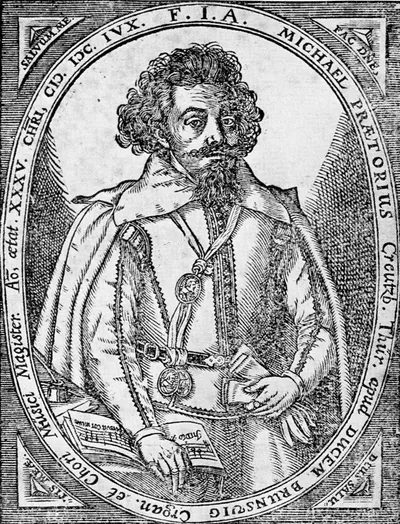
Michael Praetorius was the architect of early 17th-century German sacred music. He died on February 15, 1621, in Wolfenbüttel. He was born in Creuzburg, Thuringia, sometime around February 15, 1571. The exact day remains a mystery. But his impact? That is crystal clear.
His magnum opus, Syntagma musicum, published between 1614 and 1620, stands as the definitive encyclopedia for anyone studying baroque music. It is not just a collection of theories. It is a manual. Praetorius did more than theorize, though. His settings of Lutheran chorales remain primary examples of the era’s religious style.
From Organist to Kapellmeister
Praetorius started in Frankfurt an der Oder. He studied there before taking a job as an organist. Duke Heinrich Julius of Brunswick-Wolfenbüttel hired him eventually. The Duke made him court kapellmeister. That is a fancy term for musical director. It came with responsibility and prestige.
He served the Duke until 1613. That year, Heinrich Julius died. Praetorius lost his patron. He spent the next two years in Dresden. This was a turning point. In Dresden, he absorbed the latest Italian musical trends. He was hungry for new sounds. He admired the Italian approach deeply.
After Dresden, he became a traveler. He visited numerous German courts. He went as a director. As a performer. As a consultant. He was zealous about advancing music. He wanted variety. He loved rich, complex settings for voices and instruments.
The Massive Output
His work ethic was relentless. His output was huge. Consider Musae Sioniae. It spans nine parts, released between 1605 and 1610. It contains more than 1,200 chorale settings.
The styles vary wildly within that collection. Some pieces use the Venetian double choir style. That means eight to twelve voices spread across different spaces. Others are simpler. Two parts. Three parts. Four parts. Just the essentials.
Then there is Puericinium. Published in 1621, right before his death. Here, chorale strophes get varied treatment. This approach foreshadowed the chorale cantata. A new form was taking shape. Praetorius helped birth it.
He also acted as a publisher. He did not just write music. He shared others’ work. His collection Terpsichore, released in 1612, is particularly notable. It introduced hundreds of foreign dance pieces to Germany. These were not local folk dances. These were imported rhythms. They changed the German dance floor.
Instruments and Classification
The Syntagma musicum survives in three parts. Volume II is the heavy hitter. It describes and classifies instruments. Ancient ones. Current ones. All of them.
The book includes a lavish appendix. It is filled with illustrations. Detailed drawings of every instrument Praetorius discussed. This makes the text an invaluable visual record. We know what a viola da gamba looked like in 161