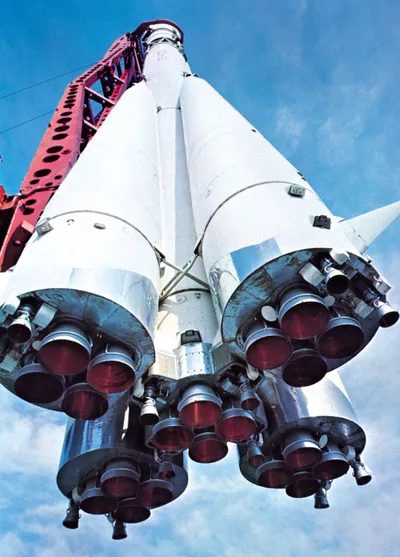
火箭不仅仅是带有方向盘的大型烟花。 它是一种携带燃料和氧化剂的喷气推进装置。 这种区别很重要。 大多数发动机,如汽车或飞机中的发动机,从空气中吸收氧气来燃烧燃料。 火箭不需要空气。 他们随身携带氧化剂。 这使得它们能够独立于大气层运行,使它们成为到达太空的唯一实用方式。
“火箭”一词涵盖了多种运载工具。 你的后院会升起小型烟火火箭。 你们拥有专为战争设计的导弹。 然后还有将卫星和宇航员送入轨道的大型运载火箭。 尽管尺寸和用途各不相同,但它们都有一个核心原理:它们通过高速排出质量来产生推力。
运动物理学
牛顿第三运动定律是火箭科学的支柱。 对于每一个动作,都会有一个相等且相反的反应。 当火箭发动机燃烧推进剂时,会产生热气体。 这种气体膨胀并从火箭后部的喷嘴喷出。 向后推动气体的力推动火箭向前。
这是在真空中进行的。 事实上,火箭通常在太空真空中工作得更好,因为没有大气压力来推动排气。 缺乏空气阻力意味着发动机不必那么努力地将气体推出。
固体与液体推进剂
Rockets typically use one of two types of propellant systems: solid or liquid.
固体火箭发动机 很简单。 When fuel and oxidizer mix, solid masses called pellets are formed. 一旦点燃,它们会一直燃烧直到耗尽。 你无法轻易停止或调节它们。 If greater thrust is required, the shape of the particles must be carefully planned in advance. They are reliable, cheap and efficient, so they are often used as boosters in large launch vehicles and military missiles.
Liquid rocket engines are more complex, but more flexible. 它们将燃料和氧化剂储存在单独的储罐中。 The pump sends these liquids to the combustion chamber, where they are mixed and burned. The ability to control the flow allows the engine to be started, stopped, restarted and throttled. Such precision is critical for rockets that travel through space and return to Earth. For example, SpaceX’s Falcon 9 uses liquid oxygen and RP-1 kerosene in its first stage to achieve reusable landing capabilities.
Why is it important?
The ability to launch payloads into orbit changes everything. This enables global communication, weather forecasting and GPS navigation. It allows us to think about our planet and understand climate change. It opens the door to space exploration from the Moon to Mars.
Without rockets, space would still be out of reach. 物理原理很简单,但工程却极其艰难。 You need materials that can withstand extreme temperatures and pressures. We need systems that can perform flawlessly in the harshest environments known to man. And once you’re there, you can’t call a mechanic, so you have to get it right every time.
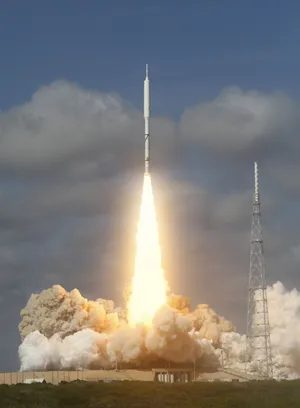
Rockets work on a completely different principle than turbojets or other air-breathing engines. The difference depends on what fuels the exhaust. In a rocket, the gas jet expelled from the rear consists exclusively of the gaseous combustion products of propellants carried entirely on board the vehicle.
Unlike a jet engine, which draws in air from the atmosphere to mix with fuel, a rocket must bring its own oxidizer. This makes it self-contained. However, the thrust generation mechanism has a key similarity with jet engines. Like a turbojet engine, a rocket creates forward motion by rearward ejection of mass.
This ejection happens at very high velocity. Newton’s third law applies here: for every action there is an equal and opposite reaction. By pushing the heavy mass backwards at incredible speeds, the rocket is pushed forward. It does not depend on pushing against the air. It pushes against its own exhaust. This is why rockets can operate in the vacuum of space, where there is no atmosphere to breathe.
The most important observation is the source of the exhaust gases. Air-breathing engines are limited by the availability of atmospheric oxygen. Rockets are not. They carry both fuel and oxidizer, allowing them to operate anywhere regardless of air density. The trade-off is the weight of carrying that extra load, but the payoff is total independence from the environment.
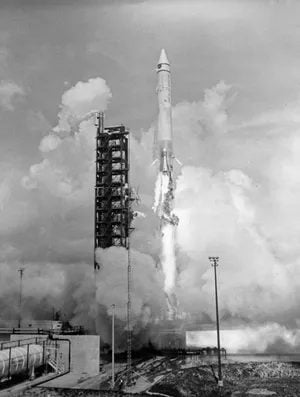
The secret to launching a rocket is not magic. It’s physics. Especially the rules that Sir Isaac Newton set back in the 17th century.
His third law of motion is simple. For every action there is an equal and opposite reaction.
That’s it.
But in space travel, it’s everything. A rocket works because it throws mass backwards at high speed. Exhaust gases fly backwards. The rocket moves forward.
It’s not about pressing against the air or the ground. This is a common misconception. If you need proof, look at how rockets work in the vacuum of space. There is no air to push against. Still, they accelerate.
The increase in the rocket’s momentum depends directly on the momentum of the exhaust gas. Heavier fuel. Faster exhaust. More thrust.
This principle allows spacecraft to move where no other vehicle can. That’s why we can send a probe to the outer planets. This is why International Station remains in orbit. It’s all about the balance of dynamics.
You are basically playing cosmic billiards with yourself. You are hitting the cue ball (exhaust gas) away from you. They rotate in the opposite direction.
Simple? Yes. Effective? Completely.
The complexity lies in the design. Let the fuel burn efficiently. Managing the heat. Control the direction. But the core idea remains tenaciously fundamental.
Push something away. Go the other way.
It seems almost too simple for what it does.

The math behind pushing
Let’s look at the rough mechanics of flight. You can strip away the glamor of space travel and find the engine at its core. It’s all about mass. It’s all about speed. And it’s about force.
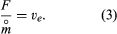
The equation determines how the rocket changes direction and speed in a fraction of a second. Here’s what each variable actually represents in the real world.
- M is the total weight of the rocket itself. Not just metal, but also fuel, crew and payload. As the rocket flies, this number decreases.
-
Δv R follows the change in velocity. It is the speed increase achieved during a very short period Δt.
-
m ° is the speed at which the mass is removed. Imagine how fast the engine burns fuel.
- v e is the effective exhaust gas velocity. Gas rushes out the back so fast. It is almost identical to the velocity of the jet measured from the rocket.
F is force. The physical push.
The most critical part of this equation is not the mass of the rocket. It is the product of m ° and v e.
The quantity m °v e is propulsive force, or thrust.
That’s what really moves the thing. It is the force that running out of fuel exerts on the rocket. Without this thrust, a rocket is just a very expensive metal tube sitting on a pad. The engine converts stored chemical energy into kinetic energy and throws mass backwards to propel the vehicle forward. Newton’s third law in its purest form.
Why is exhaust velocity more important than mass flow? Because a higher v e means more thrust with the same amount of fuel. Engineers have been trying to increase this number for decades. Faster exhaust means you need less fuel to get into orbit. It changes the entire architecture of the vehicle.
The relationship is direct. At higher speeds, more mass is removed, which creates more force. Simple physics. But doing it right requires materials that can withstand the extreme heat and pressure that would cause steel to melt. The math is clean. The engineering is brutal.
So when you see a launch, don’t just look at the flames. Look at the numbers. The rocket loses weight by throwing gas out the back as quickly as possible. Thrust balances gravity. For a few minutes it wins. Then you run out of fuel. And the rest is momentum.

Why exhaust velocity is more important than mass flow
You can boost a rocket in two ways: let more mass out of the back, or send mass out faster. The first option sounds logical until you realize that it drains the fuel tank in record time. Carrying more fuel to compensate just makes the rocket heavier and requires even more thrust to lift it. It’s a trap. The real winner here is effective exhaust velocity.
This gauge tells you how much thrust you get for every kilogram of fuel burned. It’s the best performance indicator in rocketry because it measures efficiency, not just raw power. Large mass flows are pointless. High exhaust velocities are smart. But there is an upper limit.
This upper limit is not theoretical. It’s practical.
What matters is how you accelerate the gas through the nozzle and how much energy you can throw at the problem. Most rockets rely on thermal energy from the combustion of condensed propellants at high pressure. Hot gas expands and turns heat into kinetic energy as it exits the nozzle. But there is a limit. The gas can only be heated so much that the materials melt or the combustion process becomes inefficient.
So how can you break this thermal barrier? You change the energy source.
Instead of burning the fuel, you can add electric heaters or microwaves to increase the energy of the fuel before it leaves the chamber. Go even further and you can use electromagnetic fields to directly accelerate exhaust gases. This bypasses the thermal bottleneck entirely and raises the exhaust gas velocities to a level that cannot be achieved by chemical combustion alone.
Effective exhaust velocity is a number that describes this advantage. It answers the question: “Which propulsion method produces more thrust per unit of fuel?” The higher the speed, the less fuel you need to drive the same distance. It’s not just physics. It’s economics. It’s mission design. It’s the difference between reaching Mars and staying in low Earth orbit.
But here’s the thing. Higher speed is not free. It requires complex systems, heavy generators or exotic materials. There is always a compromise. You trade simplicity for performance. And as speeds increase, the technical challenges don’t just get harder. They become fundamentally different.
The speed at which a rocket throws away its fuel is the most important number in aerospace engineering. With traditional chemical propellants, the effective exhaust velocity ($v_e$) is typically between 2000-5000 meters per second. That’s about 6,500 to 16,400 feet per second. It is fast, but the chemical energy stored in the fuel binds it.
Electrically heated fuels are changing the game. They claim that exhaust velocities are two or three times higher than their chemical counterparts. This increase in efficiency is due to using external energy sources to heat the fuel instead of relying solely on combustion. Then there is the electromagnetic acceleration. Here the predictions are breathtaking. Systems using this method can increase exhaust velocities to over 40,000 meters per second. That’s 131,000 feet per second.
Why seconds are more important than meters
You might wonder why engineers in the United States don’t just stick to meters per second. The answer is in a unit called the specific impulse. It is measured in seconds. This is not time in the traditional sense. This is a measure of efficiency determined by dividing the effective exhaust velocity by a standard gravity constant. This constant is 9.81 meters per second squared, or 32.2 feet per second squared.
Specific Impulse converts speed into a metric directly related to how much thrust you get per unit weight of fuel.
This unit reigns supreme in engineering circles because it simplifies the comparison of different propulsion systems. A higher specific impulse means you need less fuel to achieve the same change in velocity. It is the ultimate measure of propellant quality.
The Weight of Fuel
Imagine a typical chemical rocket mission. Mathematics is cruel. 50–95 percent of the total take-off mass is propellant. The rest is the structure, engines, payload and tanks. A vehicle essentially consists of a fuel tank with an engine attached to it. This reality drives the obsession with higher exhaust velocities. Every percentage point increase in efficiency reduces the amount of fuel needed, which reduces overall mass and allows for greater payload.
The relationship between the mass of the fuel and the final velocity is determined by the rocket equation. This equation assumes gravity- and drag-free flight to isolate the pure physics of momentum. It shows that exponential amounts of fuel are needed to get into orbit. The higher the exhaust velocity, the less exponential the curve becomes. For this reason, the development towards electric and electromagnetic propulsion is not just about speed. It’s about enabling physical access to space without launching mountains of metal and liquid.
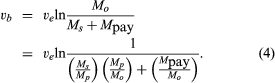
The numbers behind rocket launches are relentless. The central measure of propulsion design is the ratio of the structural mass of the system to the mass of the propellant, expressed as M s /M p. Most modern engines have a lean ratio of 0.09. Next is the ratio of propellant to total mass M p /M o, which is typically around 0.90. In the hydrogen-oxygen system, the velocity of the exhaust gas (v e ) increases to about 3,536 meters per second.
Substituting these numbers into the rocket’s equations reveals the hard truth about payload capacity. In Low Earth Orbit (LEO) a burnout velocity of about 7,544 meters per second (v b ) must be achieved. To achieve this speed, the ratio of payload mass to total takeoff mass (M pay/M o ) is reduced to only 0.0374.
Simply put, you need a massive stack to lift a reasonable amount of cargo. To lift 50,000 kilograms (about 110,000 kilograms) into low Earth orbit, the entire vehicle must weigh 1,337,000 kilograms at launch. That is 2.9 million kilograms of metal and fuel.
The payload of the rocket is typically only a small fraction of the total launch mass, although the different mass ratios are highly dependent on the specific mission profile.
This calculation is optimistic. It assumes a vacuum and ignores the gritty reality of ascent. Gravity drag, atmospheric drag and the need for directional corrections all affect performance. Including these elements only increases the required take-off mass.
This equation reveals a direct trade-off between structural mass (M s ) and payload mass (M pay). Engineers fight hard to keep the structure light, as every kilogram saved on the airframe could be used for science or the crew. In this case, the M s /M p ratio becomes the second most important figure of merit for any propulsion system. The lighter the structure compared to the fuel, the better.
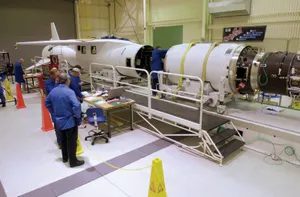
Most missions aren’t just about starting a big engine and hoping for the best. They use “multiple staging” technology to keep the launch vehicle as small and efficient as possible. The basic idea is simple: the main rocket acts as a carrier for another, smaller rocket. When the first stage runs out of fuel, it burns out and drops away. Then the second stage fires and pushes the payload towards the target.
This is important because you don’t waste energy carrying the dead weight of the first stage. The thrust of the second stage is transferred more efficiently to the actual payload. In fact, most space flights require at least two stages. If the task requires even higher speeds, the engineers expand the strategy by adding additional steps. The US Apollo missions that put men on the moon relied on an staggering six stages to get the job done.
Why rockets rule the sky and space
Rockets aren’t just bigger firecrackers. They have special properties that make them indispensable in space travel and modern warfare.
First, they work everywhere. Unlike jet engines, which require air to operate, rockets have their own oxidizer. This allows them to operate in the vacuum of space as well as in the Earth’s atmosphere.
Second, they generate massive force. A modern heavy space booster can produce a takeoff thrust of 3,800 kilonewtons, equivalent to about 850,000 pounds. This type of force is necessary to escape gravity’s grip.
The propulsion systems are also surprisingly simple. many designs do not have complex moving parts such as turbines or compressors. This simplicity means that the system can be kept in a ready-to-fire state for long periods of time, a crucial feature in military applications where surprise and speed are everything.
You can launch them from anywhere. Small rockets do not require large runways or silos. They can be fired from packing crates, shoulder-mounted launchers, or even from airplanes. Since they do not depend on reaction against an external surface, they have no recoil.
These properties explain why rockets hold all the speed and distance records, whether on land, in the air, or in space. They are the exclusive choice for space travel. They also transformed warfare both strategically and tactically. The rise of modern rocket technology can be traced directly to the development of weapons during and after World War II. Much of this progress has been funded by initiatives known as “space agency” programs, including the Ariane, Apollo, and Space Shuttle projects.
The Mechanics Behind the Burn
To understand why this works, you have to look at the chemistry. Chemical rockets are based on the rapid combustion of fuel and oxidizer.
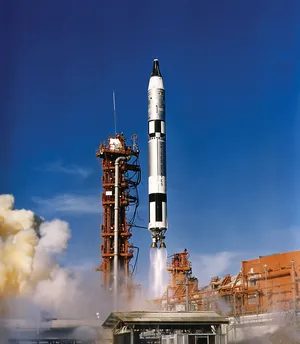
Anatomy of a Chemical Rocket
Chemical rockets can look completely different depending on the mission—whether they launch from a platform or move through the vacuum of space—but they all rely on the same basic mechanical logic. When you strip away the brand name and specific fuel types, you’ll find six core components that work together.
First you have the combustion chamber. This is where the magic happens. Here, solid or liquid fuels are pumped or ignited, turning them from a condensed state into a very hot, high-pressure gas. The second part is the nozzle. It takes this messy, hot gas and forces it out at incredible speeds. The shape of the nozzle is crucial; It accelerates the exhaust gas to create thrust.
Of course, fuel is needed. Propellant containers contain oxidizer and fuel before they are needed. But storage is pointless if the stuff can’t be moved. This is the job of the feed system which pumps or pressurizes the fuels into the combustion chamber with enough force to overcome the pressure already inside.
All equipment must withstand extreme G-forces and temperatures. A sturdy structure supports and protects these internals from shaking apart or melting. After all, it’s no use if it’s off track. Guidance and control devices control the beast and adjust the thrust vector or duration of fire to hit the target.
It’s a simple recipe. Burn stuff. Shoot it out the back. Move forward. However, the technical genius lies in the fact that these six components work together without breaking apart.
A rocket is just a controlled explosion with a direction.
However, the complexity does not end there. Once you understand these basic elements, you’ll begin to see how small changes in nozzle shape or feed rate can dramatically change performance. It’s not just about getting parts. It’s about how they talk to each other.
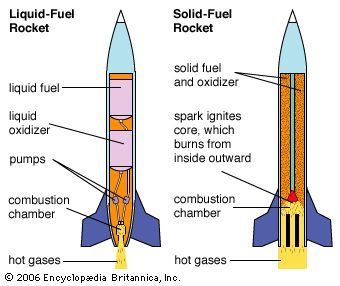
Not all rockets work the same way. Chemical propulsion falls into two main camps at the core depending on how it stores its fuel. There are solids commonly referred to as engines and liquids as engines. Then there is the hybrid intermediate, where one component is solid and the other is liquid. It’s an evolving field, but the reality is that system performance is entirely dependent on the task requirements.
Mechanics of solid rocket engines
Let’s look at the solid side first. These are simpler than their liquid counterparts. The fuel and oxidizer are mixed into a solid grain. You light it, it burns and you get thrust. There is no complicated pump system. No turbopumps. Just burning.
Because of this simplicity, solid motors are preferred for high thrust applications. Launch assist boosters? Often solid. Torpedoes? Solid. Military missiles? Almost exclusively solid. Why? Because they can sit on a shelf for years and be ready to use at any time. You don’t need to fuel the rocket before launch. It’s ready to go.
But there is a catch. When you start a solid motor, you can’t turn it off. You can’t throttle it down. It will burn until you run out of fuel or you deliberately vent the pressure. For missions that require precise adjustments or corrections in flight, this is a major limitation.
Liquid-propellant engines
Liquid engines are more complicated. They store fuel and oxidizer in different tanks. Pumps push them into the combustion chamber. This allows for control. You can reduce thrust. You can turn it off and turn it back on. This flexibility is critical in orbit, landing sequences, and space missions where precision is more important than brute force.
Disadvantage? Complexity. More moving parts. More points of failure. And the fuel often has to be cryogenic, which means it has to be stored at very low temperatures. You just can’t keep a liquid engine full of fuel for a decade. It evaporates. It degrades.
Hybrids: Trying to have it both ways
Hybrid systems try to fill this gap. Imagine a solid fuel with a liquid oxidizer flowing over it. Or liquid fuel injected onto a solid oxidizer. The idea is to combine the safety and storage stability of solids with the controllability of liquids.
In practice, hybrids are still niche. They are used in certain experimental roles or in small launch vehicles. The technology has matured, but it has not replaced the two main technologies. Most large rockets are based on purely solid or purely liquid models. Hybrids are the oddballs of the propulsion world, interesting but not yet mainstream.
Choose the right system
So which one do you choose? It depends on the task profile.
- Need an instant, massive boost? Go solid.
- Need precise control and restart ability? Go liquid.
- Need safety and control without the complexity of full fluid systems? Look at hybrids.
Chemistry is straightforward. The engineering is where the debate lives.
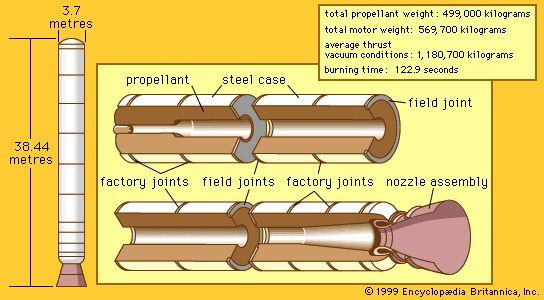
The Architecture of Solid Fuel
A solid-rocket motor is simpler than it looks on the surface. The fuel sits directly inside the motor case. This case does double duty. It holds the propellant like a tank. It also acts as the combustion chamber where the magic happens. You wouldn’t want the exhaust burning straight through the metal, so the propellant is arranged to shield the case from the heat.
Modern propellant isn’t just a block of dynamite shoved in a tube. It’s a viscous mix. Engineers pour this slurry into the motor case using specific mold fixtures. The mix solidifies, usually through polymerization. Once hard, the molds come out. What remains is a chunk of fuel bonded to the case walls. There is a perforation down the center. During flight, the fuel burns on these exposed inner surfaces. It eats away at a predictable rate. That steady burn creates the thrust needed to lift the payload.
Building the Case
The case itself is usually a steel or aluminum tube. It has a head-end dome and an aft-end dome. The front dome holds the igniter. The back supports the nozzle. Thermal insulation lines the interior surfaces. This is critical where the propellant doesn’t cover the walls. Without it, the exhaust would breach the case. That’s a failure mode you want to avoid.
Weight matters. A lot. In missions where every gram counts, engineers use filament winding. They wrap high-strength fibers around a form. Plastic is applied and cured continuously as the fibers wind. The front and aft domes are wound as part of the structure. Openings are left for removing the collapsible form. This allows them to load the propellant and attach the hardware. The case is the main structural component. It takes the stress. It must be designed to handle it.
Chemical Recipes for Power
Not all solid propellants are the same. The ingredients depend on the mission. Cost, safety, and performance drive the choice. A common mix includes ammonium perchlorate. This is a granular oxidizer. Then there is powdered aluminum. That’s the fuel. Finally, hydroxyl-terminated polybutadiene, or HTPB. This starts as a liquid during mixing. It polymerizes into a rubbery binder when cured.
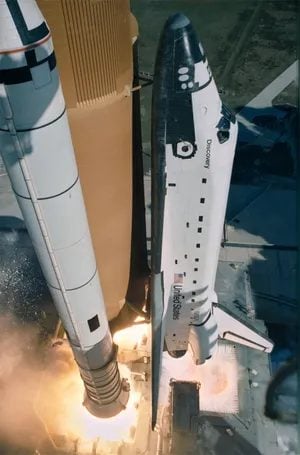
This specific combination powers major U.S. boosters. Think the Space Shuttle. Think the Titan rocket. If you need more performance, you change the chemistry. You use more energetic oxidizers like HMX. Or you use energetic plasticizers in the binder. Nitrocellulose and nitroglycerin systems are another option.
Military applications add another constraint. Visibility. A smoky plume gives away your position. Aluminum powder creates that smoke. So does high concentrations of ammonium perchlorate. To hide the exhaust, you need different materials. You use HMX. You use high-energy binders. The result burns to produce mainly carbon, oxygen, hydrogen, and nitrogen. Invisible to the naked eye. Harder to track.
The Propellant Paradox
Propellants are a study in contradictions. They have to burn fast but not too fast. They need to be dense to pack power into small spaces, yet the exhaust they create must be light and hot to push things faster. Specifically, the burning rate needs to stay consistent, usually between 0.2 and 20 cm per second. It can’t be too sensitive to pressure changes or bulk temperature spikes. If it is, the rocket becomes a bomb instead of a vehicle.
Then there’s the safety angle. These materials are essentially controlled explosives. You need to be able to manufacture them and load them into the motor without blowing up the factory. Once inside, the propellant has to hold its shape. It can’t crumble during shipping, storage, or the violent shaking of launch. High-performance propellants require special facilities and strict safety protocols. Even the less sensitive ones, like the ammonium perchlorate-aluminum-polymeric binder mix used in the Space Shuttle boosters, still demand serious respect during handling.
Shaping the Blast
The nozzle’s job is simple in theory, complex in practice. It has to turn high-pressure gas from the combustion chamber into a supersonic jet. The shape does the heavy lifting. It starts narrow, converging down to a “throat.” Here, the gas hits the speed of sound. The size of that throat controls how much mass gets out, which dictates the internal pressure.
Past the throat, the channel widens. The gas expands and accelerates to supersonic speeds while pressure drops. This divergence is where the thrust lives. But get the contour wrong, and you get shock waves. They tear at the flow. They cause separation. Thrust vanishes. Designers spend countless hours tweaking these curves to keep the flow clean.
Insulation and Steering
Nozzles don’t just sit there. They get hot. Really hot. Most applications need insulation or exotic materials like graphite to keep the structural metal from melting. If the structure fails, the nozzle fails. If the nozzle fails, the rocket fails.
Sometimes, you also need to steer. Changing the exhaust direction by a few degrees requires moving parts. These mechanisms add weight. They add complexity. They add failure points. But for a guidance system to work, you need that control.
Starting the Fire
Ignition isn’t just lighting a match. You need a rapid pressure spike to ensure the propellant catches uniformly. The igniter is a sealed container of metal-oxidizer mixture. It ignites faster and hotter than the main charge. An electric squib triggers it. When it burns, it disperses hot gas into the motor.
In large motors, this isn’t a simple spark. It’s a miniature rocket inside the rocket. A fast-burning charge in a sub-motor exhausts directly into the main chamber. This creates the initial pressure and heat needed to light the bulk propellant. Arming mechanisms prevent accidental discharge. You don’t want the igniter firing in the hangar.
The Fixed Thrust Curve
Solid rockets are different from liquids. You can’t throttle a solid motor. Once the propellant is cast, the thrust-time profile is locked in. The designer chooses the grain geometry—the shape of the propellant surface—to control how the burn progresses. More surface area means more thrust. Less surface area means less. The formulation determines the base burn rate.
This lack of real-time control is a limitation, but it’s also a feature. Missions are designed around this predictable curve. You don’t need complex throttle valves. Instead, you get enormous mass-flow rates. Liquids need pumps. Solids just burn. The thrust level depends on the operating pressure, which internal ballistic theory links to motor properties and propellant characteristics.
The equation governing this behavior is:
$$ p = \left( \frac{a \cdot P^n \cdot S_c}{C^* \cdot A_t} \right)^{\frac{1}{1-n}} $$
Where $p$ is pressure, $a$ and $n$ are burning rate constants, $S_c$ is burning surface area, $C^*$ is characteristic velocity, and $A_t$ is throat area.
It’s a balance of geometry, chemistry, and physics. You get the thrust you design for. Nothing more. Nothing less. The rocket goes where the math says it goes.

The math behind solid rocket motors isn’t just abstract theory. It’s the difference between a controlled launch and an explosion. To understand how these engines produce thrust, one must look at the specific geometry of the nozzle and the chemical behavior of the fuel inside.
One of the most critical variables in this equation is At, which represents the nozzle throat area. This is not just a hole in the middle of the engine. It is the bottleneck that controls everything. The size of this throat determines how quickly the burning fuel can exit, which in turn determines the pressure build-up in the combustion chamber.
This pressure does not work alone. It interacts with Cd, the discharge coefficient. This number accounts for the chaotic, true thermochemical properties of the gas produced when the fuel burns. It’s not a perfect flow. Turbulence, heat loss, and complex chemical reactions matter, and Cd tries to capture this inefficiency in a single number.
Then there is the fuel itself. ρp stands for solid fuel density. A denser fuel packs more energy into a smaller volume. This is important because it affects how much mass is available to burn per unit of time.
But the burning rate is not constant. It varies depending on how much pressure is in the chamber. This relationship is defined by a simple but powerful empirical law. The burning rate of solid fuel is approximately proportional to pressure raised to the power of n. The constants C and n are specific to the chemical composition of the propellant. They are determined by testing and not just by calculation.
The burning speed of solid fuels is pressure-dependent and determined according to Saint-Robert’s or Vieille’s law, where speed = C * P^n.
This feedback loop is where engineering gets tricky. If the throat area is too small, the pressure increases. Higher pressure makes the fuel burn faster. Faster combustion produces more gas, which increases the pressure even more. It’s a self-reinforcing cycle. Engineers must design the throat area so that this cycle remains stable. Too much pressure can cause the motor to rupture. Too little, and not enough thrust is generated to reach orbit.
The density of the fuel also affects the physical size of the rocket. Higher density means more fuel can fit in a smaller case. This reduces the total mass of the vehicle. A lighter rocket requires less thrust to lift off. It’s a fundamental compromise in aerospace design.
Understanding these variables helps explain why different rockets look the way they do. The small model rocket has a simple, fixed throat. A heavy launch vehicle, such as the Space Shuttle’s Solid Rocket Boosters, had complex nozzle extensions to optimize exhaust gas flow at different altitudes. The principle remains the same. The throat area regulates the flow. Pressure controls the burning rate.
The constants C and n are not universal. They vary from one chemical mixture to another. Some fuels are more sensitive to pressure changes than others. This sensitivity determines how the motor reacts to shocks or changes in altitude. A very sensitive propellant can react violently to a sudden drop in pressure. A less sensitive one might coast through it.
For this reason, materials science and chemistry are inextricably linked to the mechanical design of rockets. You can’t just shape the


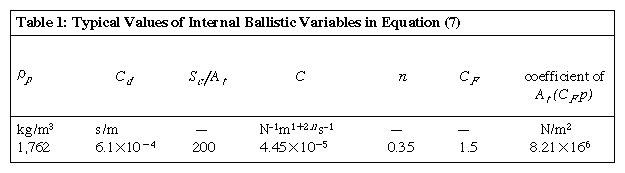
Math doesn’t lie. Thrust isn’t just a feeling; It is a calculation derived from a specific technical equation. At the heart of this calculation is $C_F$, a coefficient that acts as a bridge between raw energy and physical motion.
This coefficient is not a fixed constant. This is a changing variable determined by the complex geometry of the nozzle, the specific thermochemical properties of the fuel and oxidizer, and to a lesser, but still significant extent, external ambient pressure. A rocket in the vacuum of space behaves differently than a rocket taking off from sea level because the external pressure changes the equation.
The figures are concrete. Concrete. You just can’t guess them.
The typical values of the quantities in this equation are standardized, allowing engineers to predict performance with high accuracy.
These typical values are documented in detailed reference tables. For anyone interested in how rocket nozzle design affects thrust, these tables provide the basics. They show the relationship between specific impulse, chamber pressure, and exit area ratios.
If you want to understand what factors most affect rocket efficiency, the answer is in this $C_F$ term. It’s not just about burning hotter. The goal is to expand the gas effectively with the help of a nozzle adapted to the conditions.
The geometry determines how the exhaust gases are accelerated. Thermochemistry determines how much energy is actually available. Depending on the height, the external pressure has a braking or strengthening effect.
This is the mechanics of take off. No magic. Just physics, quantified.
You want the rocket to fly fast. You also want it to not explode. These two goals are often in conflict with each other.
Engineers are under constant pressure to save weight. Every gram counts when you’re trying to escape Earth’s gravity. So they cut corners. They use thin walls. They rely on materials that are strong but expensive. Sometimes they use exotic alloys that cost more than the rest of the satellite. It’s a gamble. You trade safety for speed. You are betting that the math holds up.
But the stakes have changed.
In the past, a failed launch meant a financial setback. With manned missions and billion dollar commercial payloads, failure is unacceptable. The cost of losing a crew or a $1 billion asset isn’t just a line item. It’s a disaster. So the industry is slowly changing. They start prioritizing safety margins over minimum weight. They are willing to pay more for reliability.
This change is most evident in the way we build liquid-fueled rocket engines.
Rocket engines that use liquid fuel
These are the workhorses of space travel. They burn fuel and oxidizer to produce thrust. Simple idea, complex execution.
The engine mixes two liquids: fuel and oxidizer. They catch fire. The resulting hot gas comes out of the nozzle. This thrust sends the rocket upward. It sounds simple until you look at pressure chambers. Temperatures rise to thousands of degrees. The pressure is huge. Materials must withstand this without melting or cracking.
So back to weight.
In the past, engineers designed these components to the absolute limits of their strength. A little extra weight was considered wasted potential. If you could have made the tank wall 0.1 millimeter thinner and saved 5 kilos, you would have succeeded. You didn’t keep a safety buffer. You ran it red-line.
Why? Because mass is the enemy. Heavier rockets require more fuel. More fuel means more mass. It’s a vicious cycle. You can break it, you have to make everything lighter.
But now the calculation is different.
With commercial satellites costing hundreds of millions and manned missions putting lives at risk, the “just-in-case” margin is coming back. Engineers add mass. They use thicker walls. They prefer materials that have stood the test of time over materials that are lightweight but finicky.
That doesn’t mean they ignore the weight. This means they are no longer obsessed with saving every gram at the expense of reliability.
Result? Engines that are a little heavier and a little more expensive to make, but fail significantly less often.
Is that the right compromise? Maybe for a government agency launching a probe to Mars. For a company trying to undercut the competition on launch prices, maybe not. But when space increases and people and money are at stake, safety is no longer optional. It’s part of the design.
And it changes everything about how we look at liquid-fueled rocket engines.
Liquid-propellant systems work on a completely different principle than solid-fueled counterparts. Instead of a static fuel block, these engines carry fuel in external tanks. Most designs rely on a liquid oxidizer combined with a liquid fuel. Pumps move these substances from their respective storage tanks to the combustion chamber.
The pumps do the heavy lifting here. They raise the pressure considerably above the operating limit of the engine. This ensures that the propellants hit the injector in a way that ensures atomization and rapid mixing. You want them to blend instantly.
Why choose liquid over solid?
Liquid systems are not always the first choice, but they offer specific advantages that make them superior in many applications. The list of benefits is distinct.
First, they achieve higher effective exhaust velocities ($v_e$). Speed matters when trying to escape gravity. Second, they boast higher mass fractions. This means that a larger part of the vehicle’s weight comes from the actual fuel and not from inert structural parts. Third, and perhaps most practical, they offer control. You can throttle the operating level during the flight. Some models even allow stop and restart functions or emergency stops.
There is also a logistical advantage. Propellant loading can be delayed until shortly before launch. In solid-fuel rockets, the fuel is often cast and loaded months in advance, creating stability and safety risks. Liquid propellants remove that constraint.
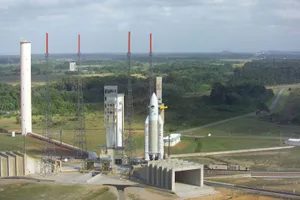
These properties promote the use of liquid systems in upper stage applications where high $v_e$ and high propellant mass fractions are critical. But they’re not just for orbit insertion. Liquid systems have been widely used as first stage launch vehicles in space missions. Think of the Saturn rockets from the USA, the Ariane series from Europe or Energia from the Soviet Union.
The debate about which is better for large launch vehicles continues. It’s not just about propulsion performance. This includes launch site logistics, capital and operating costs, and equipment recovery and reuse. It’s a complicated trade-off.
The Anatomy of a Liquid Engine
A typical liquid rocket propulsion system is a triad of components: an engine, fuel tanks, and a vehicle structure that holds everything together while connecting to the payload and launch pad.
Fuel and oxidizer tanks are typically designed to be very light. They operate at low pressure, so they don’t have to be thick-walled containers like in pressurized aircraft. However, in some applications the fuels are cryogenic. Substances such as liquid oxygen and liquid hydrogen are gaseous at ambient temperature. In order to keep them in a liquid state, they must be stored at very low temperatures. This adds a layer of complexity to the insulation and handling.
The engine itself is more intricate. It consists of a main chamber where the fuel and oxidizer mix and burn. The fore end holds the manifolds and injectors. The rear end has a supersonic nozzle that expands the hot gases to produce thrust.
The coolant jacket is integrated into this main chamber. Liquid propellant—usually the fuel— is circulated through it at high rates. This allows the engine to run continuously without the chamber melting from the heat of combustion. It’s a closed loop of survival.
The operating pressure of these engines is typically 1000-10000 kilopascals (10-100 atmospheres). The fuel is fed into the injector at an even higher pressure. High-capacity turbopumps handle this task. Typically there is one pump for the fuel and one for the oxidizer.
When you look at a liquid-propellant engine from the outside, you see a maze of pipes. This network connects the reservoirs to the pumps, transports the coolant to and from the cooling jackets, and delivers the pumped fluids to the injector. It looks chaotic, but every line has a purpose.
Finally, motors are usually mounted on a gimbal. This allows them to rotate a few degrees. Why? For controlling the thrust direction. Actuators connect the engine to the vehicle structure and hold and turn the engine to steer the rocket. Without this guidance mechanism, getting into orbit would be more luck than engineering.
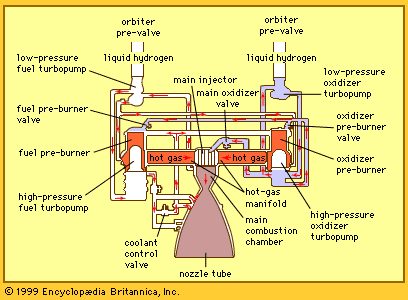
The Shuttle’s High-Performance Heart
The main engines of the U.S. space shuttle were not just powerful; they were engineering marvels designed to push the boundaries of what liquid-propellant rockets could do. Each engine burned liquid oxygen (LO2) and liquid hydrogen (LH2). These weren’t standard setups. They offered an exhaust velocity (Isp) of 3,630 meters per second. That is exceptionally high.
But speed wasn’t the only trick. The shuttle engines allowed for thrust-magnitude control ranging from 2 to 1. You could dial the power up or down significantly mid-flight. This flexibility mattered because the orbiter was winged and reusable. It carried crew and payload for up to 20 missions. The engine had to adapt to that workload.
The Simple Alternative: Hydrazine Thrusters
At the other end of the spectrum, complexity drops sharply. Consider hydrazine thrusters. These handle attitude control for conventional aircraft and unmanned spacecraft. They don’t need complex pumps. Instead, they use a valved pressure vessel.
Here is how it works. A single propellant—hydrazine—flows through a catalyst bed. The catalyst triggers an exothermic decomposition. The chemical reaction releases heat. This turns the liquid into hot gas. The gas shoots out of a nozzle. The nozzle is oriented precisely to correct the vehicle’s attitude.
These simple systems are also used as gas generators. They power the turbopumps on larger rockets. Simplicity here ensures reliability when the big engines need fuel pressure.
Balancing Performance and Practicality
Most liquid-propellant rockets rely on bipropellant systems. An oxidizer and a fuel are stored in separate tanks. They mix only in the combustion chamber. Choosing which chemicals to use is a balancing act.
Engineers look for specific properties. High exhaust velocity requires low molecular mass and high reaction temperatures. High density reduces tank weight. Low hazard factors mean less corrosion and toxicity. Environmental impact matters. Cost is always a factor. Trade-offs dictate the final choice.
Why Liquid Oxygen Is Common
Liquid oxygen is widely used because it checks many boxes. It provides high flame temperatures and low molecular mass. It is reasonably dense. It is relatively inexpensive.
There is a catch. Liquid oxygen must be kept below −183 °C (−297 °F). It cannot stay liquid at room temperature. This limits its availability. You cannot load it into tanks weeks in advance. It must be loaded shortly before launch. If a launch is delayed, the tank can be replenished or drained.
The Hazards of Better Oxidizers
Some oxidizers are technically superior. Liquid fluorine and ozone offer better performance in some respects. But they come with high hazards. They are more expensive. The corrosivity, toxicity, and hazardous nature of fluorine and ozone have prevented their use in operational systems. The low temperatures required for all these cryogenic systems also demand special design for pumps and components.
Storable Propellants for Ballistic Missiles
Not all oxidizers need to be cryogenic. Nitric acid (HNO3), hydrogen peroxide (H2O2), and nitrogen tetroxide (N2O4) are liquids at ambient conditions. They are storable.
These chemicals can be toxic or noxious. They are useful when a rocket must remain ready to fire for extended periods. Long-range ballistic missiles need this capability. They cannot wait for liquid oxygen to be loaded at the last minute.
Fuel Choices: Speed vs. Density
Liquid hydrogen is often the best fuel for high exhaust velocity. It burns clean and fast. It might be used exclusively if not for two problems. It is cryogenic. Its density is very low.
Low density means larger, heavier tanks. That adds weight to the rocket. Engineers often prefer hydrocarbon fuels like alcohol or kerosene. They are liquid under ambient conditions. They are denser than liquid hydrogen. They are also more “concentrated” fuels. Each molecule contains more fuel atoms.
The decision comes down to exhaust velocity. This value is determined by the interplay between flame temperatures and the molecular mass of the reaction products. You can have high speed with high density, or high speed with low density. You rarely get both without compromise. The choice depends on where the rocket is going.
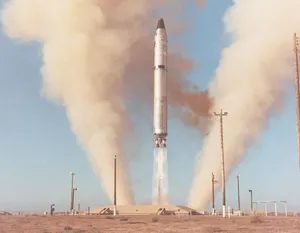
The choice of propellant isn’t just a technical detail; it dictates how a rocket flies, where it can go, and how quickly it must react. In practice, engineers have settled on specific combinations based on mission profiles. For the heavy lifting of ground-to-low-Earth-orbit flights, cryogenic systems dominate. Liquid oxygen is the oxidizer of choice. The fuel varies by stage. First stages often use hydrocarbons. Second stages frequently switch to liquid hydrogen for higher efficiency.
But speed matters, too. Intercontinental ballistic missiles (ICBMs) cannot wait hours for fuels to be loaded. They sit on launch pads, ready to strike, using noncryogenic “storable” propellants. These chemicals remain liquid at room temperature. A common mix is nitrogen tetroxide as the oxidizer paired with hydrazine or unsymmetrical dimethylhydrazine (UDMH). This same storable logic applies to long-duration missions like the Space Shuttle’s Orbital Maneuvering System and the Apollo Lunar Module.
Why Liquid Beats Solid for Control
Solid motors are reliable. They are simple. But they burn until they run out of fuel. There is no off switch. For missions requiring precise orbital adjustments, stop-start capability, or variable thrust, liquid systems are superior. They allow for throttling. They allow for shutdown and restart. This flexibility is why liquid propellants remain the backbone of complex spaceflight, despite the storage challenges they present.
Propellant Pairings in Major Vehicles
The following breakdown shows how these choices map onto famous vehicles. Note the shift between storable and cryogenic fuels depending on the stage or mission type.
| Rocket | Stage | Oxidizer | Fuel |
|---|---|---|---|
| German V-2 | All | Liquid oxygen | Ethyl alcohol–water (75%–25%) |
| Atlas ICBM | All | Liquid oxygen | RP-1 (kerosene) |
| Delta | First stage | Liquid oxygen | RP-1 (kerosene) |
| Delta | Second stage | Nitrogen tetroxide | Hydrazine-UDMH (50%–50%) |
| Saturn | First stage | Liquid oxygen | RP-1 (kerosene) |
| Saturn | Second stage | Liquid oxygen | Liquid hydrogen |
| Saturn | Third stage | Liquid oxygen | Liquid hydrogen |
| Apollo Lunar Module | All | Nitrogen tetroxide | Hydrazine-UDMH (50%–50%) |
| Space Shuttle | Main engines | Liquid oxygen | Liquid hydrogen |
| Space Shuttle | Orbital Maneuvering System | Nitrogen tetroxide | Monomethyl hydrazine |
| Ariane 4 | First stage | Nitrogen tetroxide | UDMH |
| Energia | Core | Liquid oxygen | Liquid hydrogen |
| Energia | Cluster | Liquid oxygen | Kerosene |
Electric Propulsion: The Low-Thrust Alternative
Not all rockets rely on combustion. Other systems use energy sources independent of the propellant fluid. These offer promise for specific missions, particularly those where fuel mass is a premium.
In electrically heated systems, the propellant is pressurized and heated before being accelerated through a nozzle. In ion and Hall thrusters, electromagnetic fields accelerate the propellant without a traditional nozzle. This requires the fluid to be electrically charged. The energy source can be nuclear, solar, or even beamed energy from a distant station.
However, these systems are not for everyone. Onboard energy sources generally lack the power for high-thrust missions. You cannot use an ion thruster to escape Earth’s gravity well directly. But for interplanetary flights, sustained low thrust is a game-changer. It saves massive amounts of propellant over time. The strategy involves using chemical rockets to reach Earth orbit, then switching to electric propulsion for the long haul.
Low-thrust electric systems are also ideal for manned space stations. They provide fine control over orbit and attitude without the violent shudders of chemical burns. Some proposals even suggest recycling human waste, heating it electrically using existing station power, and using it as propellant. It sounds extreme, but in the vacuum of space, every gram counts.
The Long Road to Modern Rockets
Rocket technology didn’t appear out of nowhere. It traces back to Asia between 1200 and 1300 CE. The “propellant” was black powder—a mix of saltpetre, sulfur, and charcoal. This mixture had been used for about a millennium in fireworks and other non-military applications before being weaponized.
As with many technologies, the military was the primary driver. Early rockets served as bombardment weapons. Their performance improved over centuries, culminating in the Congreve rockets of the early 1800s. Named after William Congreve, a British officer who refined their design, these were the most effective early examples.
Yet, by modern standards, they were terrible. Black powder is inefficient for propulsion. It produces low exhaust velocities and leaves significant residue. After 1815, military interest waned. Artillery guns offered better range, accuracy, and reliability. Rockets disappeared from the battlefield for nearly a century, waiting for better propellants and a new purpose.
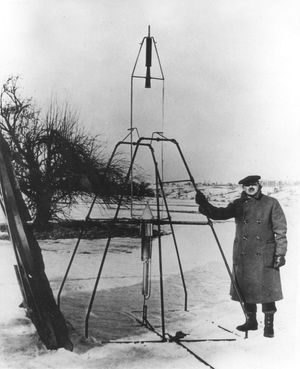
The dream of leaving Earth did not come out of nowhere in the middle of the 20th century. Between 1880 and 1930, the idea of using rockets for space travel moved from pulp literature to serious scientific research. It started with the spark of writers like Jules Verne, whose imaginative stories piqued the public’s curiosity. But curiosity alone does not build engines. It requires scientists willing to stare at math until it breaks.
Enter Konstantin E. Tsiolkovsky, a Russian thinker who worked in relative isolation. He wasn’t just dreaming; he solved the theoretical problems of propulsion and rocket motion. His ideas on multi-stage rockets were revolutionary, presenting the logic of how to escape Earth’s gravity with the right fuel and structure.
Then there was Robert H. Goddard. An American inventor who spent 37 years, from 1908 to 1945, turning theory into hardware. Goddard independently drew similar conclusions to Tsiolkovsky, but did not stop at the paper. He built them. His work involved both solid and liquid propellants, which was very important for control and efficiency.
The real breakthrough came in 1926.
Goddard launched the world’s first liquid-fueled rocket. It was small, barely audible, and flew for only 2.5 seconds, reaching a height of about 12.5 meters. To the untrained eye, it was a failure. To history, it was the moment when the modern rocket was born. His tireless design and theory experiments earned him the title “Father of Modern Rocketry”. Without his practical work, the leap from concept to launch vehicle would have stopped.
But the story was not just American or Russian. The German Hermann Oberth developed much of the same modern theory of space travel completely independently. He was not just an ivory tower theorist; He inspired a generation of visionaries. More importantly, he developed the practical application of rocket propulsion. His work helped lay the foundation for the rapid development of rocket technology in Germany in the 1930s, transforming the continent from passive observers to active producers of the very machines that defined the Cold War era.
These three men—Tsiolkovsky, Goddard, and Oberth—worked in isolation, but agreed on the same truths. They proved that space travel was not magic. It was engineering. And in 1930, the blueprint was ready. The rest was just waiting for the war to start.
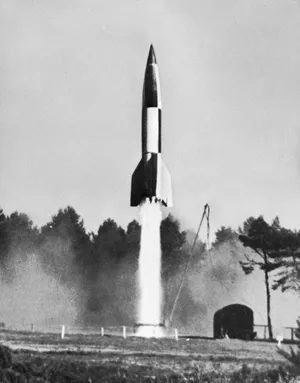
The Wartime Leap: From Theory to V-2
Before World War II, the concept of rocket propulsion was more of a vague potential than a practical reality. Early pioneers had sketched the ideas, but technical barriers kept them grounded. Then came the late 1930s, and the war years accelerated everything. Suddenly, the stakes were high, and the engineering had to keep up.
Germany led the charge. The V-2 liquid-propellant rocket became the era’s most notable achievement. It wasn’t just a weapon; it was a proof of concept for liquid fuel systems. The Me-163 rocket-powered airplane also emerged, showing that rockets could fly faster than any piston engine. Other countries were experimenting, sure, but these German designs were the only ones that saw actual combat service.
The sheer volume of firepower was staggering. Tens of millions of solid-propellant rockets were fired by German, British, and U.S. forces. These weren’t just for space exploration. They were bombards, interceptors, antitank weapons, and air-launched munitions. The focus was entirely on tactical advantage.
How Liquid Engines Survived the Fire
What actually changed the game wasn’t just the idea of a rocket. It was the hardware that made it work. For liquid-propellant engines, the breakthroughs were in the details. Engineers developed pumps that could feed fuel at the right pressure. They designed injectors that mixed propellants efficiently. They created cooling systems that kept the engine from melting under its own thrust.
For solid propellants, the challenge was consistency. You couldn’t just mix powder and hope for the best. Manufacturers needed high-energy compounds that could be cast into large, solid blocks. These blocks had to burn reliably, from the first second to the last. If the burn pattern was erratic, the rocket would tumble. If the propellant was too weak, it wouldn’t lift. The war forced rapid advances in casting methods, insulation materials, and structural integrity for both engine types.
The Post-War Military Pivot (1945–1955)
When the war ended in 1945, the momentum didn’t stop. It just changed direction. From 1945 to 1955, propulsion development remained tightly bound to military needs. The dream of spaceflight was there, lurking in the background. But the money went to the Pentagon, not the launch pad.
Liquid-propellant engines were refined for new roles. They powered supersonic research aircraft, pushing the boundaries of speed. They became the core of intercontinental ballistic missiles (ICBMs), a terrifying new strategic capability. They also fueled high-altitude research rockets, which could peek above the atmosphere.
Solid-propellant motors followed a similar path. They were critical for tactical applications where speed of launch and simplicity mattered. Think of air-to-air missiles or surface-to-air batteries. The technology improved in tandem. New structural materials allowed for larger motors. Manufacturing methods scaled up, making production faster and more consistent. Peripheral hardware like valves and direction controls became more precise.
Why Guidance Changed Everything
By 1955, rockets were getting bigger. And with size came complexity. A small rocket could fly straight by luck. A large, heavy rocket needed help.
Guidance systems became standard. You couldn’t afford for an ICBM to miss its target by miles. Two-stage rockets became the norm for missions requiring altitude or range. The first stage provided the initial boost. The second stage refined the trajectory. This multi-stage approach was a direct response to the physics of mass and fuel.
Financial resources were still directed toward military applications. The potential for spaceflight was contemplated, yes. But it was a secondary thought
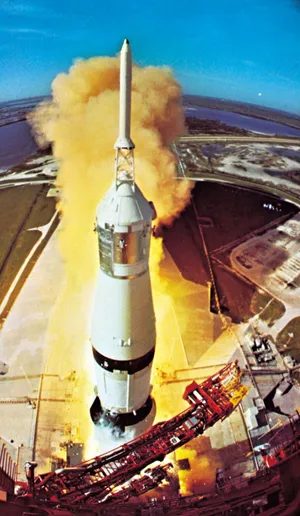
The 1960s changed everything in rocket technology due to the urgency of the Cold War, which placed readiness above all else. Large solid rocket motors were the answer. ICBMs had to sit on their launch pads fully fueled and launch within minutes. The liquid rockets stalled, leaked, froze, or required an hour of preparation. Solid motors didn’t care about time. They were ready.
This requirement forced engineers to innovate quickly. They needed stronger cases to withstand the pressure. They needed fuels that burn hotter and faster. They needed insulation that would not crack even after years of storage. They needed ways to steer the thrust. These upgrades weren’t just for the military. They spread to space travel.
In the years 1955-1965, the dream of circumnavigating the globe came true. Satellites appeared. Men flew. But early space travel depended on liquid systems. These were often militarized missiles adapted for civilian use. They were complicated. They were picky. They worked.
The Saturn V changed the playbook. It was the first large “purely civilian” launch vehicle built for the Apollo Moon landing program. The first stage used five massive F-1 engines. Each produced 7,740 kilonewtons of thrust – that’s about 1.7 million pounds per engine. Five of them. All burning liquid hydrogen and oxygen. It was a brutal approach to escaping gravity.
Since then, liquid engines have dominated. Most countries use them for orbital placement. But look at the boosters. Titan 34D. Delta. Space shuttle. They all attached solid fuel rockets to their sides. Why?
Simply. Simplicity of operation trumps pure efficiency in many scenarios.
Fluid motors are precise. They can be throttled. They can be turned off and on again. However, they require fuel tanks, turbo pumps and cryogenic cooling. Solid fuel engines are boxes that contain fuel. You light them. They will burn until the box is empty. That’s it.
The inferior performance of a solid propulsion engine is a known drawback. They do not have the specific impulse of high-end liquid engines. But when moving from low Earth orbit to geosynchronous orbit, this inefficiency is acceptable. The devices are cheaper. launch preparation are faster. The risk of the tank breaking is considerably reduced.
We still use them because they work. The technology evolved from a military need into a reliable workhorse. The same insulating materials designed to survive decades on a missile rack now ensure that the satellite reaches its final parking orbit without incident.
It’s not the most efficient way. It’s about the most reliable.
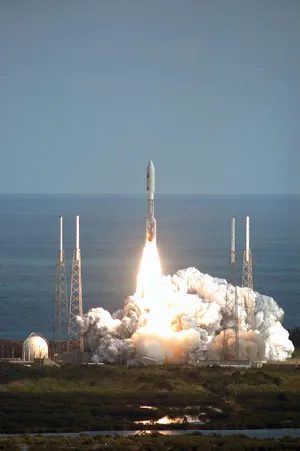

High-stakes technology of modern propulsion
Since 1965, space missions have been heavily dependent on a rapidly growing technology base. The change wasn’t just about going further. It’s about being smarter. Engineers now use better fuels and structural materials that are lighter but stronger. The models themselves have evolved to withstand more stress and efficiency.
Today’s missions rarely rely on a single engine type. Instead, they combine multiple engines. Each is selected for a specific function. Some handle the initial launch. Others adjust the orbit. Some provide the final push towards a goal. This modular approach allows for greater flexibility.
Driving systems are reaching their safe limits. Why? Because energetic fuels offer significant performance benefits. Low structural mass is equally important. Every kilo saved increases the range. Each bit of energy gained improves speed. But pushing systems to the edge comes with risks.
Reliability is the biggest challenge. The payload determines the stakes. If the payload is an expensive device, the failure will be expensive. If the payload is a human, failure is fatal. It is not easy to ensure that systems work perfectly in extreme conditions. It requires careful planning and rigorous testing.
Environmental sustainability has also become an important issue. The old fuels were toxic. They left harmful residues in the atmosphere and at launch sites. Modern missions are increasingly aware of these influences. We aim for cleaner fuels. This reduces the ecological footprint of space travel.
The tension is clear. We want maximum performance. We also want minimal risk. And now we want as little environmental damage as possible. Balancing these competing demands defines the current era of space travel. It’s not just about reaching for the stars. It’s about leaving them better than we found them. Or at least not make them worse.
How do you optimize a system that is running on the brink of failure? You don’t guess. You test. You iterate. You accept that some risks can be calculated. Others are not. Technology is advancing. Requirements change. The goal remains the same. Get there. Come back. Don’t break anything.