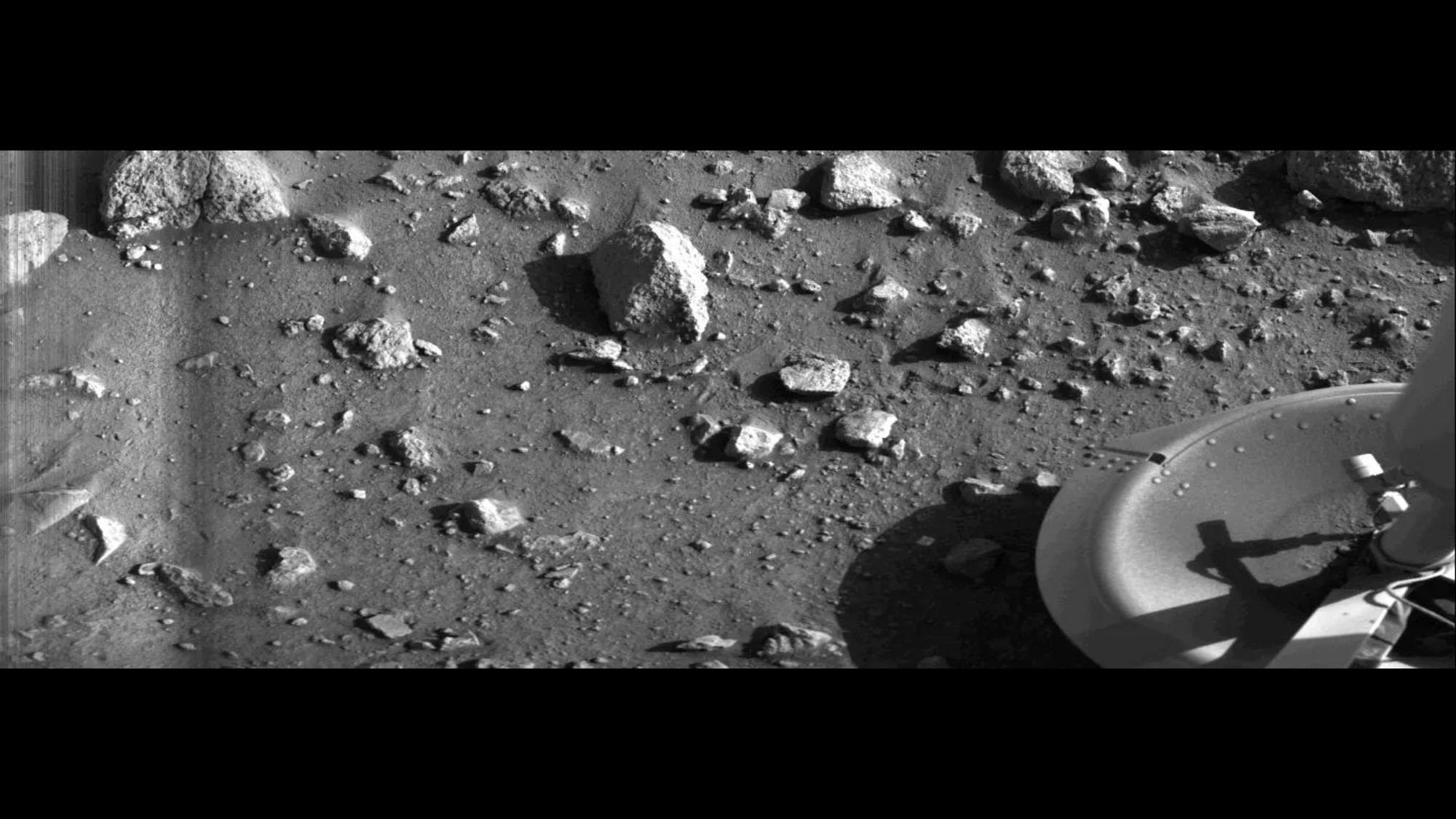
You are staring at history. It looks like a mundane grayscale shot of gravel and rocks. Don’t let the simplicity fool you. This is the very first photograph ever transmitted from the surface of Mars.
On July 20, 1919, wait — let’s get the date right. It was July 20, 1976. Just after dawn, NASA’s Viking 1 lander kissed the Red Planet. Half a century later, this image remains the definitive moment humanity truly touched Mars. The moment the wheels settled into the dust, the camera clicked. We stopped guessing. We started knowing.
How the First Martian Surface Image Changed Everything
The Soviets had been trying. Hard. Their Mars 3 lander touched down in December 1971. It survived the initial impact. Then, after less than two minutes, static ate the feed. Total signal loss. A ghost in the machine.
Viking 1 wasn’t so lucky? No. It was better. It stayed alive. The mission profile called for a 90-day study window. Instead, the lander kept working for over six years. That’s not just survival; that’s endurance.
Viking 1 didn’t work alone. It flew in formation with an orbiter, their data streams crossing and complementing each other in the thin Martian atmosphere. Soon, Viking 2 arrived to join the party, another lander and orbiter pair expanding our footprint. But it was the first one, the original pixelated view, that broke the silence.
Why the July 20 1976 Mars Photo Matters
Before this shot, Mars was a canvas for our own projections. Ray Bradbury wrote “The Martian Chronicles,” painting a world of canals, war, and romantic decay. Science fiction filled the gaps because reality was just red dust and bad radiation data from orbiting probes. We couldn’t see it.
Viking 1 showed us the ground truth. It was stark. Barren. Rocky.
No canals. No green men. Just geology.
This first close-up look at the Martian surface shifted the paradigm. It moved us from myth to measurement. The Soviets had failed. The Americans had succeeded. But more importantly, the unknown became known.
What We’ve Learned Since 1976
Fifty years have passed since that first grainy transmission. NASA’s technology has leaped from vacuum tubes and punch cards to rovers that drive for miles and analyze soil chemistry in real-time. Curiosity, Perseverance, Spirit, Opportunity — they’ve all scoured the terrain we first glimpsed in that 1976 black-and-white frame.
We have decades of surface data now. We know about the water ice. The ancient riverbeds. The perchlorates that make the soil toxic to most life forms as we know them.
But that first image holds a specific weight. It was the moment the abstraction ended. It wasn’t a prediction. It wasn’t a theory. It was a record.
The Legacy of Viking 1
Why does a 400-kilobyte file from 1976 still matter?
Because it was the threshold. Before Viking 1, Mars was a destination we talked about in books and treaties. After Viking 1, it was a place we had walked on. The rovers that follow built upon the confidence generated by that initial success. If Viking 1 had failed like Mars 3, the narrative might have shifted toward caution rather than momentum.
Instead, we got six years of data. We got the