Spotting a big cat across the savannah is thrilling. It’s also confusing. To the untrained eye, a spotted feline is a spotted feline. The debate over the cheetah vs leopard identification is common among wildlife enthusiasts who want to know exactly which creature they are looking at.
They are not the same.
At a glance, their coats might blend into the same golden canvas. But look closer. The differences are stark. They are defined by physical attributes, behavioral patterns, and evolutionary histories that place them in entirely different ecological niches.
Distinctive Coat Patterns and Camouflage
The fur is the first clue. While both animals wear spots, the patterns serve different masters.
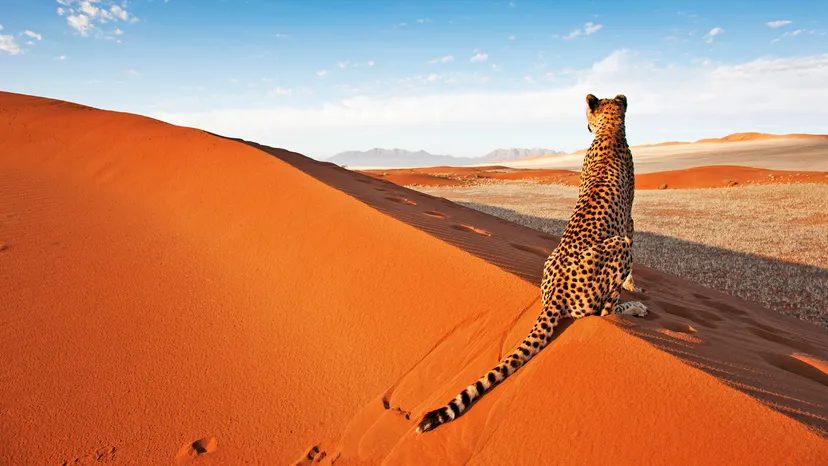
Cheetahs display solid, round black spots. These are scattered uniformly across a light tan or deep gold coat. This isn’t just aesthetic. It is a camouflage mechanism optimized for speed. In tall grass, the uniform dots break up the outline of a sprinting predator.
Leopards wear something more complex. Their coats feature rosettes. These are rose-like markings with darker edges and lighter centers—or sometimes hollow centers. This intricate pattern offers exceptional disguise in dense foliage. It breaks up the body shape in ways solid spots cannot.
“Cheetah spots are designed for open plains. Leopard rosettes are designed for dense cover.”
Facial Features and Head Shape
Facial structure reveals hunting strategy.
Cheetahs have small, well-rounded heads. This shape is aerodynamic. It helps them cut through the air while chasing prey. Their most distinctive feature is the black tear line. These markings run from the inner corners of their eyes down to the sides of their mouth. They are not just for show. They reduce sun glare. This allows cheetahs to hunt during the day with clear vision. Their eyes are amber, reflecting their diurnal habits.
Leopards have elongated heads. This accommodates powerful jaw muscles. These muscles are essential for their ambush style. They do not have tear marks. Instead, their faces continue the rosette pattern of their bodies. This maintains their overall camouflage. Their eyes often gleam with a green-blue hue. This reflects adaptability to both day and night environments.
Body Structure: Agility Versus Power
Size and shape dictate function.
Cheetahs are slender. They are the fastest land animals for a reason. Their streamlined bodies, long legs, and flexible spines allow for breathtaking acceleration. They are smaller and more lightweight than leopards. They prioritize agility over brute strength.
Leopards are robust. Their bodies are muscular and sturdy. This build is designed for power and stealth. It allows them to move silently. It lets them pounce with precision. It also enables them to drag heavy prey up into trees. This behavior avoids scavengers.
Claws and Grip
The paws tell another story.
Cheetahs have semi-retractable claws. These claws remain exposed. They act like cleats on a running shoe. This provides extra grip during high-speed pursuits. The sharp claws, combined with unique pad structures on their back feet, offer stability for swift turns. Every stride is maximized for acceleration.
Leopards have fully retractable claws. These claws stay sheathed until needed. This keeps them sharp. It also allows leopards to move silently. Silence is a necessity for ambush hunting. It also aids in climbing.
Tail Function and Balance
Both animals have long tails. They use them differently.
Cheetah tails are exceptionally long and slender. They act like a rudder. This helps the cheetah maintain balance and make sharp turns at high speeds. Changing direction swiftly is crucial for their hunting technique.
Leopard tails are muscular. They provide balance too. But leopards use them more when navigating complex terrains. This includes climbing trees or balancing on branches.
Why It Matters
Knowing the difference is not just about trivia. It is about understanding survival. The cheetah is a specialist built for the open chase. The leopard is a generalist built for stealth and strength.
Which one do you think holds the advantage in a direct confrontation? The answer might surprise you. But for now, just remember the spots. Solid dots mean speed. Rosettes mean power.
Speed as a Survival Trait
If the title of fastest land animal ever belonged to the cheetah, it is because of physics, anatomy, and sheer desperation. The leopard simply does not play that game. The cheetah is built for velocity, not power. Its elongated legs and lightweight frame are evolutionary compromises designed for one thing: closing distance in seconds.
They hit 70 miles per hour. That is 112 kilometers per hour. In bursts. For about 1,500 feet, or 460 meters. After that? Exhaustion sets in.
This specific adaptation relies on a flexible spine that acts like a spring, lengthening the stride with every leap. Large lungs and a massive heart pump oxygen into blood that is already racing. It is a high-stakes gamble. If the chase drags on, the cheetah dies of heatstroke or starves. The leopard, by contrast, is a tank wrapped in fur. It can sprint, sure. But its real advantage is stealth and brute force. It does not need to outrun you. It just needs to catch you off guard.
The Hunt: Daylight vs. Darkness
Time of day changes everything. Cheethahs are diurnal. They hunt when the sun is up, usually in the early morning or late afternoon when the heat is bearable but visibility is good. Why? Because their night vision is actually quite poor. They rely on sight to spot movement across the open plains. They are visual hunters. They see a gazelle. They run. They hope they are faster.
There is no long stalk for the cheetah. Stalking takes energy. It takes time. And time is their enemy. They use a swift approach to minimize expenditure, engaging in explosive chases to catch smaller to medium-sized prey before lions or hyenas can intervene. If you give the cheetah a head start, you are safe.
Leopards do not have this constraint. They are nocturnal by preference, though they can hunt by day if necessary. Their secret weapon is darkness. With superior night vision, they move through dense cover or under the cover of night. They use a “stalk and pounce” method. They get close. They hide in plain sight using their rosette-patterned coats.
“The leopard’s strategy is patience. The cheetah’s strategy is panic.”
Once in range, the leopard strikes with power. They take down larger prey, animals a cheetah would never attempt. And because they are strong, they drag their kill up into trees. This is not just for eating later. It is to keep the meal away from scavengers. Lions cannot climb. Hyenas cannot climb. The leopard eats in peace.
Habitat and Social Structures
Where they live dictates how they survive. Cheetahs need space. Vast, open savannahs and grasslands. They are found in parts of Africa and Iran, but their need for clear lines of sight makes them vulnerable. Habitat loss is not just a threat; it is a death sentence. Without open ground, their speed is useless.
Socially, they are weirdly cooperative. While females are solitary, males often form coalitions. They stick together. It increases their chances of defending territory and surviving. It is a rare move in the cat family.
Leopards are the ultimate survivors. They are independent, solitary, and territorial. They do not care if you are in a forest, a mountain, a desert, or a grassland. They are everywhere. From sub-Saharan Africa to India and China, the leopard adapts.
Their versatility is their armor. They thrive in dense forests where a cheetah would be blind. They survive in arid deserts where water is scarce. They overlap ranges with other predators, but they rarely compete directly because they operate in different niches.
But adaptability has its limits. When resources dwindle, leopards push into human territories. They compete with locals for food. They become pests, then threats. The cheetah avoids humans by avoiding open spaces. The leopard walks right up to the edge of civilization, eyes glowing in the dark, wondering if the fence will hold.
The Brutal Math of Survival
Gestation for these apex predators is a tight window. Cheetahs clock in at 90 to 95 days. Leopards take a bit longer, roughly 90 to 105 days. The result is similar, though. Each female drops a litter of three to five cubs. It’s a high-stakes game from day one.
Cheetah cubs don’t stand a chance if their mother isn’t on high alert. Mortality rates are brutal. Predators are everywhere. She has to hide them. She has to keep them quiet. They are weaned between three and six months. But they don’t leave. They stay with mom for a year and a half to two years. That’s not just hanging out. It’s boot camp. They are learning how to survive in a world that wants them dead.
Leopards take a different approach to the early danger. By three months, cubs are eating solid food. They are also climbing trees almost immediately. This isn’t just a party trick. It’s armor. Trees protect them from other predators. It shows how adaptable they are to different environments.
Teaching the Next Generation
The mother leopard is the instructor. She teaches her cubs how to hunt. When the cubs are 18 to 24 months old, the lesson ends. She kicks them out. They go solitary. It’s the same timeline cheetahs follow. Independence is forced upon them. There is no middle ground.
Life expectancy varies. In the wild, cheetahs last 10 to 12 years. Leopards can push that to 12 to 15 years. Some hit 17. Why the difference? Environmental pressure. Social structure. Survival strategy. The early years are the filter. Only those who learned the right skills make it to adulthood. The mother’s role is the gatekeeper for the next generation.
Did you know cheetahs are the only big cats that can’t roar? (Snow leopards can’t either, but they are technically clouded leopards in the Panthera sense, so this is a unique cheetah trait). They don’t have the hyoid bone structure for it. Instead they purr. They chirp. They hiss. It’s a distinctive sound for an animal defined by speed.