More than 20,000 species of wasps are known. They are everywhere. Some are huge. Some are small. Their colors vary from bold black and yellow to metallic blue or muted brown. Their lifestyles are equally different. Solitary hunters live alone. Others build huge social settlements. But despite this diversity, the basic plan remains the same.
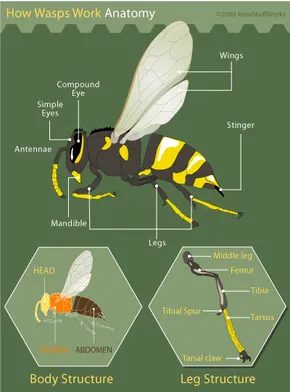
Like all insects, wasps are built on a rigid foundation. Their bodies are covered with a hard exoskeleton made of chitin. This skeleton is divided into three different parts.
Head: Sensory command center
The head is where the action begins. It has a pair of antennae. These are the primary sense organs. They detect smells and vibrations.
The mouth part is specialized for biting and licking. This allows wasps to eat both solid and liquid food. Vision is controlled by two types of eyes. First up is compound eyes. These are kidney-shaped and offer a wide field of vision. Second, there is the Ocelli. These are simple eyes. They detect light intensity.
There is a small brain in the head. It handles basic tasks. But it is adaptive. In certain species, certain brain regions expand when the wasp faces complex challenges. This suggests a level of cognitive flexibility that is rare in insects.
Chest: strength and movement
The middle part is the chest. It’s the engine room. It has six spindly legs. It also has a pair of fast, membrane-like wings.
These structures are not just for show. In many species, the legs and wings are strong enough to carry a paralyzed victim. A wasp can lift prey heavier than itself. This strength is essential for hunting.
Abdomen: organs and weapons
The abdomen contains most of the internal organ systems. It has a digestive tract and reproductive organs. In female wasps it also contains a lethal stinger.
The Stinger has been modified for self-defense. It is also used for hunting. It injects venom into its prey or threats. This makes the wasp an effective predator.
A killing machine designed for another world
Together, these three segments create a highly effective killing machine. However, this body plan did not evolve for modern gardens. It evolved before flowers existed.
To understand this anatomy, you have to look back. The structure of the wasp is a solution to problems that existed millions of years ago. It is a design that has been refined over time.
The wasp’s body is a marvel of evolutionary engineering, optimized to survive in a nectar-free world.
This old model still works. But it has limitations. Can a creature created for a flowerless world adapt to a world full of flowers? The answer lies in the way wasps eat. And this is where the story gets interestinger.
Ten million years ago, the world was a very different place. We are talking about the Cretaceous period. No flowers. No colorful flowers. Just green, evergreen monotony dominated by conifers. These plants relied on the wind to move their genetic material. It was a silent, inefficient system.
There were insects everywhere. Ants rushed. The wasps buzzed. Both belonged to the order Hymenoptera. It was a dog-eat-dog world. Everyone was hunting. Everyone was hungry.
Then plants changed the game.
Flowering plants or angiosperms began to appear. They needed a way to transport pollen from the male parts (the anthers) to the female parts (the stigmas). The wind couldn’t take it anymore. They needed something faster. Something with legs.
So they bribed the insects.
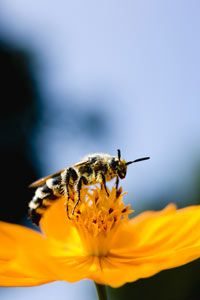
This is where the story of wasp and plant co-evolution gets interesting. The plants offered one offering: nectar. Sweet, sugary energy. In return, the wasps transport the pollen. It was a primitive form of pollination. Wasps got a free meal. Plant genes were distributed across the landscape.
Most of the wasps took the bait. They switched from a strict carnivorous diet to a nectar-rich lifestyle. Think of it as a vegan parent forcing their child to eat pepperoni pizza. Adults were allowed to sip nectar all day. But larvae? They needed protein. They needed meat. So the wasps had to continue hunting spiders and caterpillars for their young. It was a double existence. A split personality.
This biological arrangement explains much about modern wasps. Why are they so aggressive? Why do they sting?
Predator’s Body
Look at the wasp. Really look at it.
It doesn’t look like a bee. Bees are fluffy. They are built to collect pollen. Their bodies are covered in bristles that act as static magnets for pollen grains. They are collectors. They are busy.
Wasps are streamlined. Slim. Narrow waist. Long legs. They look like predators. And they are.
Their anatomy reflects their history. They have not evolved into gentle gardeners. They have evolved to hunt. The nectar diet was a bonus, not a lifestyle change. They are still hunters at heart. That’s why they have such a strong sting. It’s not just a defense mechanism. It’s a tool. A weapon honed by over 100 million years of hunting.
Bees give up some of this margin for pollination. They become hairier. More slowly. Focuses more on flowers. The wasps kept their sharpness. They kept the sting.
This is why you see a wasp buzzing around a picnic. It’s not just about the sugar. It’s looking for meat. For its kids. For the next generation. The nectar keeps them alive. Protein keeps the species alive.
It’s a compromise. Evolutionary compromise. Plants have their pollinators. The wasps got a free lunch. But wasps have never forgotten where their roots are. They never became bees. They remained wasps.
And that’s important. Because without that old agreement, the flowers we see today might not exist. Without wasps, the angiosperm revolution might have stalled. The world would still be green. But that would be boring. Quiet. Wind-blown.
Instead we have color. We have fruit. We have diversity.
We have wasps.
They are