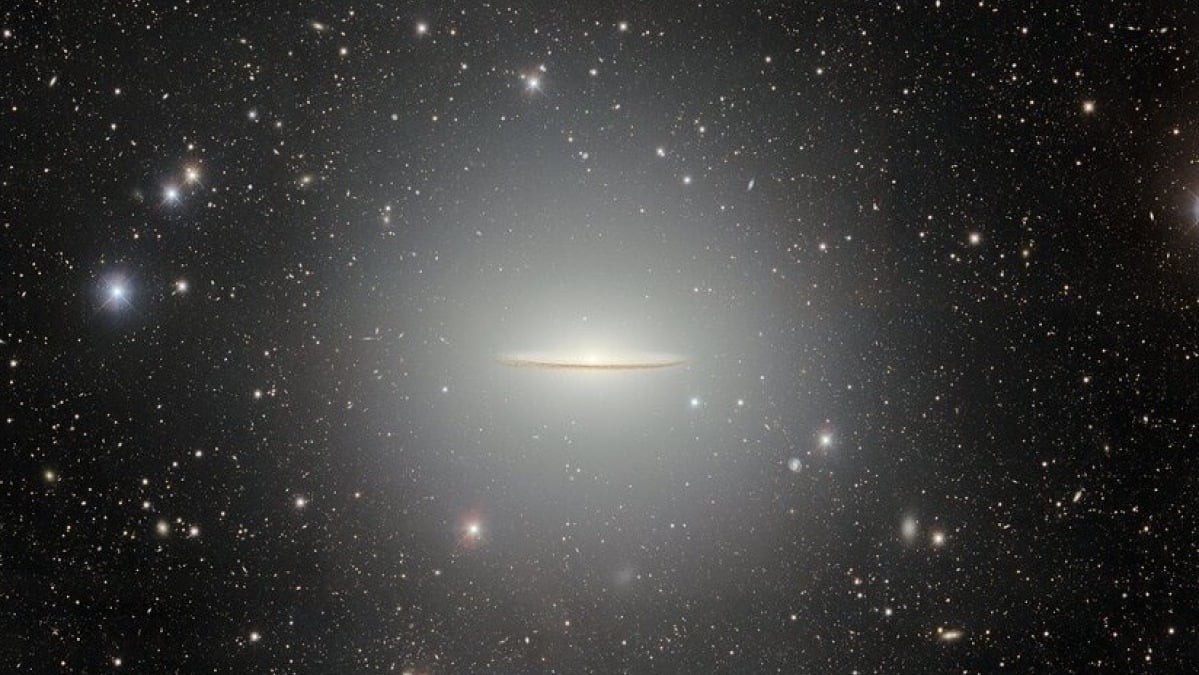
New observations from the Cerro Tololo Inter-American Observatory in Chile have unveiled a striking feature of the Sombrero Galaxy (M104) : a colossal, glowing halo that extends far beyond its iconic shape. This expansive structure is roughly 150,000 light-years wide, stretching three times the width of the galaxy itself.
A Cosmic Scale Unveiled
The images were captured using the Dark Energy Camera, an instrument attached to the Victor M. Blanco 4-meter Telescope. Although the camera was originally commissioned for a specific study that concluded in 2019, it remains a vital tool for astronomers, offering unprecedented detail of well-known cosmic landmarks.
According to NOIRLab, a program of the National Science Foundation, these images may represent the first time this halo has been captured with such high resolution and on such a vast scale.
The Mystery of the Halo: Evidence of Galactic Cannibalism
The discovery of this massive halo and a faint, vast “stellar stream” emerging from the galaxy’s southern side provides more than just a beautiful view; it offers a window into the galaxy’s violent history.
Astronomers believe these structures are composed of stars that were once part of other, smaller galaxies.
– The Halo: A massive shroud of light surrounding the main body.
– The Stellar Stream: A trail of stars being pulled away or left behind.
“The halo and the stellar stream are populated with stars that have been torn from their home galaxies,” NOIRLab reports, “hinting at a past galactic merger between the Sombrero and a smaller satellite galaxy.”
This phenomenon, often referred to as galactic cannibalism, is a key driver in how galaxies grow and evolve over billions of years. By studying these “scars,” scientists can reconstruct how the Sombrero Galaxy reached its current massive size.
A Legacy of Observation
The Sombrero Galaxy has been a subject of fascination for centuries:
– 1781: Discovered by French comet hunter Pierre Méchain.
– 1921: Formally cataloged as Messier 104 after observations by William Herschel and Camille Flammarion.
– Modern Era: While the James Webb Space Telescope (JWST) recently provided infrared views that stripped away the dust to reveal a smooth core, these new optical images highlight the sheer scale of the galaxy’s outer reaches.
The galaxy earns its name from its unique appearance: a bright, central bulge resembling a crown, paired with a dark, thick dust lane that mimics the brim of a Mexican hat.
Why This Matters
Understanding the distribution of stars in the halo and the nature of the globular clusters—of which the Sombrero has approximately 2,000—helps astronomers map the distribution of mass and dark matter in the Virgo Galaxy Cluster. These findings contribute to our broader understanding of how large spiral galaxies interact with their neighbors to shape the structure of the universe.
Conclusion: The discovery of this massive, star-studded halo confirms that the Sombrero Galaxy is not an isolated system, but a survivor of ancient galactic collisions that continue to shape its structure today.