Three visitors. Only the third gave up its secrets.
We saw 1I/’Oumuamua back in 2017. Then 2I/Borisov arrived in 2019. They passed through our Solar System, silent and fast, leaving behind mysteries we couldn’t solve with the tools we had then. 3I/ATLAS changed the game. It was bright enough, active enough, for us to finally sniff its gases.
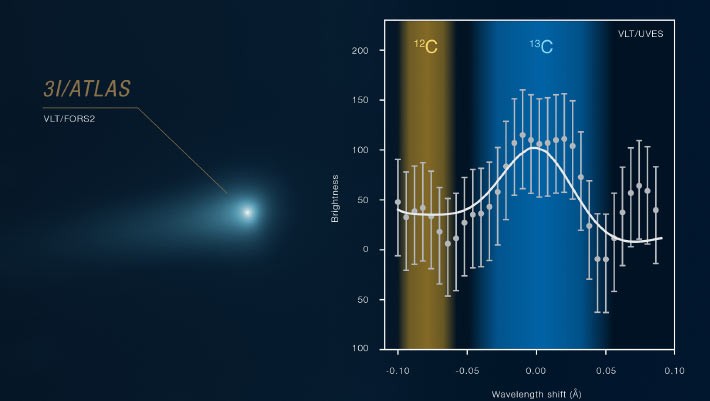
Astronomers at ESO’s Very Large Telescope got to work. They looked at cyanogen—a molecule common in cometary atmospheres—measured isotopes of carbon and nitrogen. The numbers tell a story about a place long dead and distant.
“Interstellar objects provide a rare opportunity to study material… that may have experienced very different physical conditions” — Dr. Cyrielle Opitam, University of Edinburgh
When these icy bodies get close to the Sun, they sublimate. The gases escape. We analyze the light. Isotopes are chemical fossils. Their ratios trace temperature, radiation, and age. From the prestellar cloud to the finished planetesimal, the chemistry leaves a trail.
Opitom and her team observed the comet in late December 2025. The closest approach to the Sun was over, but the coma was still leaking secrets. Using the UVES instrument, they found a carbon-12 to carbon-13 ratio of about 151. Nitrogen-14 to nitrogen-15? Roughly 363.
For context: our local comets sit around 90 for carbon and 150 for nitrogen.
The gap is stark. Why?
High nitrogen ratios usually mean the formation zone was cold and distant from the parent star. Isotope-selective chemistry doesn’t work well in the freezing dark of an outer disk. The result matches the local interstellar medium rather than processed solar material. The carbon ratio is equally high. Older, metal-poor stars produce planetary debris with exactly these signatures. Models of galactic chemical evolution predicted it. The comet confirmed it.
“3I/ATLAS is a … opportunity to probe … one that formed long before our Solar System” — Dr. Rosemary Dorsey
So we aren’t just looking at space junk. We are looking into the backyard of a star that formed when the Universe was young and hungry. A star with fewer heavy elements than our own. The comet came from its outskirts, where it stayed frozen until something knocked it loose.
The data suggests planetesimal formation can happen around such ancient stars. Efficient? Likely. But we can only guess the rest.
Where does it go next? It just passes through.
The paper is out in Nature Astronomy, signed C. Opitom et al., July 2026. We have our answers for today.
Maybe that’s enough.