The standard story is tidy. Brains get bigger. Faces get smaller. We win. It’s the progress narrative we’ve all heard in school. Step by step. Tool by tool. Ancestor becomes modern human.
A new study says this narrative is too clean. Maybe wrong, even.
The reality? Our anatomy probably stayed stuck for a long time. Stagnant. Then, only when barriers crumbled, did the big changes happen. Biology met culture. They shook hands. The locks broke.
Mark Hubbe from the University of Tennessee-Knoxville led the charge. He teamed up with Katerina Harvati at the Senckenberg Centre in Tübingen. Their work lands in Nature Communications.
They looked at the genus Homo. Only Homo sapiens remains today. The lineage started around 2.5 million years ago usually seen as a march toward intelligence.
“With few exceptions” Harvati notes. Brain size went up. The face and jaw went down.
It wasn’t just bones. Behavior shifted too. Stone tools became common. Food processing got complex. People moved into new areas. Social structures tightened.
The old theory said bigger brains meant better thinking. Tools meant softer food. Soft food meant weaker jaws. Natural selection pushed this path. Straight ahead.
But the fossils don’t line up. Not neatly.
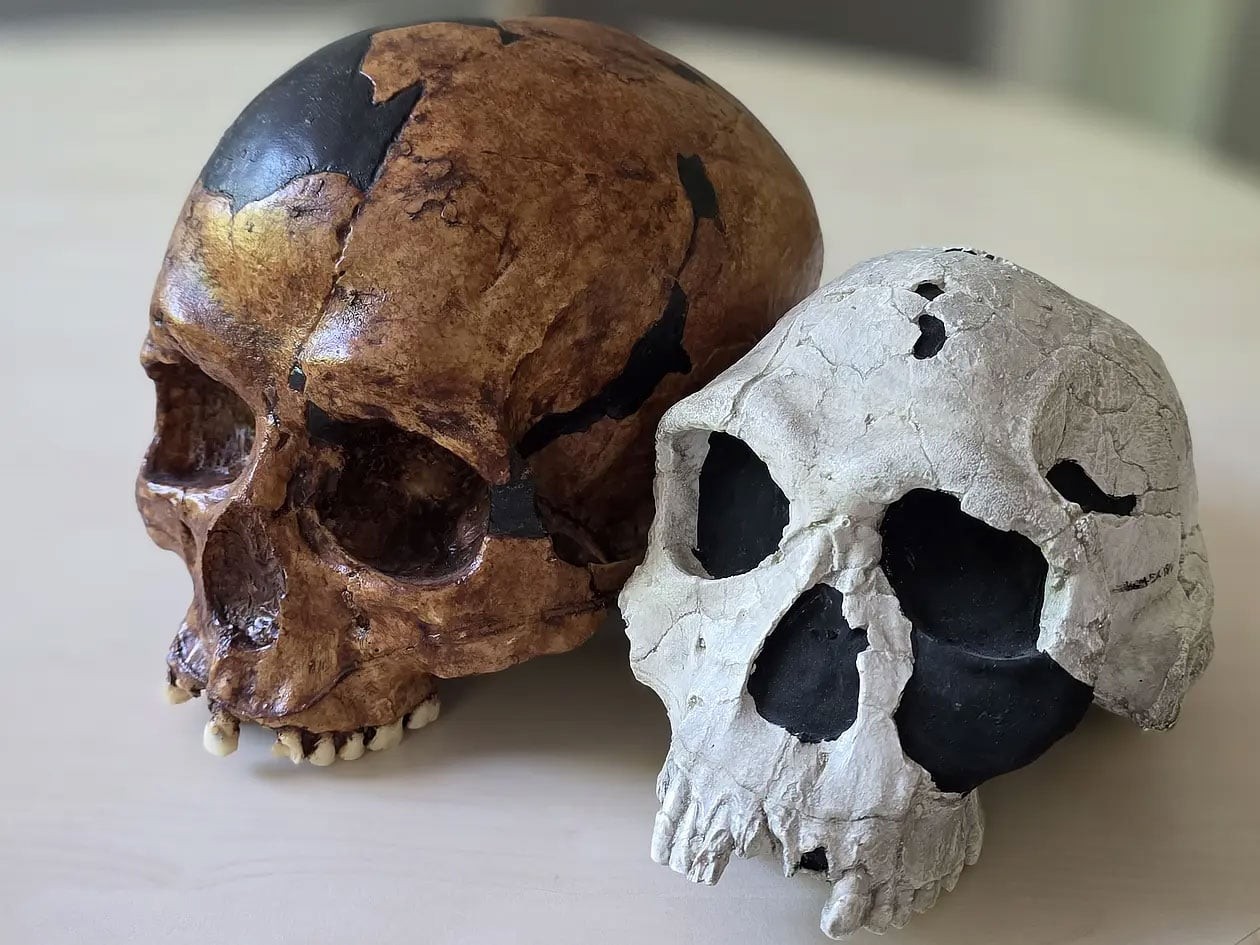
Hubbe and Harvati grabbed 87 fossil skulls. A solid dataset. They covered most of the preserved record from the last two million years. Early types like Homo habilis. Homo erectus. Neanderthals. Early and modern Homo sapiens.
They ran the stats against six evolutionary models.
They wanted to know: What drives the change?
Is it a steady push? A directed march toward a modern shape?
No. The data didn’t support that.
Randomness did. Or long pauses. Stability. The model called “punctuated equilibrium” won out. Long stretches of no change. Then, suddenly, movement.
“They show that the differences within our genre can be explained much more effectively neutral evolutionary processes,” says Hubbe.
This is a headache for the ladder analogy.
Humans are not an unfinished draft of a perfect creature. There is no blueprint. A small brain is not a mistake. A large jaw is not a flaw. It is just what worked at the time.
Genes mutate randomly. Some stick around by accident. Drift happens. Constraints lock things in place. You cannot change the face without messing with the brain. The skull teeth airways. All connected. You tweak one thing and the whole system resists.
So why did the brains actually get huge?
Because the constraints eased.
In Homo heidelbergensis. Later in Neanderthals. Finally in us.
Brains are hungry. They eat 20-25 percent of your calories despite being tiny. You need fuel. Consistent, high-quality fuel. If you can’t feed it, the big brain dies out. It’s useless weight.
But then? Culture intervened.
“In many ways, culture acts as buffer.” Hubbe puts it this way.
We cooked the meat. We shared it. We moved into new spots. Tools did the heavy lifting. The biological pressure to be tough? It dropped. The pressure to have huge teeth? Gone.
We could afford a big brain. Culture paid the bill.
This might explain why Homo sapiens look so soft compared to our cousins.
Neanderthals kept their heavy brows. Their robust faces. For millions of years. We didn’t. We went for the gracile look. Small chin. Smooth brow.
Why now? Why us?
Harvati suggests a convergence of events. A deep shift in behavior. Diet. Society. When those constraints lifted the face could shrink. Not because selection demanded it every single year. But because the environment suddenly allowed it.
The story changes.
We stop asking why we evolved straight lines.
We start asking: What broke?
Under what conditions did we slip our chains? That’s where the mystery lives. Not in the inevitable march. But in the rare moment everything clicked into place.
Who knows when that next lock breaks?
Reference: Hubbe M Harvati K. “Evolutionary drivers of encanization and facial reduction in genus Homo ” Nature Communications 2026.