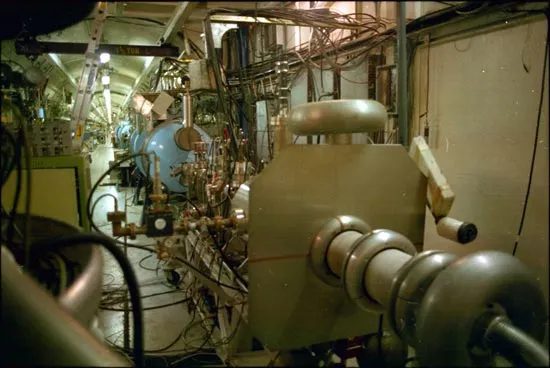
Look at the word itself. * accelerator. *It implies a car. A rocket. Something is moving faster than before. But in high-energy physics labs, these machines are doing even more violent and creative things. They don’t just speed up particles. They break them.
These devices take electrically charged atoms (called ions) or subatomic particles and accelerate them to the speed of light. The goal isn’t momentum for its own sake. This is destruction. When these rays hit the nucleus of an atom, it disintegrates. They break down the basic building blocks of matter. physicists find new particles. They mapped structures in the universe that did not exist before.
Think of it as a microscopic sledgehammer. You smash the atom to see what makes it tick. These results allow scientists to study the composition of the nucleus and understand how subatomic particles interact. It is the only way to peer inside the nucleus.
Machine types and their functions
Not all accelerators are created equal. The technique varies depending on how many particles you want to push.
Cyclotron processes positively charged particles. It spins them in a spiral pattern, gaining speed with each loop. Betatrons, on the other hand, are designed for negatively charged electrons. Accelerate them using a changing magnetic field.
And then there are the heavyweights. Synchrotron and Linear Accelerator (or Linear Accelerator). These are versatile. It can push positively charged particles and electrons into the surrounding environment. Linacs emit particles in a straight line, which is often necessary for precision. The synchrotron keeps them in a ring, building up energy over and over.
Outside the lab: why it matters to you
We often think of these machines as ivory tower toys. expensive. Abstract. Escape from everyday life. That’s wrong. The applications are surprisingly grounded.
Cancer treatment is heavily dependent on these devices. Proton beams accelerated to high speeds can target tumors with minimal damage to the surrounding tissue. It is a precise form of radiation therapy.
Next is the production of radioactive isotopes. Medical imaging techniques such as PET scans require special isotopes that decay in predictable ways. Accelerators produce these short-lived isotopes on demand.
Also used for biological sterilization. Industrial sterilization of medical equipment or food products. The high-energy beam kills bacteria and viruses without heat.
What about archaeology? One form of radiocarbon dating uses accelerator mass spectrometry. Count carbon atoms directly. Faster and more accurate than old methods. It helps us date artifacts with greater precision.
Invisible infrastructure
Physics is complicated. Engineering is more difficult. But the result is simple. We see the world differently now. We treat cancer more effectively. We date our history more accurately.
The particle accelerator is a tool for disruption. It breaks the atom to build the future. And it keeps breaking things. Even when we think we know what is inside.