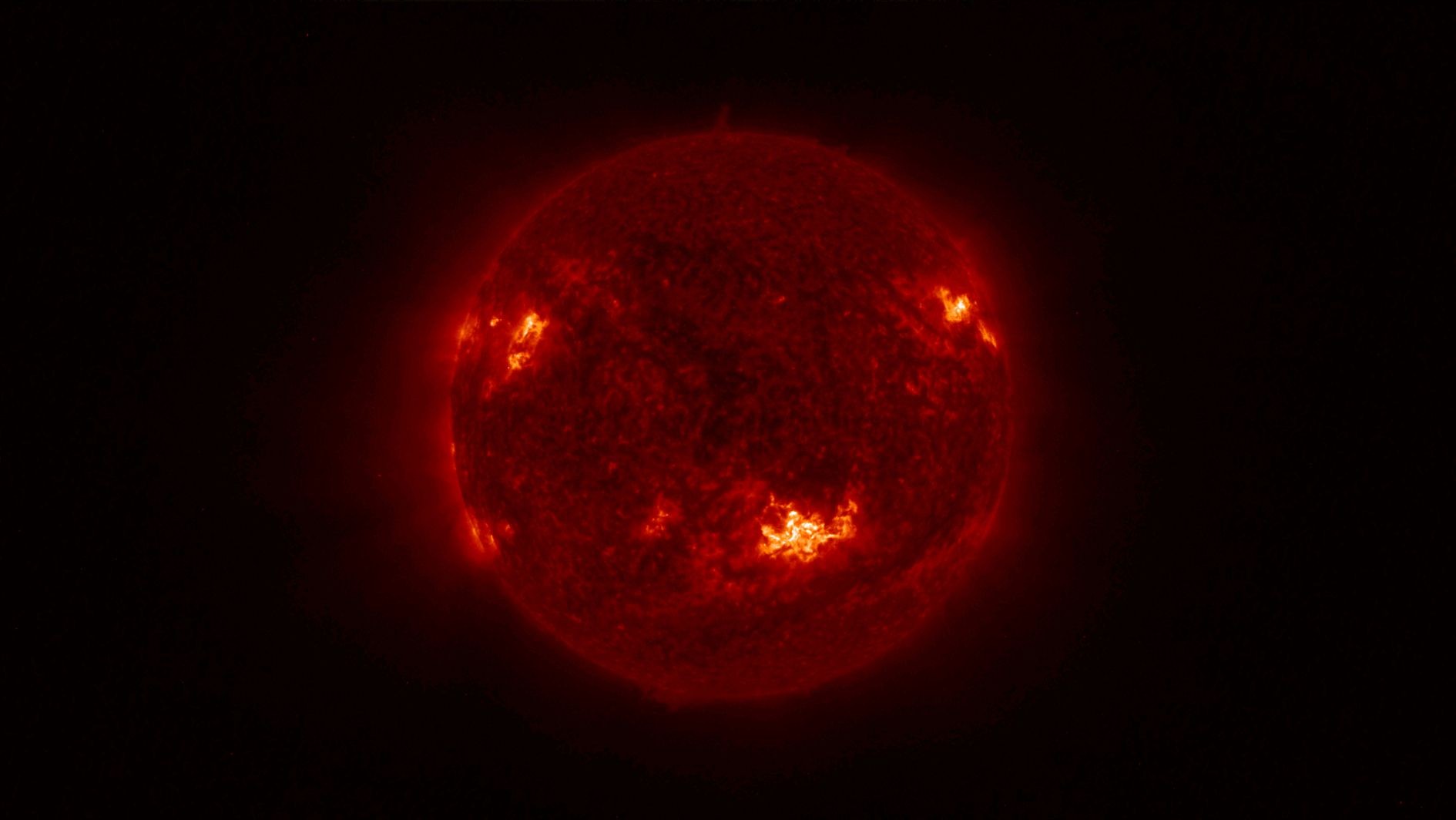
Scientists acting as “stellar archaeologists” have uncovered evidence of fossilized magnetism within white dwarfs —the dense, cooling remnants of dead stars. This discovery provides a vital link in understanding how stars evolve, specifically during the transition from massive “red giants” to compact white dwarfs.
This research is more than just academic curiosity; it offers a roadmap for predicting the ultimate fate of our own Sun.
The Evolutionary Bridge: From Red Giants to White Dwarfs
To understand this discovery, one must look at the lifecycle of a star similar in mass to our Sun. The process follows a predictable, albeit dramatic, sequence:
- The Red Giant Phase: In approximately 5 billion years, the Sun will exhaust its hydrogen core. Without the outward pressure of nuclear fusion to counteract gravity, the core will collapse, causing the outer layers to expand outward by up to 100 times their current size. During this phase, the Sun will become a red giant, potentially engulfing Earth and the other inner rocky planets.
- The White Dwarf Phase: After about a billion years as a red giant, the star will shed its outer layers into space, creating a nebula. What remains is the exposed, smoldering core: a white dwarf.
For years, astronomers have noted a discrepancy: magnetic fields appear to exist deep within the cores of red giants, yet they are observed on the surfaces of white dwarfs.
The “Fossil Field” Theory Reborn
The research team, led by Lukas Einramhof of the Institute of Science and Technology Austria (ISTA), proposes that these two phenomena are actually the same thing. They are testing the fossil field model, a theory suggesting that magnetic fields formed early in a star’s life persist through its entire evolution, eventually “emerging” on the surface once the star becomes a white dwarf.
Using asteroseismology —the study of “starquakes” or stellar oscillations—the team was able to peer into the interior of these stars. Their findings suggest:
– Structural Connection: A white dwarf is essentially the exposed core of a former red giant. Therefore, the magnetism seen on a white dwarf’s surface is likely the same magnetism once hidden in the red giant’s core.
– Field Geometry: Rather than being concentrated at a single point, the magnetic field evolves into a segmented structure, similar to the pattern on a basketball, with stronger intensity near the surface than at the core.
– Scale of Magnetism: For this theory to hold, the magnetic field must occupy a large portion of the star’s core, rather than being a localized phenomenon.
Why This Matters for Our Sun
While we can observe other stars with great detail, our own Sun remains a mystery at its center. Currently, solar models assume the Sun’s core is not magnetic, but this is an assumption rather than a proven fact.
“If it turns out to be [magnetic], this information would change everything we know and all the models we’ve based our work on,” says Einramhof.
The presence of a strong magnetic field in the Sun’s core could fundamentally alter our understanding of its lifespan. If magnetic fields facilitate the movement of hydrogen from the outer layers into the core, the Sun could potentially extend its life beyond current scientific predictions. Conversely, magnetism could lead to an entirely different evolutionary path than the one we currently anticipate.
Conclusion
By connecting the magnetic signatures of red giants to those of white dwarfs, scientists are bridging a massive gap in stellar evolution theory. This “fossil field” evidence suggests that magnetism is a persistent, structural force in stars, potentially reshaping our understanding of the Sun’s internal mechanics and its eventual end.