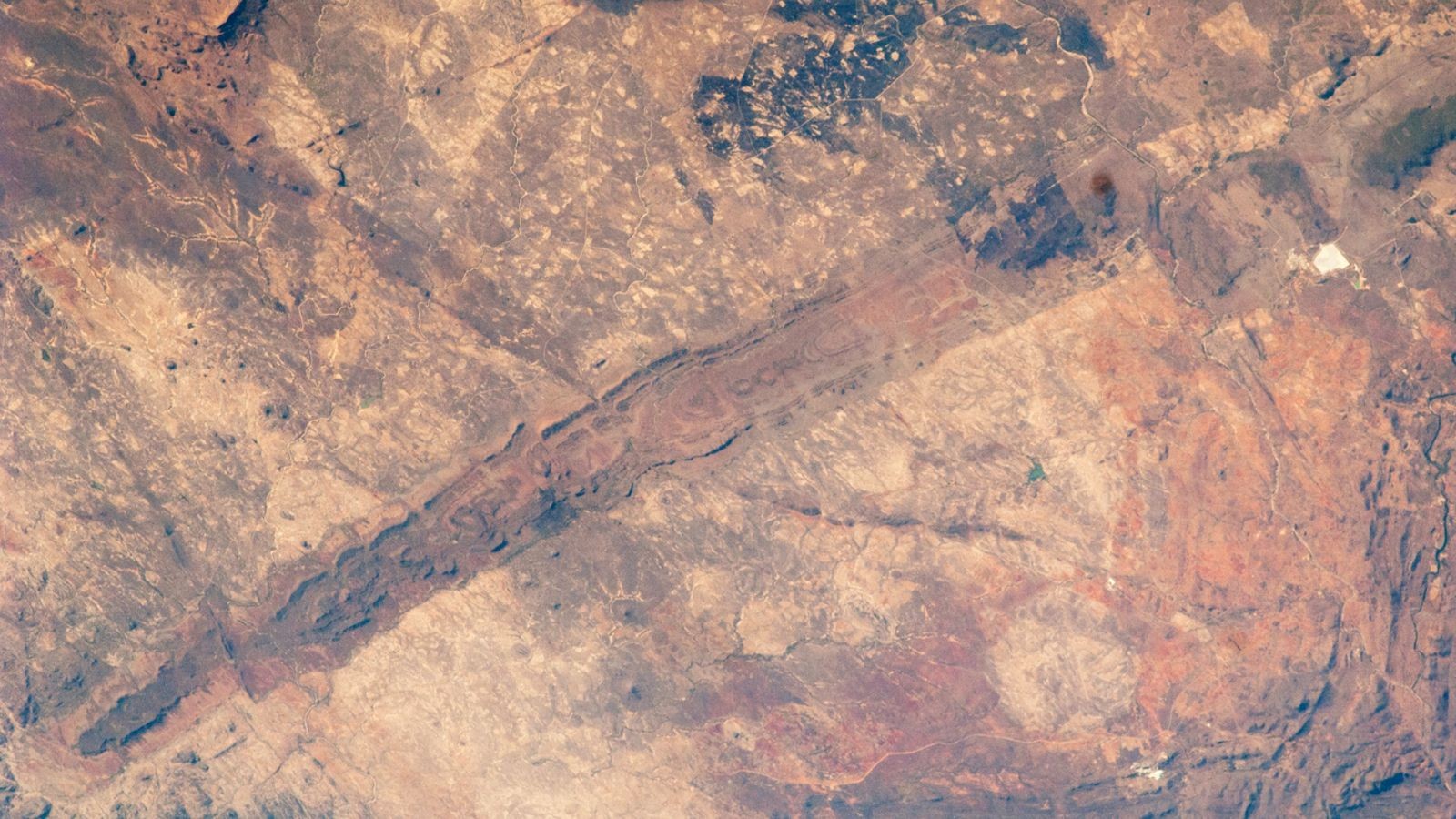
Striking new astronaut photography highlights the immense scale and hidden beauty of Zimbabwe’s Great Dyke, a geological formation that has been quietly shaping the country’s landscape—and economy—for billions of years. The structure, stretching over 550 kilometers, is not just a scenic wonder but a crucial source of resources.
Ancient Origins and Unique Structure
The Great Dyke isn’t a typical geological feature. Unlike a dike, which is a vertical intrusion of magma, this formation is a lopolith. This means it formed parallel to existing rock layers, creating a broad, saucer-shaped structure that’s both flatter and wider. It’s the longest continuous igneous intrusion on Earth, a testament to the planet’s early geological activity.
Formed roughly 2.5 billion years ago—over half of Earth’s 4.5 billion-year history—the Dyke owes its existence to magma rising from the mantle through ancient tectonic faults. This process brought valuable minerals normally trapped deep within the crust to the surface, making the region a mining hotspot.
A Resource-Rich Landscape
The Great Dyke isn’t just visually impressive; it’s an economic powerhouse. The area hosts at least six major mines, extracting a wealth of metals, including:
- Platinum: Zimbabwe holds the third-largest platinum deposits globally.
- Chromite: The Dyke contains exceptionally pure chromite, essential for stainless steel production.
- Other key resources: Gold, nickel, copper, titanium, iron, vanadium, and tin.
These minerals are critical for modern industries, making the Dyke a strategic asset for Zimbabwe and a significant contributor to global supply chains.
Beyond Mining: Art and Cultural Significance
The Great Dyke’s geological composition isn’t just valuable for industrial extraction. Local artists, like Michael Nyakusvora, recognize the area as a source of high-quality sculpting stone, comparing it to the famed marble quarries of Greece. This dual role—industrial resource and artistic medium—underscores the Dyke’s multifaceted importance.
“The Great Dyke of Zimbabwe is more than a line on a map—it’s a lifeline of economic opportunity and a geological marvel.”
The Great Dyke stands as a powerful reminder of Earth’s deep history and the enduring interplay between geology, economy, and culture. Its existence has shaped the landscape and the livelihoods of those who depend on its resources for millennia.