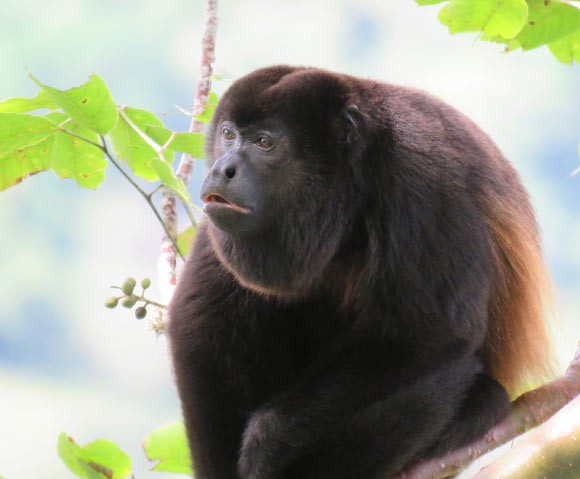
Fossils discovered in Colombia reveal that early howler monkey ancestors adapted to a leaf-based diet around 13 million years ago, marking a pivotal moment in primate evolution in South America. This dietary shift allowed Stirtonia victoriae, an ancient monkey species, to grow larger, fill a new ecological niche, and potentially set the stage for the development of the iconic howls characteristic of modern howler monkeys. The findings, detailed in the journal PaleoAnthropology, provide a key insight into the dietary and body mass evolution of primates in the forming Amazonian rainforest.
The Discovery: Fossil Jaws Reveal Ancient Diet
Researchers led by Dr. Siobhán Cooke of Johns Hopkins University analyzed two well-preserved mandible (jaw) fossils of S. victoriae from the La Victoria Formation in Colombia’s Tatacoa desert. The fossils show that these monkeys had relatively large molars with sharp protrusions, adaptations commonly found in primates that consume tough plant matter like leaves. Prior to this discovery, there was no evidence of leaf-eating among South American primates from this period.
Why This Matters: Size, Competition, and the Amazon’s Rise
The transition to leaf-eating had significant ecological consequences. By tapping into a plentiful, yet previously unexploited food source, S. victoriae could grow larger – estimated at 17 to 22 pounds (8-10 kg) – than other contemporary primate species. This increased size reduced competition for food, allowing them to establish a unique niche in the evolving Amazonian ecosystem. The Amazon basin at that time was very different from today, consisting of swamps, forests, and rivers, inhabited by now-extinct megafauna like giant sloths and armored armadillos.
The Howler Connection: Jaw Structure and Vocal Evolution
The researchers also suggest a possible link between the jaw structure of S. victoriae and the evolution of the howler monkey’s signature call. The deep mandibular body may have provided the anatomical basis for a larger hyoid bone, the structure that amplifies sound in modern howlers. While direct evidence of vocalization is absent, this discovery raises the intriguing possibility that the precursors to the world’s loudest land mammal were already developing the physical adaptations for their future roar.
From Fragments to Reconstruction: The Power of 3D Modeling
The study relied on a combination of fossil analysis and cutting-edge technology. Researchers created 3D models of the jaw fossils, allowing them to compare S. victoriae with other ancient and modern South American primates, including S. tatacoensis (another howler ancestor), spider monkeys, and woolly monkeys. This comparative approach confirmed that S. victoriae possessed unique dental features indicative of a leaf-rich diet.
The discovery of Stirtonia victoriae fills a critical gap in the fossil record, offering a clearer picture of primate evolution in South America. This study not only reveals when these monkeys first adapted to eating leaves but also provides a foundation for future research into the origins of howler monkey behavior and vocalizations. The results underscore how dietary shifts can drive ecological specialization and pave the way for significant evolutionary changes.