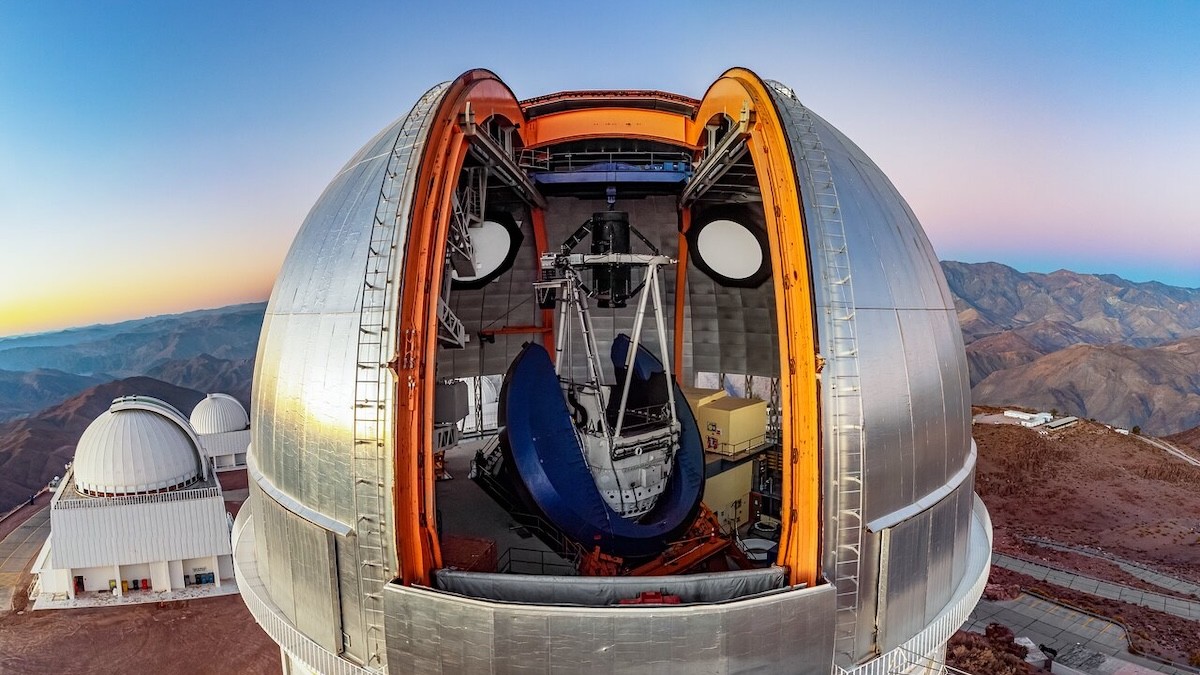
Astrophysicists have released the most comprehensive analysis yet from the six-year Dark Energy Survey (DES), a massive international project studying the accelerating expansion of the Universe. The results don’t overturn current cosmological models, but they do offer tantalizing clues that suggest our understanding of “dark energy” – the unknown force driving this expansion – might be incomplete.
The Expansion Problem
For decades, scientists have known the Universe isn’t just expanding, but doing so at an increasing rate. This acceleration is attributed to dark energy, which constitutes roughly 68% of the Universe’s total energy density. The standard model, known as lambda-CDM, assumes dark energy is a constant force. However, the DES data opens the door to alternative explanations.
How the Survey Works
The Dark Energy Survey scanned a vast portion of the sky between 2013 and 2019, employing four independent methods to measure the Universe’s expansion history:
- Baryon Acoustic Oscillations (BAO): Analyzing ancient ripples in the distribution of matter.
- Type Ia Supernovae: Measuring brightness changes in exploding stars.
- Galaxy Clusters: Mapping how galaxies group together.
- Gravitational Lensing: Studying how gravity bends light from distant galaxies.
Combining these methods for the first time provides a more robust picture of dark energy’s behavior than ever before.
Findings: Consistent, But Not Definitive
The new analysis confirms that the Universe’s expansion still aligns with the lambda-CDM model, where dark energy density remains constant over time. However, the data also supports an alternative model known as wCDM, in which dark energy density changes over time.
Notably, the distribution of galaxies in recent cosmic history shows slight discrepancies with predictions from both models. This discrepancy isn’t yet statistically significant enough to claim a breakthrough (it’s short of a five-sigma certainty), but it raises the possibility of new physics at play.
What This Means
The DES results underscore the ongoing challenge of understanding dark energy. While no single theory has emerged, the latest findings suggest that current models might need refinement. The collaboration plans to test how well other alternative theories fit the data, potentially even revisiting fundamental assumptions about gravity itself.
This research doesn’t solve the mystery of dark energy, but it narrows the possibilities and sets the stage for future investigations. The Universe remains a complex puzzle, and the DES data provides another critical piece.