Astronomers using the James Webb, Hubble, and ALMA telescopes have made a surprising discovery: galaxies from the early universe matured far faster than expected. These “cosmic adolescents,” existing just over 1 billion years after the Big Bang, exhibit characteristics previously thought to develop over much longer timescales, raising questions about established models of galactic evolution.
Rapid Chemical Enrichment
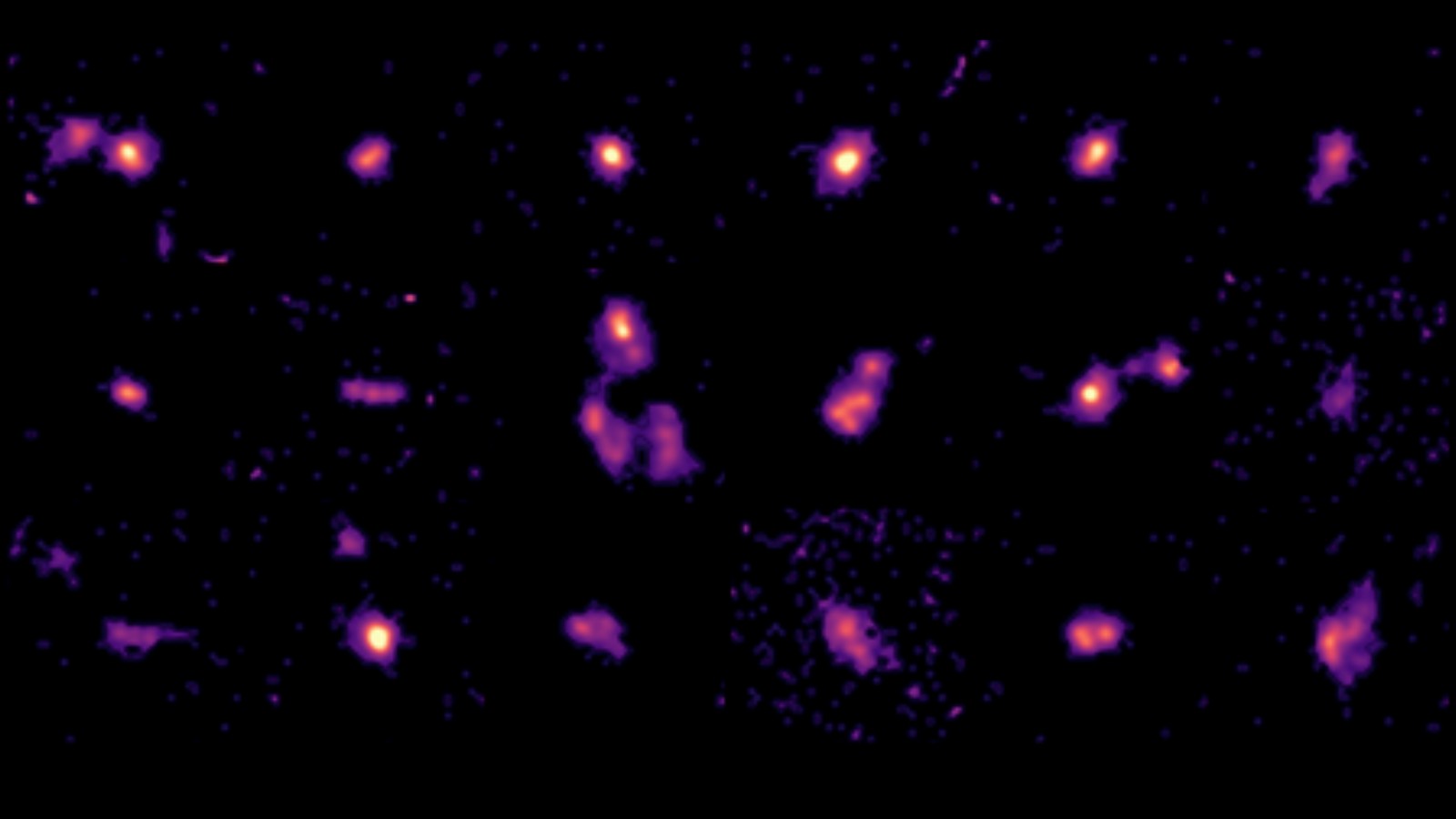
The research team observed 18 galaxies roughly 12.5 billion light-years away. A key finding was that these galaxies are unusually rich in heavy elements—metals like carbon and oxygen—despite their young age. The standard model predicts that heavy elements accumulate gradually through stellar lifecycles and supernova explosions. Yet, these galaxies appear “chemically mature,” as if they skipped developmental stages.
“It was a surprise to see such chemically mature galaxies,” explains Andreas Faisst of Caltech. “It’s like seeing 2-year-old children act like teenagers. How do metals form in less than 1 billion years?” This raises fundamental questions about the processes governing metal production in the early universe, and whether current simulations accurately reflect reality.
Unexpectedly Mature Structures
Beyond chemical composition, the galaxies also exhibit surprisingly developed structures. Many possess rotating stellar disks, similar to those found in mature spiral galaxies like our Milky Way. Such features were previously thought to emerge much later in galactic history. The presence of these structures so early suggests that the universe may have accelerated galaxy formation more efficiently than previously believed.
Hungry Black Holes and Metal-Rich Gas
The rapid growth isn’t limited to the galaxies themselves. Supermassive black holes at their centers are also accreting matter at a high rate, fueling their own rapid development. Furthermore, the gas surrounding these galaxies—the circumgalactic medium—is also enriched with metals, extending out tens of thousands of light-years. This suggests that metal enrichment isn’t confined to the galaxies themselves but is a widespread phenomenon in the early universe.
Future Research and Implications
The research team now plans to compare these observations with advanced simulations of galactic growth and metal enrichment. The goal is to refine our understanding of star formation, dust production, and the early universe’s chemical evolution.
“The combination of observations and simulations provides a powerful synergy to understand the details of star formation… The knowledge of these will ultimately help us understand the formation of the first stars and planets and how our own Milky Way came into being.”
These findings highlight that the early universe may have been a more dynamic and rapidly evolving environment than previously thought. Understanding how galaxies matured so quickly will be crucial for unraveling the origins of cosmic structures and our own galactic home.