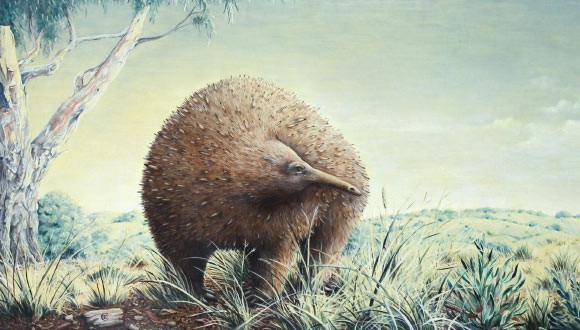
A long-forgotten fossil tucked away in a museum collection has provided a crucial missing piece to the puzzle of Australia’s prehistoric wildlife. Paleontologists have identified a partial skull of Owen’s giant echidna (Megalibgwilia owenii ) in Victoria, marking the first confirmed evidence of this extinct species in the state.
Filling the Geographical Gap
Until now, the fossil record for Megalibgwilia owenii presented a confusing map. While scientists knew the species existed across much of the continent—stretching from Western Australia through southern New South Wales and into Tasmania—there was a conspicuous absence of evidence in Victoria.
This discovery changes that narrative. By confirming the presence of the giant echidna in southeastern Australia, researchers can now suggest that the species enjoyed a much more continuous and widespread range than previously believed.
The Specimen: A Century-Old Mystery
The discovery was not the result of a recent trek into the wild, but rather a meticulous re-examination of existing archives. The fragmentary skull was found within the Museums Victoria Palaeontology Collection.
Key details regarding the specimen include:
– Origin: Recovered approximately 120 years ago from Foul Air Cave in the Buchan Caves Reserve, East Gippsland.
– Historical Context: Dr. Tim Ziegler of the Museums Victoria Research Institute traced the specimen back to a 1907 expedition led by naturalist Frank Spry, who explored the caves using little more than kerosene lamps and ropes.
– Physical Profile: As a species, the giant echidna was a formidable creature, reaching up to 1 meter in length and weighing approximately 15 kg.
The Value of “Old” Science
This find highlights a growing trend in paleontology: the importance of revisiting historical collections. Often, specimens collected decades or even a century ago sit in storage, waiting for modern technology or fresh eyes to unlock their potential.
Dr. Tim Ziegler and Deakin University student Jeremy Lockett emphasize that museum collections serve as a vital bridge between heritage and modern science. The fact that a specimen collected in 1907 could provide groundbreaking data in 2026 underscores how much remains to be learned from existing archives.
A Window into Australia’s Megafauna
The Buchan Caves have long been recognized as a biological goldmine. The region is known to preserve an exceptional record of Australia’s ancient megafauna, including:
– The short-faced kangaroo (Simosthenurus occidentalis )
– The giant marsupial (Palorchestes azael )
As researchers continue to survey both fossil sites and museum drawers, they aim to build a more complete picture of the diversity and distribution of species during the Quaternary period—a time of significant climatic and biological shifts.
“The next amazing discovery could come from inside the museum, from continued fieldwork, or the keen eyes of a citizen scientist.” — Dr. Tim Ziegler
Conclusion
By identifying this long-lost fossil, scientists have bridged a major gap in the known territory of Owen’s giant echidna, proving that revisiting historical museum collections is essential for understanding Australia’s prehistoric past.