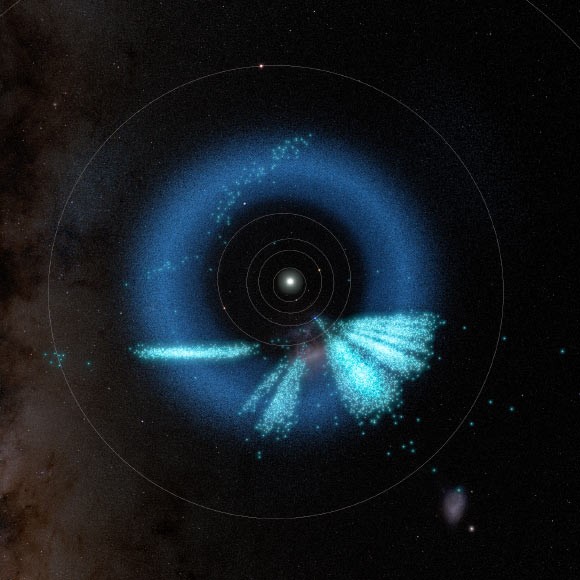
The Vera C. Rubin Observatory has dramatically increased the known number of asteroids in our solar system, identifying over 11,000 new objects in just a month and a half of operation. This includes a significant number of trans-Neptunian objects (TNOs) and 33 previously unknown near-Earth asteroids (NEOs). The data has been submitted to the International Astronomical Union’s Minor Planet Center (MPC), marking a major leap in our ability to map the solar system.
Accelerated Discovery Rate
The observatory’s rapid discovery rate represents a substantial shift in how astronomers catalog celestial bodies. According to Dr. Mario Juric, Rubin Solar System lead scientist at the University of Washington, “What used to take years or decades to discover, Rubin will unearth in months.” This is possible due to the observatory’s advanced capabilities and efficient data processing algorithms.
The submitted dataset contains over one million observations of both new and previously known asteroids, demonstrating the observatory’s operational readiness. This speed is crucial because many asteroids remain undiscovered, even those that occasionally cross Earth’s orbit.
Near-Earth Objects and Planetary Defense
Among the new finds are 33 NEOs – small asteroids and comets that come within relatively close proximity to Earth. None of these currently pose a threat, with the largest measuring approximately 500 meters in diameter. Still, identifying and tracking NEOs is critical for planetary defense efforts. Early detection allows for trajectory analysis and potential mitigation strategies if an asteroid were ever found to be on a collision course with Earth.
Exploring the Outer Solar System
The Rubin Observatory’s findings extend far beyond near-Earth space. Roughly 380 new TNOs have been identified, icy bodies orbiting beyond Neptune. Two of these, provisionally named 2025 LS2 and 2025 MX348, stand out with extremely distant and elongated orbits. These objects reach up to 1,000 times farther from the Sun than Earth, placing them among the most remote minor planets known.
Implications for Solar System History
The discovery of these distant TNOs is more than just cataloging space rocks. Dr. Matthew Holman, astrophysicist at Harvard-Smithsonian’s Center for Astrophysics, explains the search process required “novel algorithmic approaches” given the difficulty of identifying faint, distant objects among millions of other light sources.
These objects hold clues to the solar system’s formation and early evolution. Dr. Kevin Napier, also from Harvard-Smithsonian, suggests they may even offer insight into the potential existence of a ninth large planet beyond Neptune. The distribution and characteristics of these TNOs can reveal how planets migrated in the early solar system and whether undiscovered gravitational influences are at play.
“Objects like these offer a tantalizing probe of the Solar System’s outermost reaches… to whether a hitherto undiscovered 9th large planet may still be out there.”
The Rubin Observatory’s initial output proves its ability to transform our understanding of the solar system. The rapid discovery of thousands of new asteroids, including those in potentially hazardous near-Earth orbits and those in the distant outer reaches, will accelerate research and improve our ability to predict and address celestial risks.