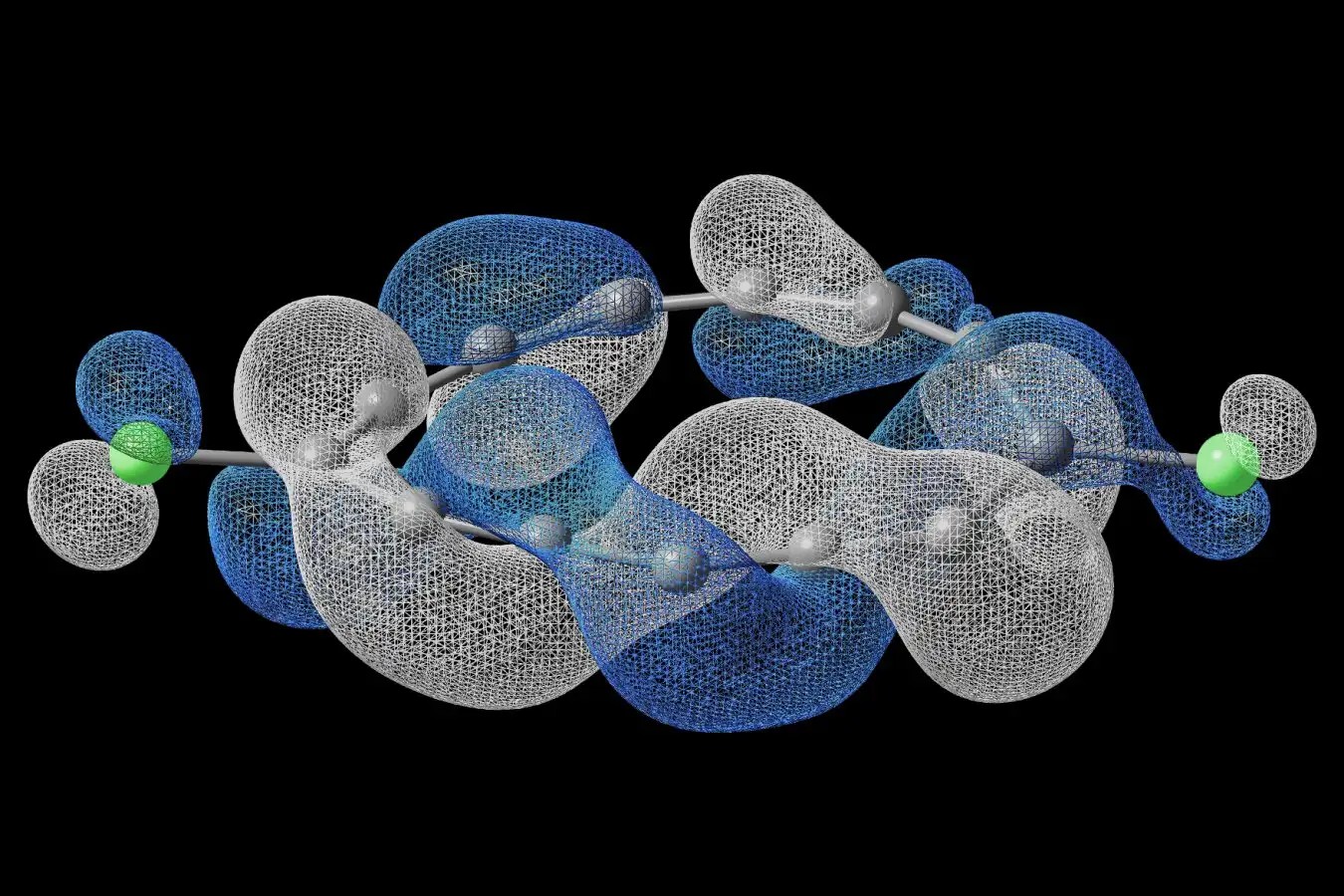
Chemists have synthesized a molecule with an unprecedented structure: a “half-Möbius” twist that surpasses the complexity of the well-known Möbius strip. This breakthrough, led by Igor Rončević at the University of Manchester, not only demonstrates the feasibility of this exotic topology but also opens new avenues for engineering molecules with precisely controlled 3D shapes.
The Twist Explained
The Möbius strip is a familiar concept: a band looped and twisted so that an ant crawling along it would need two full circuits to return to its starting point on the same side. The newly created molecule takes this concept further. A quantum particle traveling around its ring-like structure would require four full circuits to return to its origin.
This strange behavior arises from the way electrons interact within the molecule, not from the atoms themselves. The molecule consists of 13 carbon and 2 chlorine atoms arranged on a gold surface at extremely cold temperatures. Electrons in this molecule aren’t tightly bound to individual atoms; instead, they spread out like waves, creating the unique twist.
On-Demand Shape Shifting
Crucially, the team demonstrated the ability to manipulate this molecular topology. By applying a small electromagnetic pulse, they could switch the molecule between left-handed and right-handed twists, or even untwist it entirely. This on-demand control is what makes the discovery truly significant.
“This is a beautiful and inspiring study that brings abstract topological concepts vividly into the realm of molecular chemistry.” – Kenichiro Itami, RIKEN.
Quantum Computing’s Role
Simulating the molecule’s behavior required advanced computational methods. Conventional computers struggle to accurately model the interactions between electrons, but quantum computers – built on the principles of quantum mechanics itself – excel at these calculations. The researchers used both conventional and IBM quantum computers to confirm the molecule’s stability and predict its behavior. This highlights the increasing practical utility of quantum computing in materials science.
Implications for Future Technologies
The ability to dynamically alter molecular shapes has promising applications. Dongho Kim of Yonsei University suggests the molecule could be used in sensors that respond to magnetic fields by changing shape in a pre-programmed way. The manipulation of molecular topology offers a new dimension of control over matter at the nanoscale.
This discovery demonstrates that complex, previously theoretical molecular structures are achievable, and that we are entering an era where molecular engineering can be performed with unprecedented precision.