


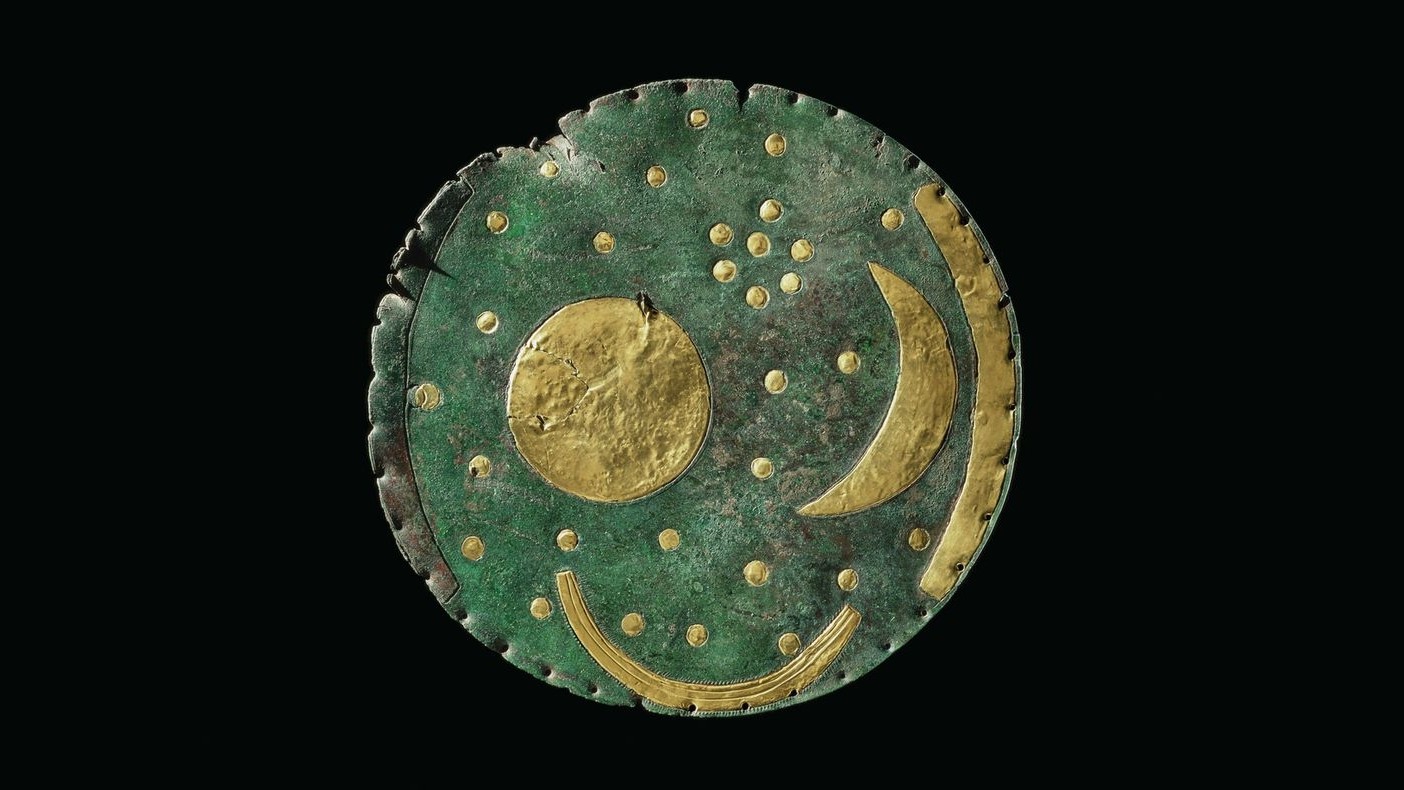
The Nebra Sky Disc, unearthed in Germany in 1999, stands as the oldest known concrete depiction of astronomical phenomena in the world. Dating back roughly 3,800 years – predating Egyptian star maps by centuries – this bronze disc offers a unique glimpse into the cosmological understanding of Bronze Age Europeans. The disc’s story is complex, beginning with its illegal excavation by metal detectorists and subsequent recovery by authorities, making its scientific study both urgent and challenging.
Discovery and Authentication
The disc, weighing approximately 4 kilograms and measuring 32 centimeters in diameter, was found alongside a hoard of bronze artifacts. Its surface is inlaid with 50 grams of gold, forming symbols representing the sun or full moon, a crescent moon, and at least 32 stars. Initial skepticism surrounded the disc’s authenticity, with some claiming it was a forgery or much more recent than estimated. However, rigorous analysis – including stylistic comparisons to contemporary tools and carbon dating of associated wooden artifacts – has largely confirmed its age and origin, though it was constructed in phases over time.
Construction and Evolution
The Nebra Sky Disc wasn’t created in a single moment. Archaeological evidence shows it was assembled in at least five stages. First, the core design – the sun/moon, crescent moon, and stars – was etched into the bronze. Then, arcs representing horizons were added, followed by a boat-shaped symbol along the lower edge. Finally, the left arc was removed before it was buried with the hoard. The exact timeline of these additions remains unclear, but the gradual construction suggests an evolving understanding or refinement of its astronomical function.
Astronomical Significance
The most striking feature of the disc is its depiction of stars, specifically what appears to be the Pleiades star cluster, also known as the “Seven Sisters.” The golden arcs on either side are believed to represent the horizon, with possible markings for summer and winter solstices. The boat symbol might depict a mythical vessel carrying the sun across the sky. Aligning the disc with the landscape at Mittelberg Hill, where it was found, reveals that the western horizon arc corresponds to the Brocken mountain, where the sun sets during the summer solstice. This alignment suggests the disc served as a practical tool for tracking astronomical dates, a crucial function in early agricultural societies.
Mysteries Remain
Despite its age and clear astronomical markings, several questions remain unanswered. The identity of those who created and used the disc remains unknown, partly because its discovery wasn’t part of a controlled archaeological dig. The treasure hunters who initially found it caused some damage, making precise reconstruction difficult. It is likely the disc belonged to an elite figure, perhaps a chieftain, given the presence of well-furnished burial mounds from that period. However, without proper excavation context, definitive conclusions are impossible.
The Nebra Sky Disc represents more than just an ancient artifact; it’s a tangible link to the cosmological beliefs and practical knowledge of Bronze Age Europe. It demonstrates that sophisticated astronomical observation existed far earlier than previously thought, pushing back the history of scientific thinking in the West.


