A startling discovery in a Russian cave has upended our understanding of prehistoric medicine. For decades, the title of “earliest known dental intervention” belonged to Homo sapiens. However, a 60,000-year-old Neanderthal tooth reveals that our extinct relatives were performing sophisticated dentistry—specifically, a form of root canal treatment—long before modern humans arrived on the scene.
The finding challenges the lingering stereotype of Neanderthals as brutish, unintelligent cavemen. Instead, it paints a picture of a species capable of complex problem-solving, pain management, and advanced cognitive flexibility.
The Mystery of the Drilled Molar
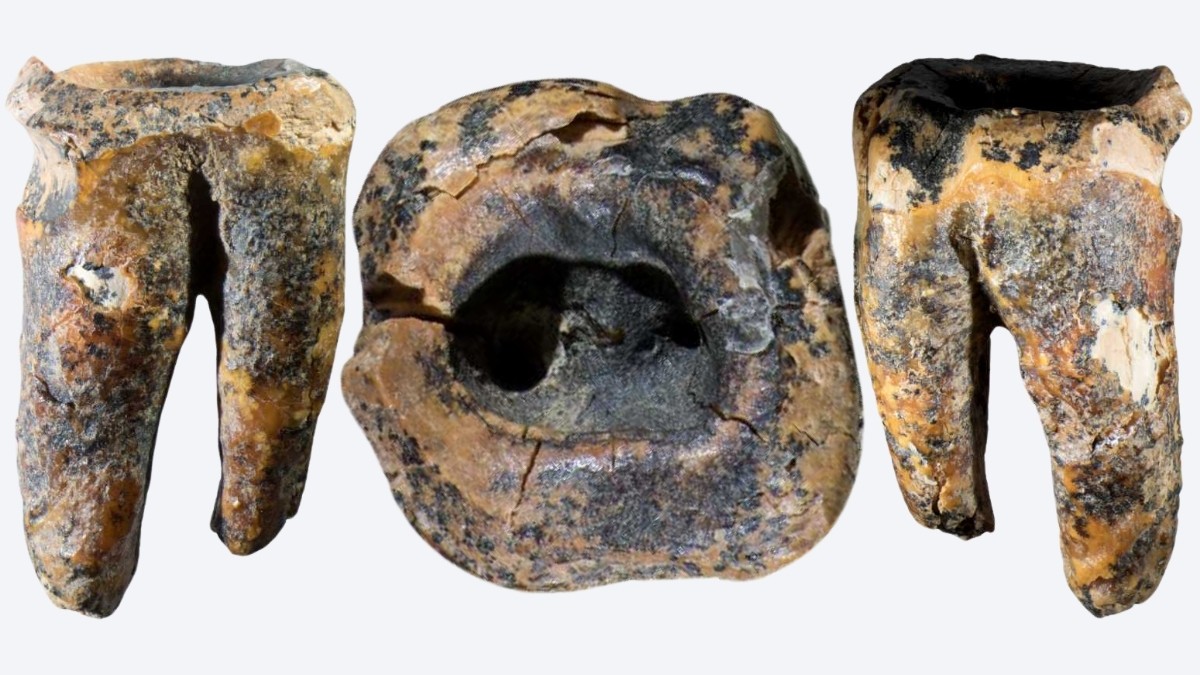
The evidence comes from Chagyrskaya Cave in Siberia, Russia. Among the artifacts was a molar from the lower left jaw of a Neanderthal. At first glance, archaeologists assumed the tooth had simply suffered from severe decay or had broken off naturally. The crown was missing, leaving a deep, unusual cavity in the root.
However, Alisa Zubova, an anthropologist specializing in dental morphology, suspected something more deliberate. Under microscopic examination, the team led by Kseniya Kolobova of the Russian Academy of Sciences found clues that natural decay could not explain:
- Linear Marks: The surface showed clear scratches consistent with a rotating, drilling motion.
- Structured Cavity: The hole was not a random void but comprised three overlapping depressions, suggesting a methodical approach to removing tissue.
“This was intentional, hands-on treatment,” Kolobova explained. “It could no longer be explained by disease or accident.”
Repurposing Technology for Medicine
Neanderthals did not have electric drills or anesthesia. So, how did they perform this procedure? The answer lies in their existing toolkit. The region around Chagyrskaya Cave was rich in jasperoid, a hard stone commonly used by Neanderthals to craft sharp, asymmetrical knives and scrapers.
The researchers hypothesized that the Neanderthal did not invent a new tool for the toothache but rather repurposed an existing design. They likely took a fine, pointed jasperoid tool—already mastered for hunting or skinning—and applied it to a painful, infected tooth. This act required significant cognitive flexibility: transferring a technology from one domain (tool-making) to a completely new one (medicine).
To test this theory, the team conducted experiments. They attempted to drill into old teeth from anthropological collections, but found limited success. The breakthrough came when they used a replica Neanderthal tool on a fresh wisdom tooth extracted from Lydia Zotkina, a traceologist on the team.
“Lydia’s tooth was as close as we could possibly get to the fresh, moist condition of a Neanderthal tooth still in a person’s jaw,” Kolobova noted. By applying a gentle, rotating motion with the stone tool, they successfully replicated the marks found on the 60,000-year-old molar. The experiment proved that while difficult and painful, the technique was feasible with the materials available at the time.
A Leap in Cognitive Complexity
The implications of this discovery extend far beyond dentistry. The Neanderthal technique appears more advanced than early Homo sapiens methods, which often involved scraping away decay rather than drilling into the root to remove infected pulp.
This finding adds to a growing body of evidence that Neanderthals possessed a rich culture and high-level cognition. Previous discoveries have shown they:
* Buried their dead with ritual care.
* Created cave art and decorative objects.
* Cared for injured or elderly members of their communities.
The drilled tooth suggests they also understood the concept of long-term gain versus short-term pain. Enduring the intense agony of a stone drill without anesthesia required a belief that the procedure would save the tooth—and potentially the individual’s life. In an era where food was scarce and infection could be fatal, saving a functional molar was a matter of survival.
Conclusion
The drilled Neanderthal molar is not just a medical curiosity; it is a testament to human ingenuity that predates our own species’ dominance. It demonstrates that Neanderthals were capable of abstract thinking, technical innovation, and self-care. As we continue to uncover these details, the line between “us” and “them” blurs, revealing a shared heritage of resilience and intelligence.