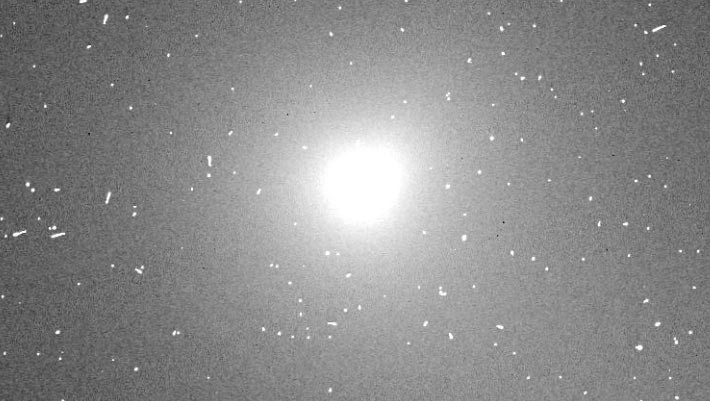
In a remarkable astronomical event, the Hubble Space Telescope captured unprecedented detail of the interstellar comet 3I/ATLAS on January 22, 2026. The comet aligned almost perfectly with the Sun-Earth axis, revealing a complex system of jets and a pronounced anti-tail – features previously unseen in similar interstellar visitors. This observation provides scientists with a unique opportunity to study materials originating from another star system.
Why This Matters: A Glimpse Beyond Our Solar System
Interstellar objects, like 3I/ATLAS, are relics from other stars, offering clues about the formation and composition of planetary systems beyond our own. Unlike asteroids or comets born within our solar system, these visitors carry materials from distant stellar nurseries. Studying them is essential for understanding the diversity of planetary systems throughout the galaxy.
Previous interstellar objects – 1I/Oumuamua and 2I/Borisov – did not present ideal conditions for detailed study. Oumuamua lacked visible gas or dust, while Borisov was never observed at an angle close enough to the Sun-Earth line to reveal its full structure. The 3I/ATLAS alignment was rare, with the comet passing within just 0.69 degrees of the Earth-Sun axis.
The Jets and Anti-Tail: What Hubble Revealed
The precise alignment caused a surge in brightness, allowing astronomers to analyze the comet’s composition via the particles emitted by its jets. Observations made with Hubble’s Wide Field Camera 3 (WFC3) showed four distinct jets, including a prominent anti-tail directed almost towards Earth and the Sun. The remaining three jets are spaced equally at 120-degree intervals, with one appearing faint due to its orientation relative to our planet.
“The residuals showed the system of 4 jets, including a prominent anti-tail directed nearly towards the Sun and Earth, supplemented by three mini-jets,” Professor Abraham Loeb of Harvard University explains. This structure suggests that 3I/ATLAS is shedding material in a highly organized way, potentially due to subsurface activity.
A Once-in-Decades Opportunity
Astronomer Man-To Hui from the Shanghai Astronomical Observatory described the conditions as “may not repeat for decades,” underscoring the uniqueness of this event. The detailed images obtained by Hubble will remain a valuable dataset for years to come, allowing scientists to refine models of interstellar object composition and behavior.
The alignment of 3I/ATLAS with the Sun-Earth axis is not just a rare astronomical event; it’s a key to unlocking insights into the formation of planetary systems beyond our own. This observation will help refine our understanding of interstellar materials and the diversity of cosmic environments.