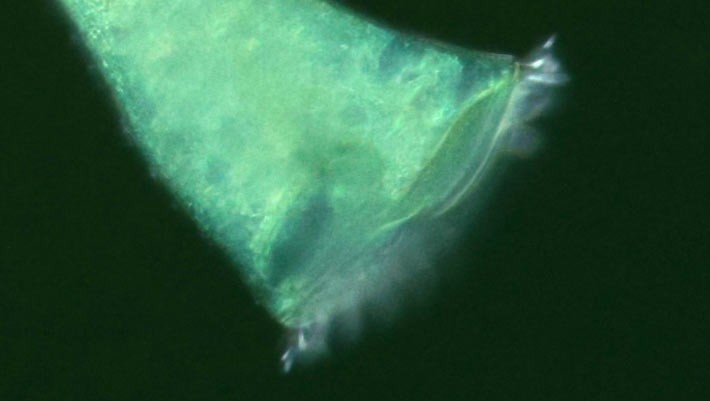
New research suggests that the ability to navigate and exploit physical environments is not exclusive to complex organisms. A study from Hokkaido University has revealed that a single-celled microorganism, Stentor coeruleus, possesses a remarkable ability to sense and seek out geometric corners to anchor itself.
The Life of a Trumpet-Shaped Protist
Stentor coeruleus is a specialized protist, measuring just one millimeter in length. Its life cycle is defined by two distinct modes of existence:
– The Swimming State: The organism moves freely through water, using hair-like organelles called a membranellar band to generate propulsion. During this phase, it navigates based on light and chemical signals.
– The Anchored State: To feed, the cell undergoes a physical transformation, elongating into a trumpet shape and attaching itself to a surface via an organ at its posterior end. Once anchored, it creates water currents to pull in bacteria and small ciliates.
However, this lifestyle involves a critical trade-off. While anchoring allows the organism to feed efficiently, staying in one place makes it a stationary target for predators.
Seeking Shelter in the Microscopic Landscape
To understand how these organisms choose their “homes,” researchers led by Dr. Syun Echigoya placed the microbes in custom-designed micro-chambers. These environments ranged from smooth, flat surfaces to complex structures with various angles, edges, and deep corners.
By using high-speed video recordings and numerical simulations, the team observed a highly intentional pattern of behavior:
1. Exploration: The cells initially swim freely through the chamber.
2. Surface Detection: Upon encountering a wall, the cells shift into an asymmetric shape and begin gliding along the surface using their cilia.
3. Corner Seeking: Rather than settling anywhere, the microbes actively steer themselves toward tight, corner-like spaces.
A Physical, Not Cognitive, Intelligence
One of the most striking findings of the study is that this “geometric sense” does not require a brain or complex sensory processing.
“Stentor coeruleus does not need to recognize structures in a cognitive sense. With a simple shift in body shape, it can physically interact with surfaces to find suitable corner spaces to attach,” explains Dr. Echigoya.
This suggests that the organism’s behavior is driven by mechanics rather than cognition. By changing its physical shape, the protist can “feel” its way into niches that provide better protection and stability.
Why This Matters for Biology
This discovery highlights how much the “microscopic landscape” dictates the survival of life. In natural aquatic environments, surfaces are rarely smooth; they are filled with crevices, cracks, and sheltered pockets.
The ability of even the simplest life forms to exploit these geometric features explains several key biological trends:
– Niche Colonization: How microorganisms find stable environments to grow.
– Community Formation: How microbes settle in specific patterns to form colonies.
– Survival Strategies: How organisms use the physical world as a shield against predation.
Conclusion
By utilizing simple physical interactions rather than complex thought, Stentor coeruleus effectively navigates its world. This study demonstrates that geometry plays a fundamental role in how microscopic life survives and organizes itself in the natural world.