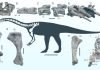
A remarkably well-preserved fossil from Argentina reveals a new species of dinosaur, Alnashetri cerropoliciensis, that weighed less than a modern chicken. The discovery provides crucial insight into the evolution of alvarezsaurs, a group of small, predatory dinosaurs, and complicates previous assumptions about how these creatures adapted to shrinking body sizes.
Unearthing Alnashetri : A Breakthrough in Understanding
The 95-million-year-old skeleton was excavated from the La Buitrera site in Patagonia. Prior discoveries of this species were limited to incomplete hindlimb fragments, leaving scientists uncertain about its size and maturity. Now, with a nearly complete specimen, researchers confirm that Alnashetri was a fully grown adult, at least four years old, yet weighed a mere 700 grams.
This is significant because it provides the first clear picture of an early alvarezsaur’s anatomy. The fossil exhibits slender hind limbs and surprisingly well-developed forelimbs with three functional fingers—a feature not seen in later, more specialized species.
Rethinking Alvarezsaurs: Not Just Ant-Eaters
For years, paleontologists believed that alvarezsaurs shrank in size while evolving short, stout forelimbs with a prominent thumb to dig for ants and termites. However, Alnashetri defies this pattern. Despite being one of the smallest alvarezsaurs discovered, its forelimbs are proportionally longer and its teeth are not reduced.
“Alnashetri represents an earlier branch on the alvarezsaur evolutionary tree,” explains Peter Makovicky, a paleontologist involved in the study. “It’s built more like a typical theropod, suggesting it likely had a broader diet than just insects.”
This means that the evolutionary path toward extreme specialization in ant-eating wasn’t a direct consequence of size reduction. Instead, alvarezsaurs likely occupied the niche of small predators over a much longer period, and the adaptations for insectivory came later.
The Puzzle Remains: Why So Small?
The discovery leaves researchers with more questions than answers. While Alnashetri sheds light on the early evolution of alvarezsaurs, the ultimate reason for their dramatic size reduction remains unclear. The prevailing theory suggests that alvarezsaurs were successful in exploiting the ecological role of very small predators, but the exact selective pressures that drove their evolution are still unknown.
The ongoing investigation highlights how much remains to be learned about dinosaur evolution, even from fossils discovered in well-studied regions. The story of Alnashetri is a reminder that paleontology is a science of constant revision, as new finds reshape our understanding of the past.