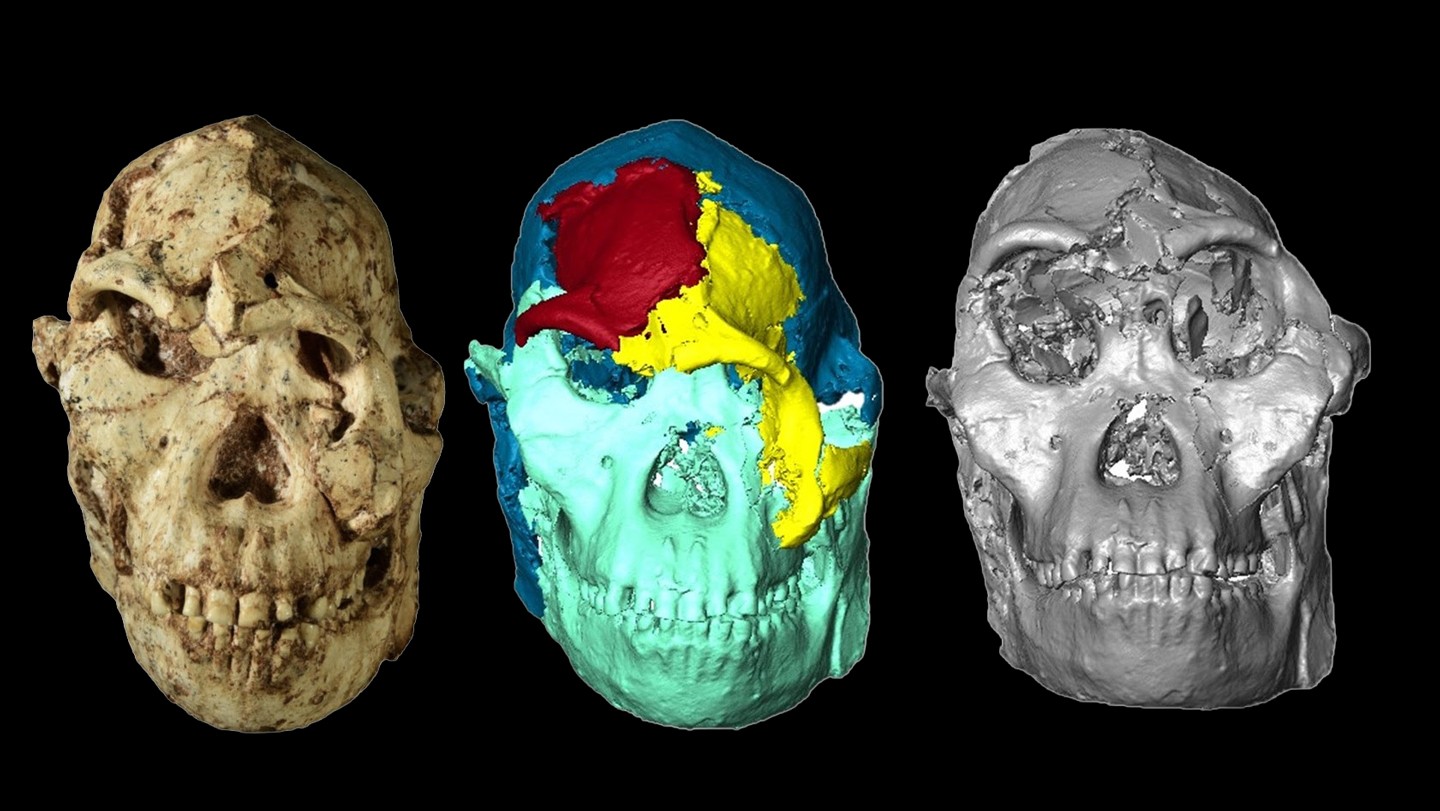
For the first time, scientists have digitally reconstructed the face of “Little Foot,” a remarkably well-preserved Australopithecus fossil that lived over 3.5 million years ago. The reconstruction, published in Comptes Rendus Palevol, provides unprecedented insight into one of humanity’s oldest known relatives and offers clues about early hominin evolution.
The Discovery and Reconstruction Process
The story of Little Foot began in 1994 when partial skeletal remains were discovered among a collection of fossils at the University of the Witwatersrand in Johannesburg. The complete skeleton was later excavated from the Sterkfontein Caves, encased in solid rock. Due to the partial crushing and distortion of the skull and facial bones, researchers turned to advanced synchrotron X-ray imaging in the United Kingdom in 2019. This allowed them to create highly detailed models of the bones, which were then digitally reassembled over several years.
According to paleoanthropologist Amélie Beaudet of CNRS in France, “Now we have a very good reconstruction, something we could not do with the physical specimen.” The digital reconstruction is crucial because the fossil itself is fragile and incomplete.
Key Features and Evolutionary Implications
The reconstructed face of Little Foot displays several distinctive features. Notably, the wide eye sockets bear a striking resemblance to Australopithecus fossils from East Africa rather than other finds from South Africa. This has led researchers to hypothesize that Little Foot may represent a population that migrated from East Africa to South Africa over 3.5 million years ago. If true, this could explain why Little Foot looks different from other Australopithecus individuals who lived in the region at later dates.
However, scientists urge caution in drawing definitive conclusions, given the limited number of available Australopithecus skulls for comparison. As Beaudet notes, “We have only a few specimens, so we need to be really careful.” The small sample size makes it difficult to confidently determine whether the observed differences are due to migration patterns or natural variation within the species.
Why This Matters
The reconstruction of Little Foot’s face is significant for several reasons. First, it provides a tangible image of an ancient ancestor, making the study of human evolution more accessible and engaging. Second, the facial features offer a new perspective on the physical characteristics of early hominins, helping refine our understanding of their adaptations. Finally, the potential migration hypothesis raises important questions about the early dispersal patterns of Australopithecus and the factors that drove their evolution.
This discovery underscores the importance of advanced imaging techniques in paleoanthropology. As more fossils are scanned and digitally reconstructed, our ability to piece together the story of human origins will continue to improve.
The reconstruction of Little Foot’s face is more than just an image — it’s a window into the past, offering clues about our ancient origins and the complex journey of human evolution.