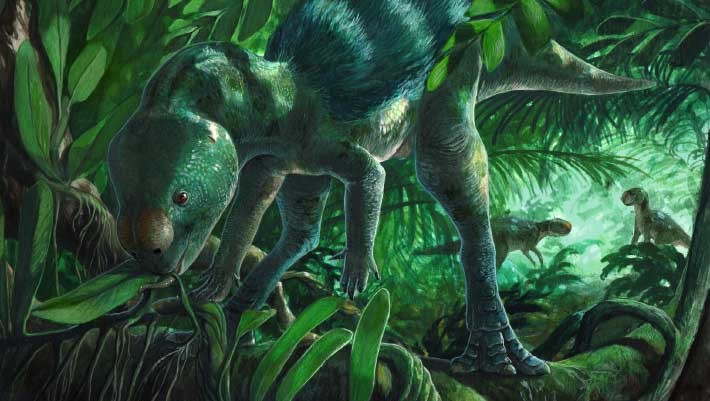
A newly identified dinosaur species, Foskeia pelendonum, unearthed in Spain’s Burgos province, is challenging long-held assumptions about dinosaur evolution. The creature, which lived roughly 120 million years ago during the Early Cretaceous period, was remarkably small – about the size of a modern chicken.
A Unique Find in the Fossil Record
Foskeia pelendonum belonged to the Rhabdodontomorpha, a group of herbivorous ornithischian dinosaurs. However, its diminutive stature sets it apart from many of its larger relatives. Paleontologists note that its small size does not equate to simplicity; rather, the skull exhibits highly specialized and unusual features.
“This is not a ‘mini Iguanodon,’ it is something fundamentally different,” explains Dr. Tábat Zanesco Ferreira of the Universidade Federal do Rio de Janeiro. The discovery fills a crucial 70-million-year gap in the fossil record, providing a key piece to understanding a previously missing chapter in dinosaur history.
Growth, Metabolism, and Evolutionary Links
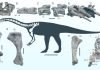
Fossilized remains from at least five individuals were recovered from the Vegagete site in Burgos, confirming that at least one specimen was a fully grown adult. Histological analysis of the bones suggests the dinosaur had a metabolic rate comparable to that of small mammals or birds. This means the animal likely grew quickly and required high energy intake relative to its size.
The species is a sister group to the Australian dinosaur Muttaburrasaurus within Rhabdodontomorpha, and expands the European clade Rhabdodontia. Researchers propose that plant-eating dinosaurs form a natural group called Phytodinosauria, though this remains a hypothesis needing further validation.
Challenging Assumptions About Evolution
Despite its small size, Foskeia pelendonum exhibits specialized teeth and shifting posture during growth, suggesting the creature relied on bursts of speed in dense forests. The discovery highlights that evolution was just as experimental at smaller body sizes as it was with large dinosaurs.
“These fossils prove that evolution experimented just as radically at small body sizes as at large ones,” said Dr. Paul-Emile Dieudonné of the National University of Río Negro.
The research underscores the importance of studying incomplete and fragmented fossils, as even humble remains can revolutionize our understanding of prehistoric life. The discovery is detailed in a paper published in Papers in Palaeontology.
Ultimately, Foskeia pelendonum demonstrates that dinosaur evolution was far more diverse and unpredictable than previously thought. Its unique anatomy and evolutionary relationships force scientists to reconsider long-held assumptions about how dinosaurs adapted and thrived.