Recent research from MIT planetary scientists sheds light on why Jupiter and Saturn exhibit strikingly different polar vortex patterns. The study suggests that these differences aren’t random but are instead linked to the composition and density of material deep within each planet’s interior—a finding with significant implications for understanding gas giant structure.
Contrasting Polar Features: Jupiter’s Swirls vs. Saturn’s Hexagon
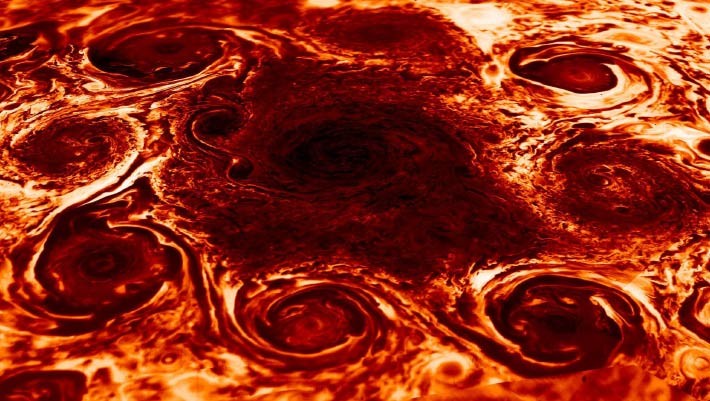
NASA’s Juno and Cassini missions provided the crucial visual data for this study. Juno, orbiting Jupiter since 2016, captured images of the planet’s chaotic north pole, dominated by multiple swirling vortices, each roughly 3,000 miles across. In contrast, Cassini, before its mission ended in 2017, observed Saturn’s north pole as a single, stable hexagonal vortex spanning nearly 18,000 miles.
The question has long puzzled scientists: why such drastically different patterns on planets of comparable size and composition? Both Jupiter and Saturn are predominantly hydrogen and helium, making the disparity even more perplexing.
A Simplified Model Yields Surprising Insights
To tackle this mystery, the MIT team employed a two-dimensional fluid dynamics model—a deliberate simplification that proved effective. Fast planetary rotation ensures consistent movement along the axis, allowing researchers to accurately represent vortex evolution in two dimensions instead of complex three-dimensional simulations. This approach made the study significantly faster and more efficient.
The team adapted existing equations used for modeling cyclones on Earth, adjusting them to fit the unique conditions of Jupiter and Saturn’s polar regions. By simulating fluid behavior under various scenarios—altering planetary size, rotation speed, internal heating, and the softness/hardness of the underlying fluid—they observed consistent patterns.
The Key: Interior Density Dictates Vortex Formation
The simulations revealed that the “softness” of the material at the bottom of a vortex dictates its size. Softer, lighter material allows for smaller, multiple vortices to coexist (like those on Jupiter), while denser, harder material enables the formation of a single, planetary-scale vortex (as seen on Saturn).
This suggests that Jupiter’s interior may be composed of lighter, less stratified materials, whereas Saturn’s interior could be enriched with heavier metallic compounds that create stronger layering.
“What we see from the surface… may tell us something about the interior, like how soft the bottom is,” notes graduate student Jiaru Shi.
Implications for Understanding Gas Giant Structure
This research provides a novel way to infer internal planetary composition from observable atmospheric phenomena. The study highlights that surface fluid patterns aren’t merely aesthetic features, but instead act as indicators of deeper, fundamental properties. The findings will appear in the Proceedings of the National Academy of Sciences.
Ultimately, understanding these vortex patterns is not just about unraveling planetary weather; it’s about gaining deeper insight into the hidden interiors of gas giants and the processes that shaped their formation.