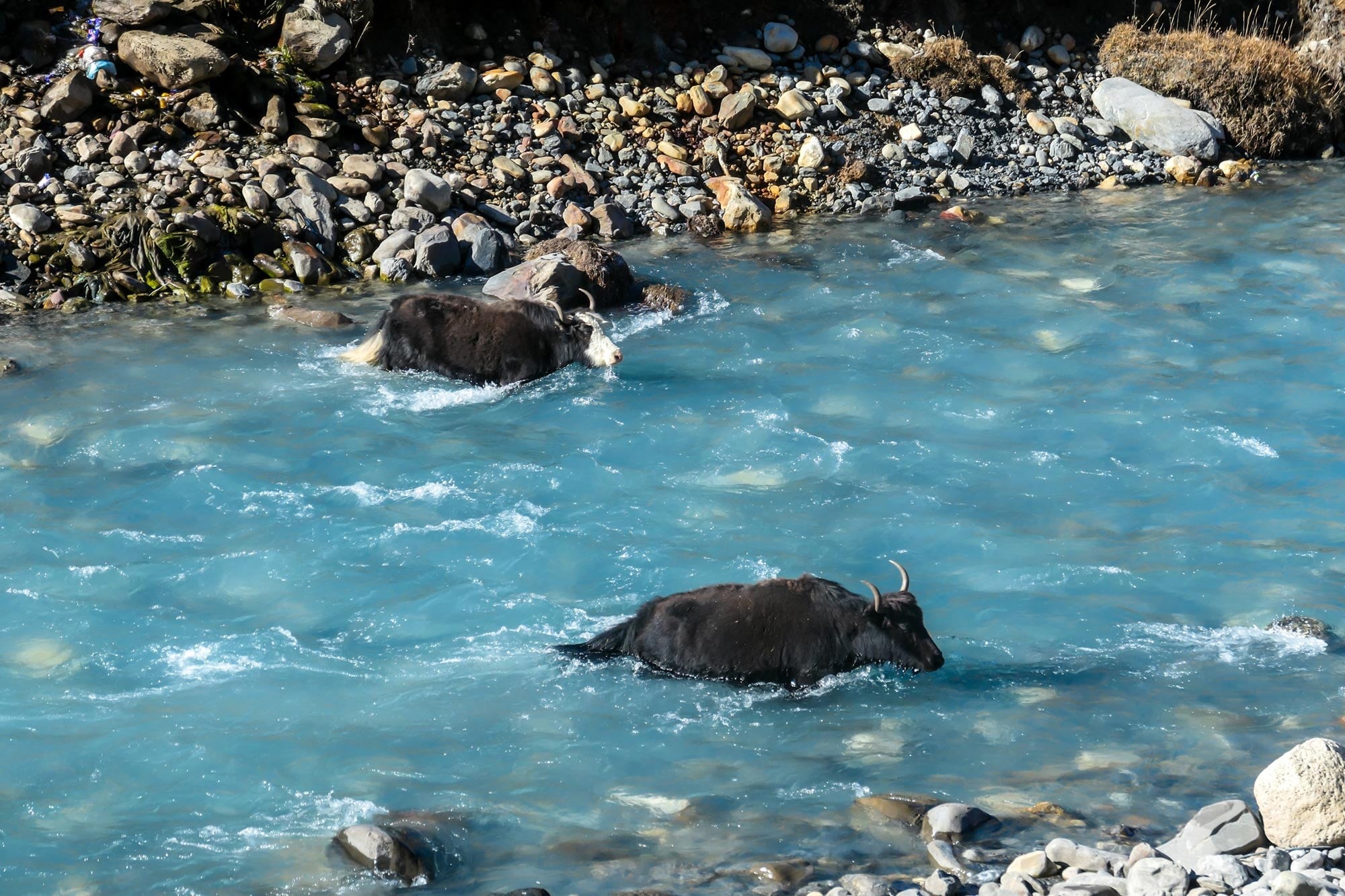
The mountains aren’t just scenery. They are the water tower for half a continent. Two billion people live in the shadow of the Himalayas. They depend on this water.
That system is breaking.
A new study says the frozen plumbing is becoming unstable. The climate is warming. Fast. And the rivers don’t know what to do with it.
Speed and chaos
Between 1980 and 2020 something changed in the ice. Temperatures in the Himalayas rose nearly twice as fast as the rest of the planet.
That heat melted glaciers. It thawed the permafrost underneath.
Researchers Chengshan Wang and Zhongpeng Han from the China University of Geosciencias Beijing teamed up with Lin Zhipeng from Sichuan University. They looked at three major basins. They used satellite images and field data.
They found that rivers are shifting quicker.
- Overall migration rates went up 33% over 40 years.
- Bends that can move freely jumped almost 97%.
Think about that. Nearly double the number of loose river bends.
The rivers aren’t just wandering. They are having tantrums. More “cutoffs” happened, where a river punches through to a shorter path. More “avulsions” too, sudden jumps to new channels.
Why it hurts
Warm water carries more sediment. It has more energy. Meanwhile the banks holding it together are soft.
Frozen ground usually acts like concrete. It keeps the river in line. Now that ground is thawing. The banks are weak.
Dr. Zhongpeng Han noted the upper Himalayas are a hotspot for this chaos. Channel migration interacts strongly with the heat. It’s a feedback loop of erosion.
Here is the kicker. This isn’t happening like it does in the Arctic.
In the north, vegetation stabilizes banks. Roots hold the soil.
The upper high Himalayas stand out… providing an opportunity to study the effects…
In the Himalayas, there is barely any plants. Just rock and mud and melting ice.
When the bank thaws, it goes. There are no roots to catch it.
Downstream consequences
Who pays?
The communities below. Farmers. Bridge operators. Anyone building near water.
Prof Wang warns of risks to water security and infrastructure. The river changes affect sediment loads too. That messes up reservoirs and flood control models.
The study appeared in Science on May 14 2026.
It calls for long term planning. We can’t just build bridges where rivers were yesterday. We need to account for rivers that might be elsewhere tomorrow.
The water is still there.
But it won’t stay where we expect it to.
Reference: Lin, Zhipeng et al. “Accelerated Himalayan river meandering…” Science. 2026 May 14;372(6540). doi:10.1126.science.adg8401
Funding provided by several Chinese national and provincial grants including the National Natural Science Foundation and the Sichuan Provincial Natural Science.