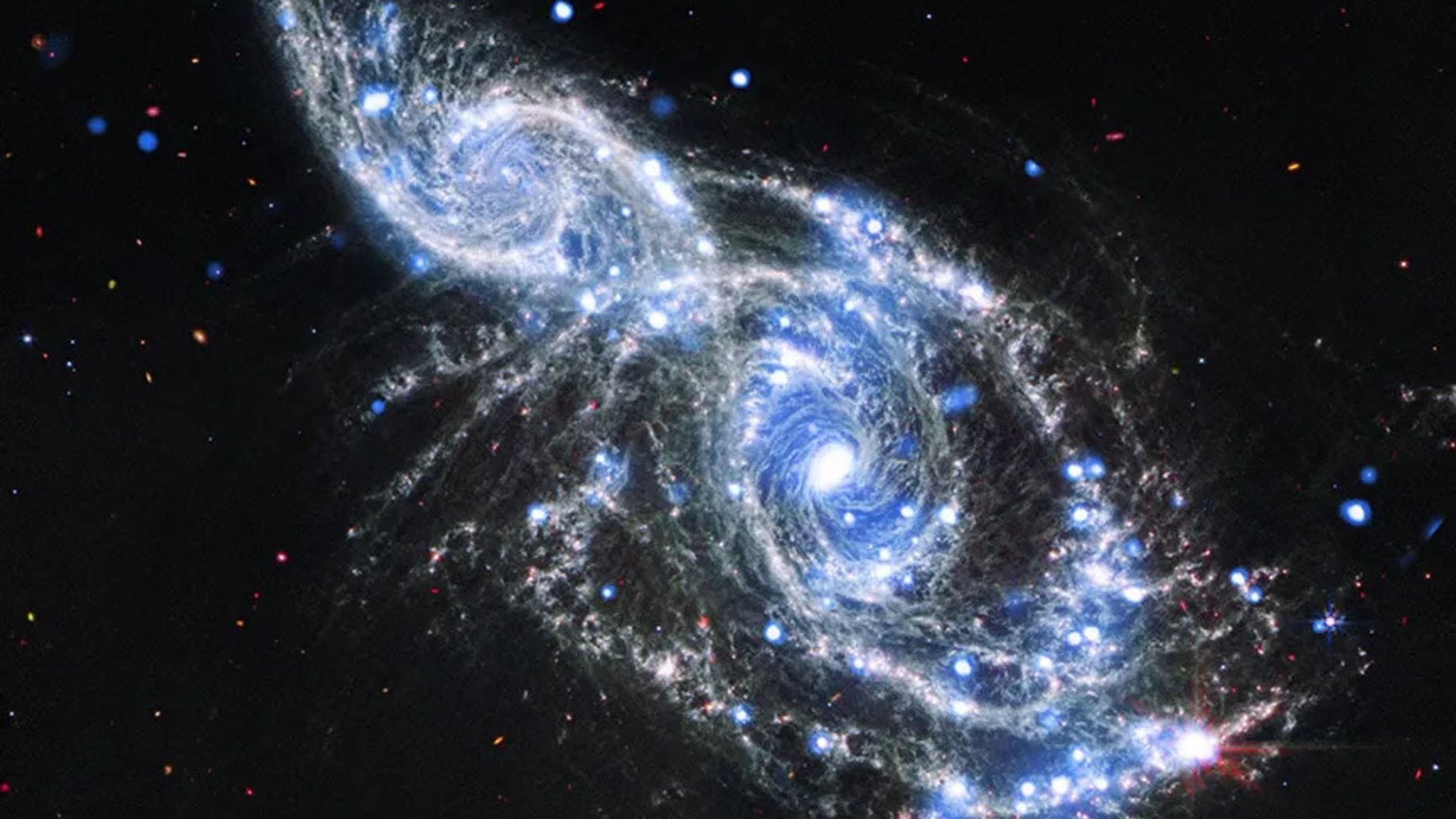
Two galaxies, IC 2163 and NGC 2207, are locked in a slow-motion collision millions of years in the making, as recently captured by the James Webb Space Telescope and the Chandra X-ray Observatory. The composite image released by NASA combines visible and X-ray data, offering an unprecedented view of this galactic interaction. This event is not just a spectacular sight but a crucial demonstration of how galaxies evolve over cosmic time.
The Dance of Galaxies
The collision began millions of years ago, with the smaller galaxy, IC 2163, grazing past the larger NGC 2207. The gravitational forces involved stretched and distorted their spiral structures, a process that will eventually lead to a full merger billions of years from now. The image reveals long, silvery-blue spiral arms speckled with bright knots — active regions where stars are born and matter is violently reshaped.
This type of galactic interaction isn’t rare, but observing a near-face-on collision like this one provides astronomers with unique insight into the mechanics of galaxy growth. It allows them to trace how spiral arms warp, where material compresses, and how the interaction triggers star formation.
The Power of Combined Observatories
The power of this image lies in the synergy of the two telescopes. The James Webb Space Telescope excels at capturing infrared light, piercing through dust clouds to reveal cooler gas and star-forming regions. Operating a million miles from Earth, it maintains the stability and cold temperatures necessary for sensitive observations.
Meanwhile, the Chandra X-ray Observatory detects X-rays emitted from matter heated to millions of degrees, often in areas of extreme gravity or explosive events. By combining Webb’s infrared view with Chandra’s X-ray data, astronomers gain a more complete understanding of the physical processes unfolding within and between the galaxies.
Location and Significance
Located approximately 120 million light-years away in the constellation Canis Major, this galactic collision showcases a critical stage in galaxy evolution. The image captures the aftermath of an initial close pass, where gravity has already reshaped both galaxies but before they fully merge into a single entity.
Galactic collisions and mergers are fundamental mechanisms for galactic growth, redistributing gas and dust that fuel new star formation. Studying such events helps astronomers understand how galaxies have evolved over billions of years.
In essence, this image is not just a beautiful depiction of cosmic forces but a valuable dataset for understanding the universe’s long-term evolution.