


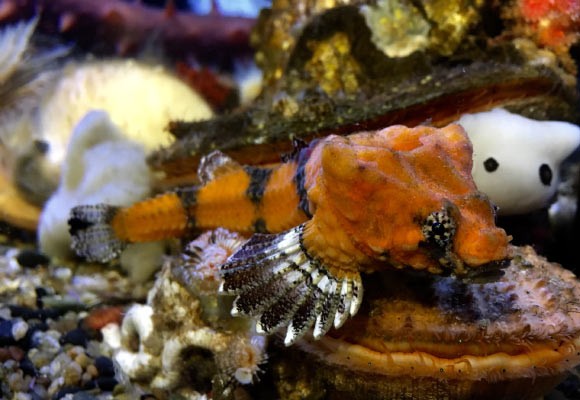
For over 150 years, marine biologists have puzzled over a bizarre feature of the armored rockhead poacher (Bothragonus swanii ): a deep, bowl-shaped cavity in its skull. Now, new research suggests this isn’t just an anatomical oddity – it’s a natural drum.
The Mystery of the Cranial Pit
First documented in 1876 by Franz Steindachner, B. swanii inhabits the eastern Pacific from Alaska to California, typically living in shallow, rocky intertidal zones. The function of the cranial pit has been debated for decades, with theories ranging from camouflage to enhanced sensory perception. The fish’s habitat is uniquely noisy, with constant crashing waves and other environmental sounds that make traditional aquatic communication difficult.
The Discovery: Ribs as Drumsticks
Daniel Geldof, a student at Louisiana State University, used high-resolution micro-CT scanning to build 3D models of the rockhead poacher’s anatomy. He found that the fish’s first set of ribs are unusually large, flattened, and free-moving, positioned directly above the cranial pit. These ribs connect to powerful muscles and tendons, essentially functioning as biological drumsticks.
When vibrated against the skull’s cavity, these ribs generate subterranean pulses of sound. Geldof posits that this percussion system evolved as a way for the fish to communicate through the substrate (the ground) in its noisy environment. Vibrations travel more effectively through rock than sound does in water, making this a surprisingly effective strategy.
Beyond Communication: A Sensory Role?
The cranial pit may also play a sensory role. Geldof’s scans revealed that a branch of the fish’s lateral line nerve – used for motion sensing – enters the pit. The arrangement of microstructures inside suggests it could be used for mechanoreception, detecting movement or pressure. This suggests the feature isn’t just for drumming, but also for feeling the vibrations of other creatures nearby.
“What this tiny thing looks like up-close isn’t merely a scientific question — it’s a basic human curiosity,” Geldof noted, highlighting the broader appeal of unraveling the mysteries of the natural world.
The rockhead poacher’s cranial pit demonstrates how evolution can create unexpected solutions to communication and sensory challenges. This discovery underscores the remarkable adaptations found in even the smallest and strangest creatures, and challenges us to reconsider what we know about how animals interact with their environments.


