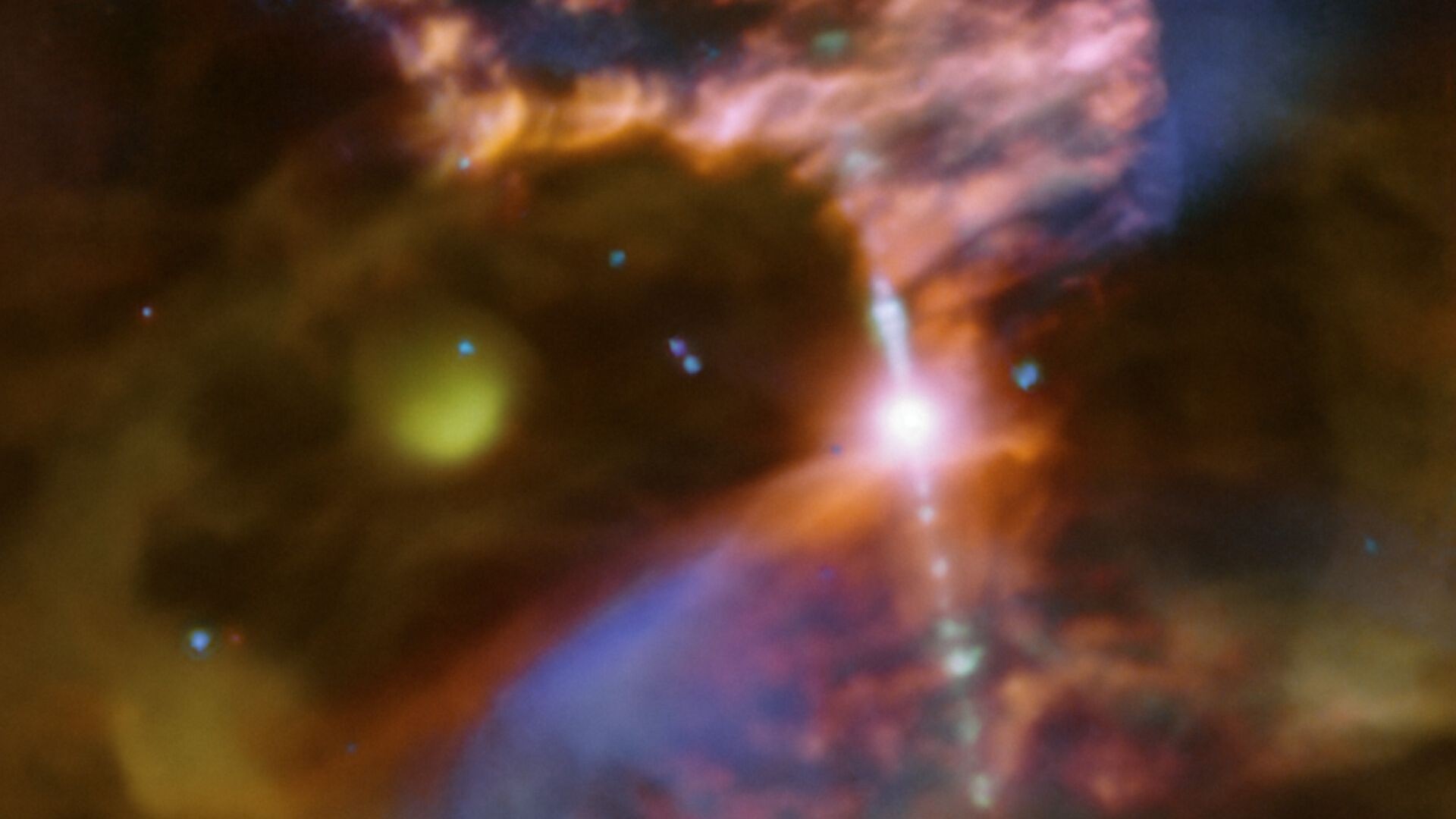
Astronomers have reclassified a celestial object previously thought to be a dying star’s final exhale as a newborn star forming within the debris of an ancient supernova. The discovery, made using the European Southern Observatory’s Very Large Telescope (VLT), resolves a long-standing debate about the object’s true nature and provides a new measurement for the distance to the surrounding supernova remnant.
Misidentified Object Finally Classified
For years, Ve 7–27 was categorized as a planetary nebula — the expanding shell of gas shed by a star in its twilight years. However, detailed spectroscopic analysis from the VLT’s MUSE instrument revealed high-speed jets and energetic “bullets” of material shooting out from the center. These features are characteristic of young stars violently interacting with their surroundings, definitively marking Ve 7–27 as a stellar nursery, not a stellar graveyard.
“Instead of being the ‘last breath’ of a dying star, Ve 7-27 is a newborn one,” stated Janette Suherli, a Ph.D. candidate at the University of Manitoba and lead author of the study.
Stellar Recycling: Birth Amidst Death
The image captured by the VLT doesn’t just show a new star; it also includes a startling juxtaposition: a neutron star at the center. This ultra-dense remnant formed from the core collapse of a massive star that exploded as a supernova, part of the Vela Junior remnant. The newborn star, Ve 7–27, is embedded within the expanding material ejected by this ancient explosion.
The connection between the two objects is significant because it finally clarifies the distance to the Vela Junior supernova remnant. By accurately determining Ve 7–27’s distance at roughly 4,500 light-years, astronomers can now place Vela Junior at the same distance, resolving inconsistencies in previous size, expansion rate, and age estimations.
Why This Matters
This discovery highlights the chaotic yet cyclical nature of star formation. Stars are born from the remnants of their predecessors, with supernovae providing the raw materials and energetic shockwaves that trigger new stellar birth. The fact that Ve 7–27 formed within the debris of a supernova underscores this cosmic recycling process, where stellar deaths directly fuel new beginnings. The use of advanced instruments like MUSE is crucial for untangling these complex events and refining our understanding of the universe’s ongoing evolution.
The universe doesn’t just end stars; it uses their ashes to create new ones.