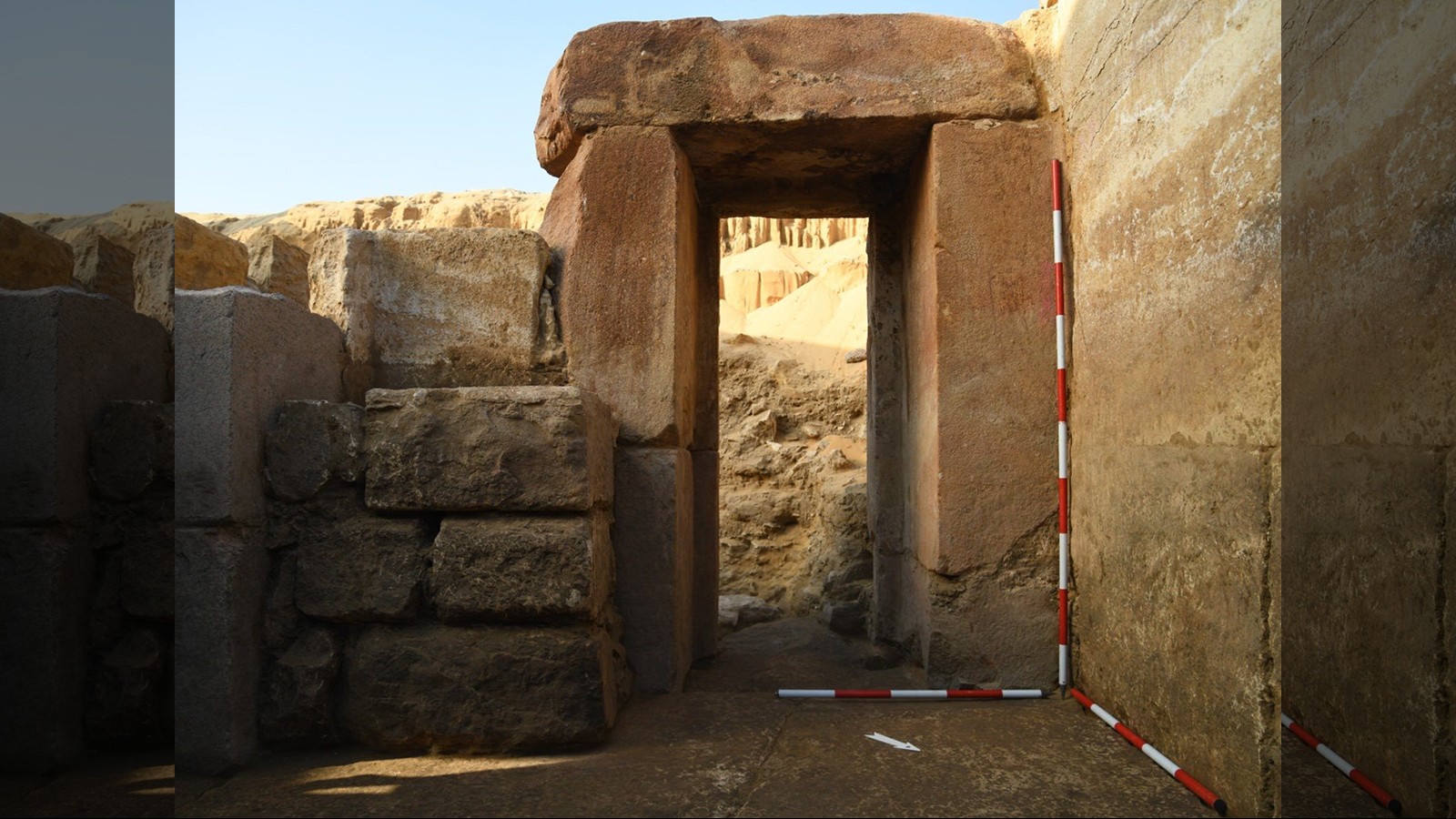
Archaeologists in Egypt have completed excavation of a 4,500-year-old valley temple linked to a massive sun temple dedicated to the god Ra, revealing a sophisticated religious complex built during the reign of Pharaoh Niuserre. The site at Abu Ghurab, approximately 10 miles southwest of Cairo, provides fresh insight into ancient Egyptian worship and daily life.
Valley and Upper Temples Connected
The newly excavated valley temple served as the primary access point for the larger sun temple, which includes an upper temple previously excavated. The two structures were connected by a causeway, allowing processions and worshippers to move between them. The valley temple’s location near the Nile River suggests it functioned as a landing stage for boats, facilitating religious ceremonies and access to the upper temple on higher ground.
Rediscovered After a Century
Initial excavations in 1901 by German Egyptologist Ludwig Borchardt were halted due to high groundwater levels. Modern teams, working since 2024, have managed to unearth half of the valley temple as water levels have dropped. This renewed effort has yielded significant discoveries, including a columned entrance portico, inscribed blocks detailing religious events, and remnants of the Pharaoh Niuserre’s reign (circa 2420 B.C. to 2389 B.C.).
Public Calendar and Astronomical Observations
One of the most striking finds is a public calendar carved into stone blocks. The inscriptions detail feasts for gods like Sokar and Min, and processions for Ra. This suggests the temple complex played a central role in regulating religious life, with the calendar publicly displayed on the temple facade. The roof of the valley temple appears to have been used for astronomical observations, indicating that the ancient Egyptians combined religious practices with scientific study.
From Ritual to Residence
After roughly a century of use, the valley temple was repurposed as a residential area. Archaeologists discovered evidence of this shift in the form of wooden game pieces for “senet,” a popular board game of the time. This transition highlights how sacred spaces could adapt over time, becoming integrated into daily life rather than remaining strictly ceremonial.
The unearthing of this complex provides a rare glimpse into the practicalities of ancient Egyptian religion, including how worship was organized, accessed, and eventually integrated into the broader community. The discoveries at Abu Ghurab confirm that the valley temple wasn’t just a religious site but a functional part of ancient life.