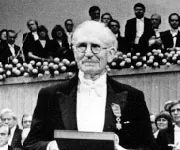
Most people assume physics is a language locked behind heavy math and jargon. Jeremy Bernstein proved them wrong. Born in Rochester, New York, on December 31, 1929, he became one of the few voices who could explain modern science to the lay reader without talking down to them. He didn’t just teach the subject. He made it understandable.
Bernstein’s path to clarity started at Harvard, where he earned his Ph.D. in 1955. The early career moves were standard for a bright academic. He worked at Harvard and then at the Institute for Advanced Study in Princeton, New Jersey. But by 1962, he had settled into a role as an associate professor of physics at New York University. Two years later, he moved to Stevens Institute of Technology in Hoboken, New Jersey. He stayed there for the rest of his career.
His influence extended far beyond the classroom walls. He wrote for The New Yorker. He held appointments in Switzerland, France, and Pakistan. He taught in the United States. This global experience shaped his perspective. It gave him the distance needed to see science not just as equations, but as a human endeavor.
“Bernstein illuminated topics ranging from cosmology to the origins of the computer.”
He tackled big questions. How did the universe begin? Where did the computer come from? He didn’t just summarize existing knowledge. He wove it into narratives that stuck. His books on these topics became staples for readers who wanted to understand the world without getting lost in technical details.
Writing for The American Scholar, he maintained a regular column called “Out of My Mind.” It wasn’t just about hard science. It was about the personal side of intellectual life. The column showed how a scientist thinks when the lights go out and the grading stops.
In 1986, he published an autobiographical memoir titled The Life It Brings. It traced his journey from a kid in Rochester to a respected figure in the scientific community. The book offered a rare look at the life of a physicist who spent his career trying to bridge the gap between the lab and the living room.
He didn’t seek fame. He sought understanding. And in a world often divided by complexity, that remains a rare and valuable thing. The questions about how we know what we know are still with us. He left us with better tools to ask them.