He was a kid who did cube roots before he learned to tie his shoes.
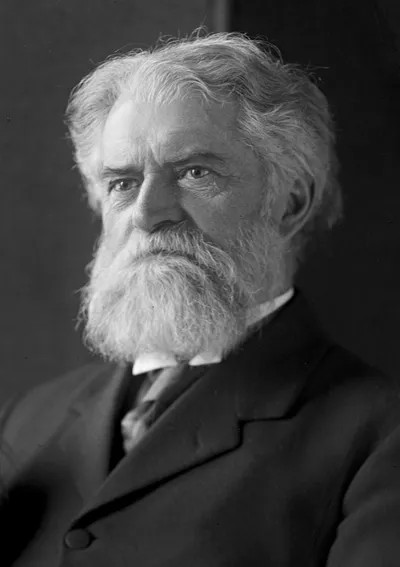
Born in Wallace, Nova Scotia, in 1835, Simon Newcomb didn’t just like numbers. He lived inside them. By age four, his itinerant schoolteacher father had him counting. By five, he was spending hours on addition and multiplication drills. By seven, he had finished every arithmetic book in the house, including the nasty business of extracting cube roots.
This wasn’t just precociousness. It was a wiring issue.
Newcomb had almost no formal schooling. At 16, he was apprenticed to a quack herb doctor in New Brunswick. He hated it. He ran away to join his widowed father in Maryland. There, he found something better than herbs. He found libraries.
Specifically, the libraries in Washington, D.C.
He devoured technical texts until he realized his brain was built for one thing: mathematics. He became obsessed with the American Ephemeris and Nautical Almanac. This annual handbook predicted where celestial bodies would be in the sky. To Newcomb, it wasn’t just a schedule. It was a puzzle waiting to be solved with precision.
He applied for a job. He got it in 1857, starting as a computer at the American Nautical Almanac Office in Cambridge, Massachusetts. He also enrolled at Harvard’s Lawrence Scientific School, earning a degree in 1858.
In 1861, the Navy took notice. He was commissioned into the corps of professors of mathematics and assigned to the United States Naval Observatory in Washington. For over a decade, he determined the positions of celestial objects. First with meridian instruments. Then, for two years, with a brand-new 26-inch refractor telescope.
The work changed everything.
In 1877, Newcomb took charge of the American Nautical Almanac Office. He had a massive project in his head. He was going to calculate the motions of every body in the solar system. It would occupy the rest of his life.
By 1897, he hit the compulsory retirement age for captains. The Navy made him an exception. He retired with the rank of rear admiral. A rare distinction.
He also taught. From 1884 to 1893, he was a professor of mathematics and astronomy at Johns Hopkins University in Baltimore. He lived in Washington. He edited the American Journal of Mathematics. He founded the American Astronomical Society and served as its first president from 1899 to 1905.
But the real legacy wasn’t the titles. It was the data.
His most important work appeared in the Astronomical Papers Prepared for the Use of the American Ephemeris and Nautical Almanac. He started the series in 1879. His goal was simple but brutal: use the best existing data to systematically determine astronomical constants. He wanted to reinvestigate the theories of celestial motion. He wanted tables, formulae, and precepts for building ephemerides.
The result was 36 articles. About 4,500 quarto pages. The first nine volumes.
Newcomb was the sole or principal author of 25 of them.
He produced tables for the Sun, Mercury, Venus, Mars, Uranus, and Neptune. George W. Hill, another American astronomer, devised the tables for Jupiter and Saturn. Together, these became the global standard.
Who used them?
Every astronomer on Earth.
These tables calculated the daily positions of celestial objects from 1901 to 1959. And they didn’t stop being useful then. For the Sun, Mercury, Venus, and Mars, they remained relevant long after.
The quality was sustained and high. Hardly anything in those papers proved incorrect. By the mid-20th century, they were still worthy of attention from any serious student of celestial motions.
Newcomb died in Washington, D.C., in 1909. He had been elected to the National Academy of Sciences in 1869. He served as home secretary, vice president, and foreign secretary until the end.
He earned numerous honorary degrees. He won the highest scientific prizes of his day.
But look at the sky tonight. Look at where the planets are.
You are looking at the result of a man who ran away from a quack doctor and decided that numbers were the only thing worth trusting.
The push for a universal astronomical standard
Newcomb’s most enduring legacy wasn’t just a number. It was a system. Alongside A.M.W. Downing, the superintendent of the British Nautical Almanac Office, he forced a fragmented field into line. Before this, exact astronomy was a mess. Astronomers in different countries used different fundamental data. The confusion was total. Institutions calculated positions based on whatever constants they preferred.
This lack of unity made global coordination nearly impossible. Newcomb and Downing saw the problem clearly. They needed a single set of values. One that everyone, everywhere, would agree on.
How the 1896 Paris Conference changed everything
The solution came in May 1896. Directors from the national ephemerides of the United States, Great Britain, France, and Germany met in Paris. They didn’t just talk. They acted. The conference resolved to adopt a specific set of constants starting in 1901. The choice? Substantially Newcomb’s work.
It was a bold move. Some of Newcomb’s calculations weren’t even finished yet. The committee trusted him enough to implement unfinished data. They believed in the accuracy more than the current timeline.
This decision did more than standardize numbers. It launched a scheme of international collaboration. It was ambitious. It required trust between rivals. And it held up. The system survived two World Wars. It grew stronger with each conflict, not weaker.
Why the 1896 constants lasted decades
Was this collaboration just a wartime convenience? No. It was structural. In 1950, another conference met in Paris. They reviewed the system. The verdict was unanimous. The constants adopted in 1896 were still preferable to any new alternative for practical use.
Why did they last so long? Because Newcomb’s data was robust. It worked. The initial confusion of diverse foreign data was replaced by a single, unified voice. This unified system of astronomical constants became the backbone of celestial navigation.
The impact was immediate. Ship navigators could rely on tables that were consistent across borders. Pilots could trust coordinates that didn’t shift based on nationality. The sky, once a source of calculation errors, became a fixed grid.
Newcomb didn’t just give us a new value for the precession of the equinoxes. He gave us a protocol. A way for the world to look up and see the same stars, calculated by the same math. That kind of standardization doesn’t just help scientists. It keeps the world moving.