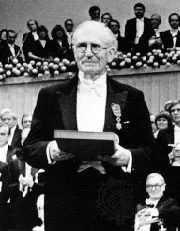
Sir Nevill F. Mott changed the way we interact with technology, even if you never heard his name. Born in Leeds in 1905 and raised in the UK, Mott was a physicist who looked at the messy, irregular world of materials and saw potential where others saw waste. He won the Nobel Prize in Physics in 1977 for this work. He shared the honor with two American colleagues, P.W. Anderson and J.H. Van Vleck. Their research focused on something obscure to most people: noncrystalline or amorphous semiconductors.
Mott’s path to this discovery was long and academic. He studied at Cambridge, earning his bachelor’s degree in 1927 and his master’s in 1930. By 1933, he was a professor of theoretical physics at the University of Bristol. There, he dug into solid-state physics. He studied metals. He looked at alloys. He even analyzed how light hits photographic emulsions at an atomic level. In 1938, he created a theoretical description of that exact interaction. It was precise work. It was foundational.
In 1954, he moved up to the University of Cambridge as the Cavendish professor of experimental physics. He stayed until his retirement in 1971. But the real breakthrough came later. It came from his earlier work.
The Science of Messy Materials
In the 1960s, Mott shifted his focus. He had been studying electrical conduction in various metals. He started wondering about amorphous materials. These are substances with irregular atomic structures. They lack the neat, ordered lattice found in crystals. Glass is the most common example. Most scientists ignored these messy materials. They seemed unpredictable. They seemed useless for precise electronics.
Mott saw them differently. He developed formulas that explained how these amorphous substances transition between states. Specifically, he described how they move between being electrically conductive (metallic states) and insulating (nonmetallic states). This transition is what makes a material a semiconductor. It is not a fixed property. It is a shift. A switch.
“Mott devised formulas describing the transitions that glass and other amorphous substances can make between electrically conductive and insulating states.”
This insight was theoretical at first. But the application was immediate and massive. These glassy substances are simple to produce. They are cheap to manufacture. Crystalline semiconductors, by contrast, are expensive and complex to create.
From Lab Bench to Your Pocket
The economic impact of Mott’s theory cannot be overstated. Because amorphous semiconductors were cheaper, they replaced more expensive crystalline versions in many electronic devices. This shift lowered the cost of production significantly.
Think about the devices you use every day. Personal computers became affordable. Pocket calculators became ubiquitous. Copying machines entered every office and home. These innovations were not accidents. They were direct results of cheaper materials enabled by Mott’s understanding of electrical conduction in disordered materials.
Mott was knighted in 1962, recognizing his earlier contributions. But the 1977 Nobel Prize cemented his legacy in