Heat usually spreads. It moves outward through a solid, chaotic and uncontrolled. Once it starts moving, it is hard to rein in. This has been a persistent bottleneck for engineers. You can’t build high-performance electronics if the core cooks itself.
Until now, there was only one way to manipulate heat as a wave rather than a diffuse gas. It required cryogenic temperatures. Extremely low. Practically impossible for consumer devices. The phenomenon was called phonon focusing. It kept thermal waves traveling in straight, ray-like paths. But it only worked near absolute zero.
That changed this week.
Researchers at UCLA Samueli School of Engineering found room temperature phonon focusing. They did it in boron arsenide. A crystalline semiconductor. It conducts heat exceptionally well. And it holds the key to directing thermal energy with nanoscale precision.
“This is a fundamental observation that enables us think about thermal management in a new way.”
— Yongjie Hu, UCLA Samueli
The discovery, published in Nature Physics, could reshape how we handle overheating in AI hardware. Or next-generation quantum computers. Or microelectronics. It shifts the paradigm from removing heat to steering it.
Why room temperature matters
Most materials act like a sieve for heat. Thermal energy scatters in every direction. It diffuses. It spreads. This is conventional diffusion. It limits performance. It restricts scalability. It forces designers to add bulky cooling systems.
Boron arsenide behaves differently.
The UCLA team, led by Yongjie Hu, observed quantum vibrations called phonons. These vibrations carry heat. In this specific material, the phonons do not scatter randomly. They travel along concentrated, ray-like paths. They follow the underlying crystal structure.
The heat didn’t just spread. It flowed like light through an optical fiber.
Why is this rare at room temperature? Usually, phonons collide frequently. They scatter. They lose wave coherence. The wavelike behavior dies out. It gets replaced by chaotic diffusion.
Boron arsenide breaks this rule. It experiences unusually weak phonon scattering. This allows the wavelike transport to survive at ambient temperatures. The heat travels unusually far before scattering. That is the essential condition for the effect to work outside a lab freezer.
Visualizing the heat rays
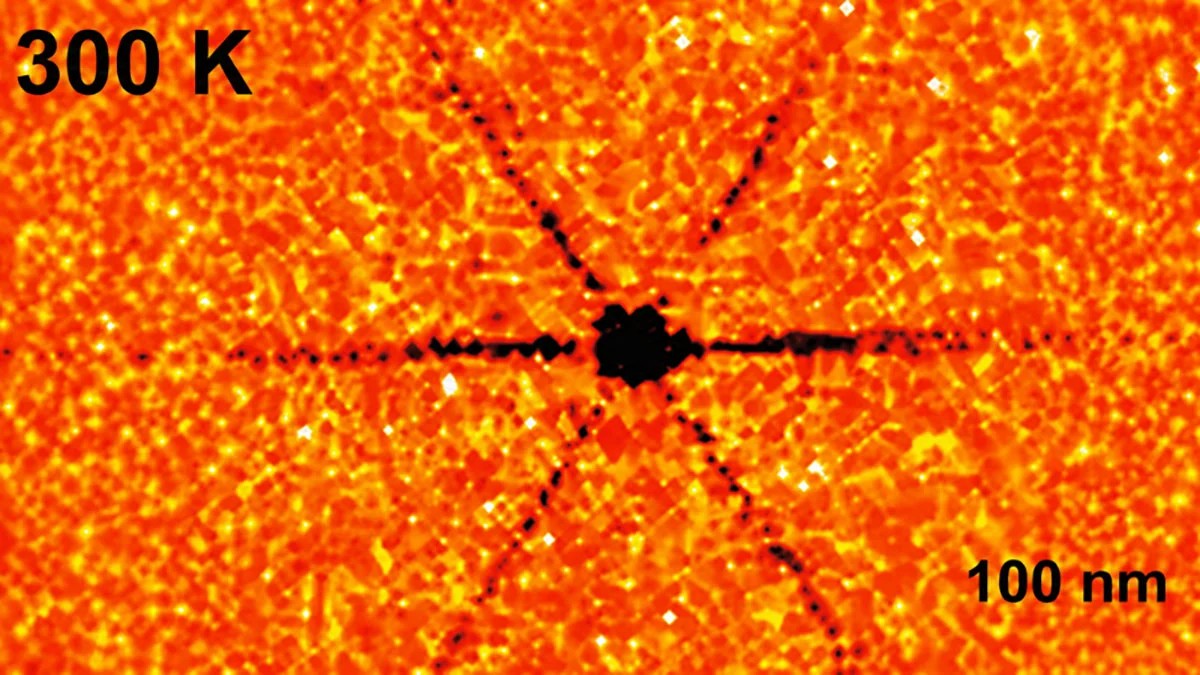
You cannot see heat with your eyes. But the researchers developed a method to map temperature at the nanoscale.
Ordinary materials produced circular patterns. The heat diffused evenly. Boring. Expected.
Boron arsenide was different. The temperature patterns formed distinct rays. Sharp angles. Defined paths. The heat was traveling preferentially in specific directions.
The team manipulated the crystal orientation. The pattern changed predictably. Different planes produced sixfold, eightfold, or fourfold arrangements of focused heat.
It was not a glitch. It was structural. The crystal lattice dictated the flow.
How boron arsenide steers thermal energy
The range matters. The researchers observed this effect across distances of one micrometer. It could potentially extend to tens of micrometers.
Is that large enough? Yes. It is relevant for many electronic and photonic devices. It bridges the gap between atomic-scale physics and macro-scale engineering.
This opens a path for quantum thermal engineering. You could design circuits where heat is guided, focused, and redistributed on command. No more hot spots. No more thermal throttling.
Hu notes that this control allows researchers to adjust interactions between phonons, electrons, and other energy carriers. The implications extend beyond cooling.
- AI Hardware: Processors generate immense heat. Controlled heat flow could sustain higher clock speeds.
- Quantum Computing: Qubits are sensitive to thermal noise. Precision cooling enhances stability.
- Aerospace Systems: Reliability depends on managing extreme thermal gradients.
The path forward
Hu’s group has been working with boron arsenide since 2018. That is when the material was experimentally discovered. They have since demonstrated high-performance thermal interfaces. They built gallium nitride devices using the material for cooling.
This latest finding confirms theoretical predictions. The measured heat patterns matched the models. Phonons do travel farther in boron arsenide than expected.
The science is sound. The application is tantalizing. But it is still early. We are looking at a foundation for future technologies. Not a product on a shelf today.
Can we engineer devices that never overheat? The physics suggests we might. The heat doesn’t have to be a byproduct. It can be a feature.
The rays of heat in boron arsenide point toward a new architecture for computing. One where energy flows exactly where it needs to go. And nowhere else.
The rest remains to be seen.